


I
Introduction
For organizations looking to set themselves apart, the concept of being one of the top ranked charities has evolved to a strict operational excellence criterion. The phrase itself describes organizations that are not just nominally non-profit but are solely devoted to charity endeavors, subject to stringent standards, and able to offer their supporters the financial benefits of tax-exempt status.

To stand out in this crowded field, an organization must adopt a strategy of radical transparency, technological sophistication, and strategic positioning that makes it indispensable to the communities they serve, going beyond typical good intentions. This shift is spurred by a volatile financing environment that puts strain on traditional assistance flows and raises donor expectations to unprecedented levels of scrutiny.
II
Legal and Strategic Differences in the Definition of a Charitable Charity
Clearly defining what constitutes a charitable charity in the strictest sense is a crucial first step in making an organization stand out. These organizations have a strictly philanthropic nature, which sets them apart from the larger volunteer sector. This means that their goals must be acknowledged as serving the public good, such as preventing poverty or alleviating illness and disability. In 2026, the strategic core of these top ranked charities must exhibit a combination of mission-driven heart and business-like efficiency. They must uphold a statutory asset lock that guarantees all residual assets continue to serve the public interest while operating within well-established corporate law frameworks.

The rise of social entrepreneurship, which generates social value through creative, market-based solutions, is what is driving the shift toward this approach. In addition to other nonprofits, charitable organizations today face competition from Community Interest Companies (CICs) and social businesses, which frequently have stronger brands for community-based entrepreneurship.
Now more than ever, charities must embrace the transparency and reporting norms of the private sector while utilizing their special capacity to provide tax receipts for donations in order to set themselves apart. This demands a shift from an unremarkable posture to gaining a special place in the community’s hearts and thoughts.
III
Critical Statistics on Top Ranked Charities
In this section, we will consider critical statistics on top ranked charities that stand out for their notable impacts.
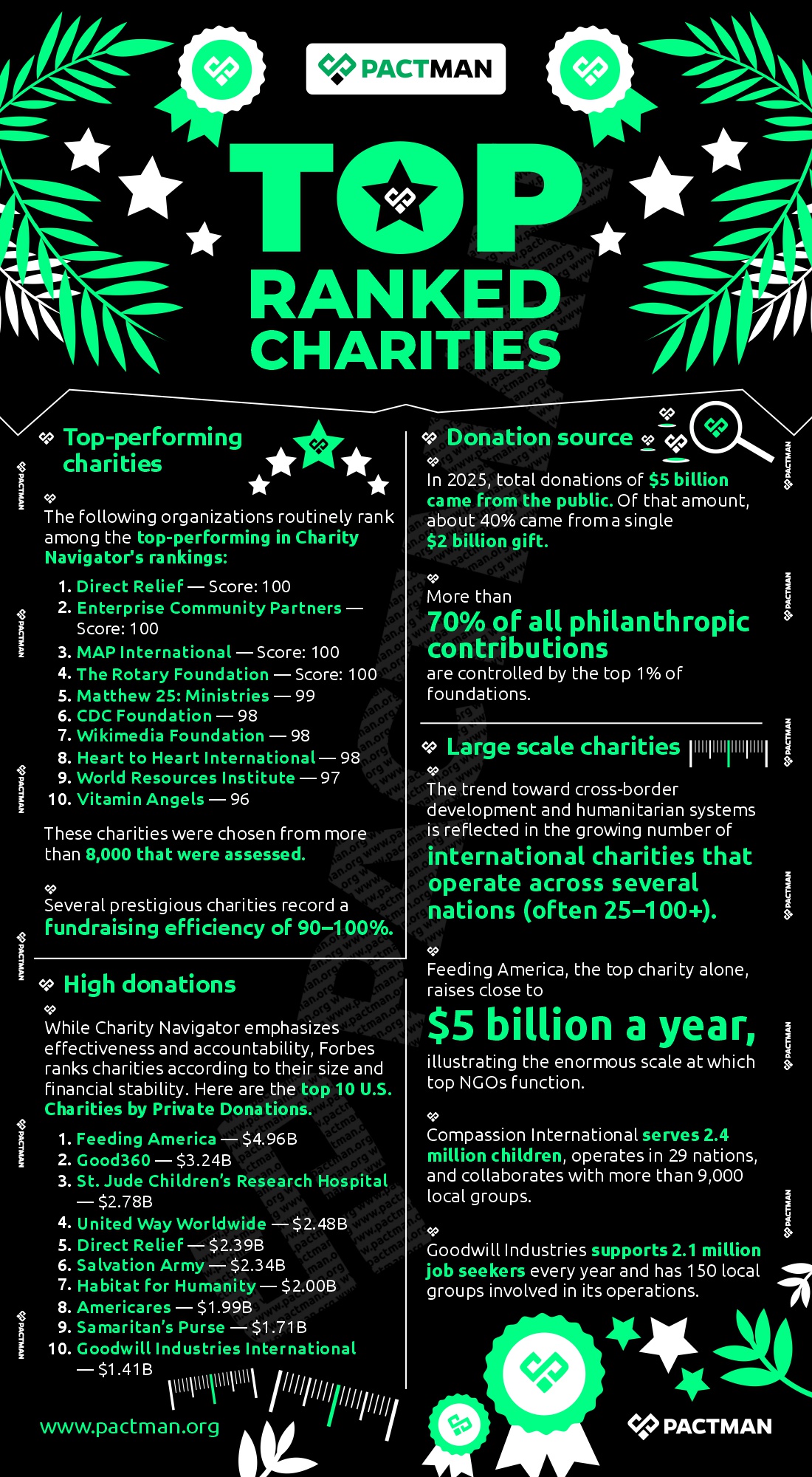
a. Top-performing charities
The following organizations routinely rank among the top-performing in Charity Navigator’s rankings:
- Direct Relief — Score: 100
- Enterprise Community Partners — Score: 100
- MAP International — Score: 100
- The Rotary Foundation — Score: 100
- Matthew 25: Ministries — 99
- CDC Foundation — 98
- Wikimedia Foundation — 98
- Heart to Heart International — 98
- World Resources Institute — 97
- Vitamin Angels — 96
These charities were chosen from more than 8,000 that were assessed. Also, several prestigious charities record a fundraising efficiency of 90–100%. This means that almost all of the money is used for programs rather than overhead.
b. High donations
While Charity Navigator emphasizes effectiveness and accountability, Forbes ranks charities according to their size and financial stability. Here are the top 10 U.S. Charities by Private Donations.
- Feeding America — $4.96B
- Good360 — $3.24B
- St. Jude Children’s Research Hospital — $2.78B
- United Way Worldwide — $2.48B
- Direct Relief — $2.39B
- Salvation Army — $2.34B
- Habitat for Humanity — $2.00B
- Americares — $1.99B
- Samaritan’s Purse — $1.71B
- Goodwill Industries International — $1.41B
c. Donation source
Institutional donations and ultra-high net worth individuals frequently support large charities. In 2025, total donations of $5 billion came from the public. Of that amount, about 40% came from a single $2 billion gift. As can be seen, more than 70% of all philanthropic contributions are controlled by the top 1% of foundations.
d. Large-scale charities
The trend toward cross-border development and humanitarian systems is reflected in the growing number of international charities that operate across several nations (often 25–100+). Feeding America, the top charity alone, raises close to $5 billion a year, illustrating the enormous scale at which top NGOs function.
Compassion International serves 2.4 million children, operates in 29 nations, and collaborates with more than 9,000 local groups. Goodwill Industries supports 2.1 million job seekers every year and has 150 local groups involved in its operations.
IV
Shifting from Niche to Necessary in Strategic Positioning
Being stuck in a niche identity is one of the biggest reasons organizations don’t stand out. A niche organization may be very successful at addressing a specific issue, like a local youth ballet program or a specialist animal rescue. However, it will remain on the periphery of donor awareness if its impact is not conveyed as a basic community need.

For a charity to flourish, it must be viewed as crucial or an organization that is so integrated into the local or industry-wide ecology that its elimination would leave a noticeable gap. This shift is accomplished by refining the value proposition to demonstrate how specialized knowledge closes a gap that larger, more visible organizations are unable to fill.
An external evaluation of the competitive landscape is necessary for strategic positioning. Essentially, organizations should consider:
- What issue can we solve more effectively than others?
- Who depends on our success, whether they are aware of it or not?
Choosing smart relationships over isolation is generally necessary to stand out among top ranked charities. In order to obtain quantifiable results, forward-thinking executives are considering partnerships, mergers, or shared services because they understand that being a part of a broader, functional community ecosystem boosts visibility and transfers credibility.
| Positioning Strategy | Focus Area | Goal |
| Niche Strategy | Specialized, small-scale issue or audience | Establish unique, non-replicable expertise |
| Necessary Strategy | Integration into local systems and policy frameworks | Become a vital community anchor |
| Systemic Alliances | Shared services and resource pooling | Reduce overhead and increase collective impact |
| Competitive Analysis | SWOT, uniques, and personas | Identify and occupy the “unique space” in the market |
V
Water Case Study: How Top Ranked Charities Prioritize Radical Transparency
Radical openness has become the gold standard for donor involvement in a time when public institutions are losing public trust. Charity: Water, which has reinterpreted the social contract between the charity and the supporter, offers a definitive case study in this method. With a distinct group of private donors known as “The Well” covering all operational and administrative expenditures, their “100% Model” guarantees that every penny of public donations goes directly toward funding water projects. Essentially, the notion that donations are used for overhead rather than impact is the main deterrent to contributing, and this strategy tackles that.

Also, Charity: Water uses technology to demonstrate impact outside of the fundraising mechanism. Every dollar is tracked, and contributors receive pictures and GPS coordinates of the specific well that their contributions funded. Now more than ever, this degree of geographic and visual accountability will be expected rather than a luxury.
In order to ensure long-term sustainability and real-time data, the organization also uses remote sensors to monitor the continuous operation of its water projects. They transform the donor relationship from one of basic generosity to one of quantifiable investment. This is by fusing professional-caliber narrative with tangible, verifiable proof. By and large, this model has significant ramifications for other nonprofit organizations. Transparency needs to cover:
- Financial Allocation: Explicit, audited records that demonstrate the precise expenditure of each dollar.
- Operational Milestones: Honoring both the outcomes and the “how” of the job, such as significant launches or infrastructure upgrades.
- Factual storytelling: the use of data-driven stories that provide a clear, reproducible connection between the issue, the theory of change, and the specific solution.
VI
Data-Driven Narrative: Bringing the Statistics to Life
The most prosperous nonprofits will be those that have perfected the skill of converting complex data into gripping, human-centered narratives. Donors now prefer to see the faces of the children whose lives were transformed by their contributions rather than a “data dump” in an annual report. This calls for a deliberate planning approach where leadership and program teams have a common framework for recording outcomes.

Oftentimes, sharing what happened is only one aspect of effective storytelling. Another is relating results to the concerns of donors and demonstrating how future investment will have a greater impact.
The following are important “Impact ROI” reporting best practices:
- Consistent Data Collection: Monitoring both qualitative (higher graduation rates) and quantitative (number of meals) results.
- Narrative Archetypes: Using frameworks such as “Freytag’s Pyramid” or the “StoryBrand” model. In this case, the organization guides the donor hero to create narrative tension around a community’s problem and the organization’s pivotal intervention.
- Multi-Platform Adaptation: Creating a visually appealing short-form video for social media followers and a comprehensive report with lots of metrics for a donor.
Lastly, ethical data visualization ensures that graphs and charts are inclusive, accessible, and do not mislead the people they serve.
VII
Contemporary Fundraising: Co-Creation, Global Reach, and Retention
Modernizing fundraising tactics is the last key to making a charity stand out. The emphasis has switched to retention over acquisition as acquisition costs increase. Now more than ever, organizations are using welcome sequences and targeted stewardship to increase recurring giving and second-gift rates. This also includes viewing the donor journey as an organized lifecycle rather than a series of one-time requests.
Here are new fundraising trends:
- Global Giving: Enabling mobile-first and alternative payment options, such as Apple Pay, Venmo, and Google Pay, to ensure donors across the globe make fast contributions.
- Co-Creation: Encouraging communities and funders to participate in the development of campaigns and initiatives, creating a sense of ownership that increases advocacy and involvement.
- Micro-Touch Stewardship: Transitioning from impersonal drip campaigns to authentic automation that encourages donors to engage in non-cash activities like participating in learning circles or providing feedback.
- SMS Engagement: With open rates as high as 99%, text messaging is used as a primary medium for urgent advocacy and fundraising.
Making global initiatives seem local is a renewed priority for top ranked charities. By demonstrating how global work promotes shared communal well-being, this entails creating pertinent connections between global initiatives and the ideals of national or local supporters.
Conclusion
As can be seen, charities can safeguard their future in an unstable economic environment. A great way to go about it is by shifting from being a niche provider to a necessary communal pillar. Also, these organizations must make investments in their personnel, update their systems, and exercise transparent leadership so that their influence is indisputable. By doing this, they set themselves apart from the noise of the industry. Not to mention, they also create the enduring relationships and trust that are the real value of contemporary philanthropy.
Organizations must see every obstacle, from technological upheaval to regulatory pressure, as a chance to reassert their purpose and demonstrate their worth.