A diverse group of new players has erupted in recent times to address the global water crisis through charitable endeavours. Among the prominent Non-Governmental Organisations are global water charities. These nonprofits promote market-based approaches to increase access to water while elevating a proper understanding of charity and philanthropy. By and large, they are formed and run by common people who are motivated by the principles of philanthrocapitalism while others are directly headed by philanthropists.
Water charities
As we all know, NGOs are frequently represented as agents of change. Also, they are known for their constant support of grassroots development, people-centred and participatory methods, and the provision of essential services to the most disadvantaged. Over the years, water charities and charitable groups have been tackling the persistent lack of sustainable, clean drinking water in drought-stricken third-world regions for almost 40 years.
However, the recent impact of pollution and global warming on water supplies has led even wealthy nations to request assistance. We live in a time where water resources and services are becoming more and more commercialised and scarce. Hence, this article seeks to investigate the impact of water charities and their contribution to sustainable living across the globe.
II
Critical Statistics on Water Access and Usage
In this section, we will consider statistics that assess the indispensability of water and its availability and access across nations.
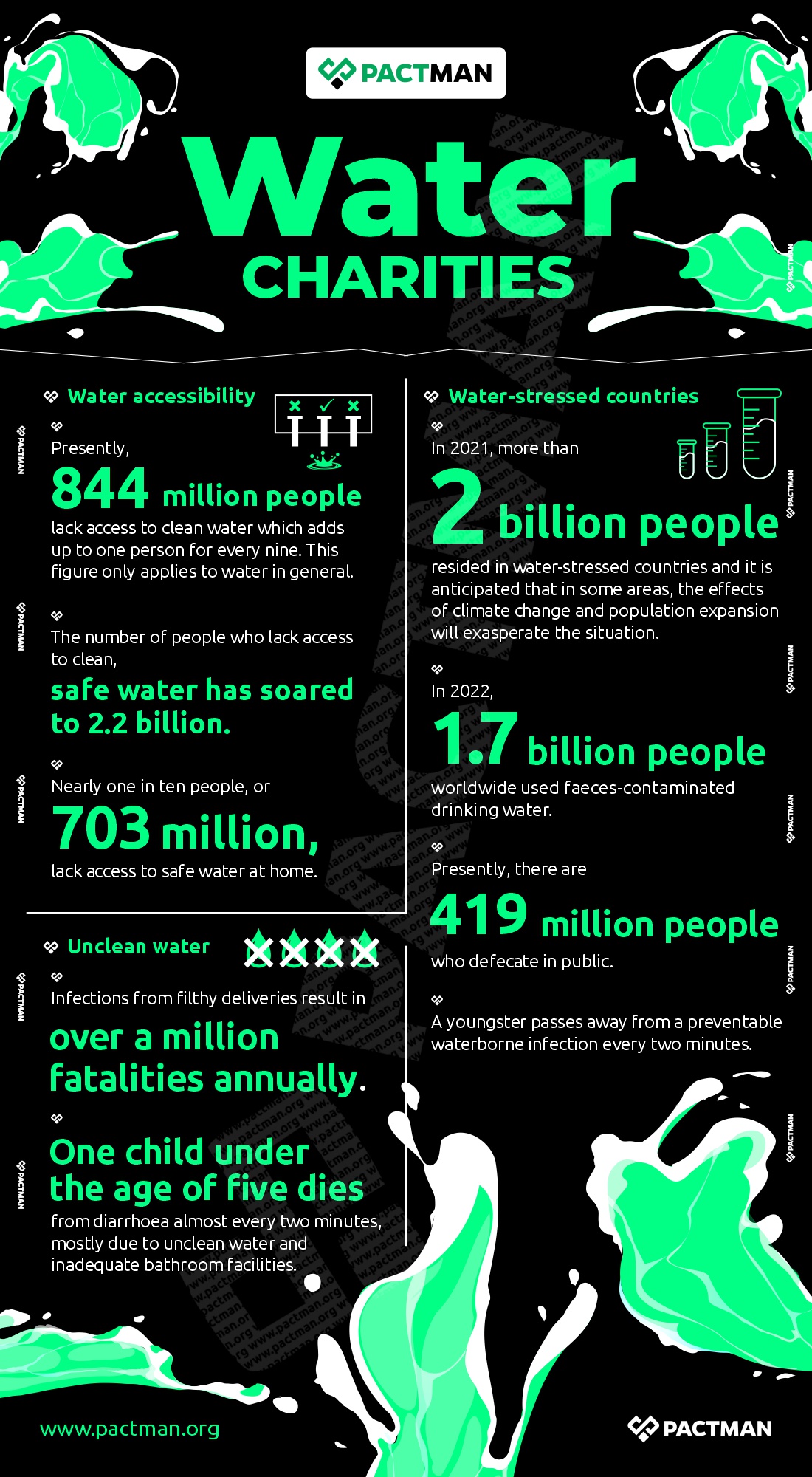
In 2021, more than 2 billion people resided in water-stressed countries and it is anticipated that in some areas, the effects of climate change and population expansion will exasperate the situation. In 2022, 1.7 billion people worldwide used feces-contaminated drinking water.
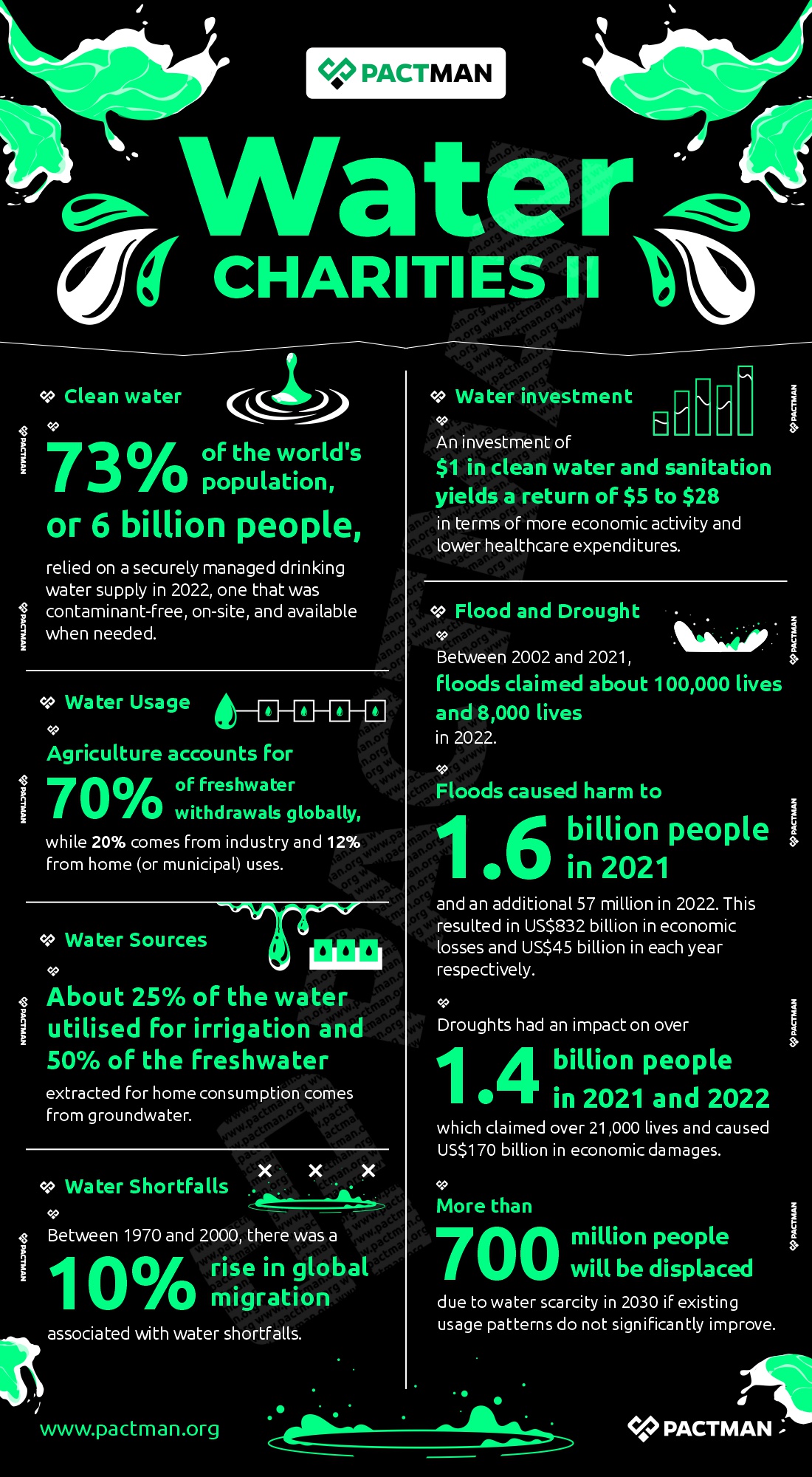
Between 2002 and 2021, floods claimed about 100,000 lives and 8,000 lives in 2022. Also, floods caused harm to 1.6 billion people in 2021 and an additional 57 million in 2022. This resulted in $832 billion in economic losses and $45 billion in each year respectively. Also, droughts had an impact on over 1.4 billion people over that period which claimed 21,000 lives and resulted in economic damages of $170 billion.
The Rising Debate Over Addressing Water Issues Globally
The world’s limited freshwater supply is under pressure from pollution, population growth, and rising living standards. At the same time, millions of people still lack access to clean water to drink or adequate sanitation. Human demand will soon outpace supply, leading to desperate situations and maybe a conflict.
Water charities
As a way out of the crisis, many financial firms are pushing privatisation. Essentially, they contend that the commodification of water (the implementation of market principles like full-cost pricing and the elimination of subsidies to the poor) will stop wasteful usage. In addition, this school of thought assert that private sector investment is both necessary and more effective.
However, this economic approach to water has been rejected by NGOs and civil society organisations, especially water charities. They contend that the life of humans and ecosystems depends on water, which is not a common resource. 20% of people on earth do not have enough access to clean drinking water to meet their basic needs. Also, more than 700 million people will be displaced due to water scarcity in 2030 if existing usage patterns do not significantly improve.
By and large, there have been differing perspectives in the discussion of water access. While some concentrate on the financial and economic aspects of enhancing access, others are focused on the fundamental right to water.
In general, while everyone acknowledges that a global water problem is rapidly approaching, opinions differ on how to address it. Civil society actors and NGOs are significant participants in counterbalancing the dominance of multinational companies and their supporters.
Environmental concerns, consumer issues, human rights, children’s rights, and the rights of indigenous peoples have all been the focus of water charities for a long time. Also, numerous organisations are raising public awareness of the concerns. This includes contesting the corporate water strategy and advocating for the environment and developing nations. As water continues to be a worldwide issue, NGOs and civil society organisations have also maintained consistency in engagement by undertaking various activities and projects to address the challenge.
IV
The Major Water Challenges and Threats that Must be Addressed by Water Charities
In this section, we will consider some of the recurring challenges and threats caused by the global water crisis.
Water charities
a. Water risk
Food, energy, and general long-term social and economic development are all based on the security of water supply. Particularly in developing nations, water is essential for economic growth, equity, gender equality, nutrition, and overall health. Also, issues with fair water availability and quality are endangering the security of some of the world’s most advanced nations. For instance, the United States’ ability to meet its demands for food, energy, and water is already threatened which has been designated as a national security risk.
b. Water stress
Water stress is spreading throughout the world, but it is most noticeable in mid-latitude nations where it is already considered scarce. This adds to the complexity of the situation and poses a threat to further impede significant development progress. Every day, the severity of the worldwide water problem increases. This is largely due to the growing number of environmental migrants who are relocating within and beyond national borders in response to the effects of climate change and other water-related issues.
c. Water crisis
The water crisis’s effects on the ecosystem are equally concerning. Globally, several accumulating and exacerbating issues with the availability and quality of water are coming together. The natural world and growing population are already in competition for limited water resources. Rivers are becoming fewer in number and contaminated both above and below the surface, rendering precious water resources unusable for various purposes. Hence, it will be necessary to monitor water contaminants more thoroughly. This includes setting stricter wastewater treatment standards due to the increasing number of contaminants, including compounds that change hormones.
At present, there hasn’t been any tangible progress towards addressing the water crisis, despite apparent willingness across sectors and jurisdictions to work together.
V
Top Water Crisis Solutions
This section will highlight the various solutions that can be adopted by water charities in addressing the global water crisis.
Water charities
1. Research and development
In many regions of the world, both economic growth and scientific investment have lagged. Research and development in the areas of water technologies, systems, treatment, use, and productivity can have a great deal of promise. Presently, urban water infrastructure is getting older, water demand is rising, and water supply is declining. Hence, to solve these challenges, innovation, best practices, and technological advancements must keep up with the present rate of expansion.
2. Prioritise Ethical Factors
Secondly, ethical factors must be taken into account to guarantee that everyone has fair access to sufficient water. This is especially true for underprivileged groups who often lack a voice in decision-making. Despite the overwhelming legislative congestion among leaders and policymakers, action must be taken in response to the escalating global water issue.
To guarantee that problems with water supply and quality do not impede social or economic advancement or spark new conflicts in various regions of the world, assistance from other nations as well as funding are needed. Further advancements in water security will also require support to promote established international water protocols.
However, money won’t be sufficient on its own to address every issue. Even in cases where adequate finance is available, significant public organisations in many nations cannot deal with challenges related to water. Hence, it’s critical to investigate how partnerships between the public and private sectors might help address the expanding worldwide shortfall in water infrastructure. Government regulations have the power to strongly encourage change.
Also, with the possibility for public-private collaborations, technological and developmental advancements present the private sector with numerous avenues to participate in solving the world’s water demands.
4. Adopt Legal Frameworks
Establishing strict guidelines for the preservation of water quality can result in quick change by fostering innovation in water treatment and conservation. This opens up business opportunities and ensures that corporations can be profitable and socially conscious at the same time. Likewise, new legislation has the power to ignite and maintain the ingenuity engine.
Establishing transboundary linkages that lead to optimal levels of food, water, and health security for all users sharing a given river system requires regional cooperation. There are globally applicable examples such as Canada’s Northern Waters, Northern Voices water stewardship strategy in the Northwest Territories. This shows how the rights of nature and people to water may serve as the cornerstone of sustainable economic growth.
5. Creative thinking
In addition to preventing crises, creative thinking can also boost economic development and raise general living standards. For instance, the problem of global food security is largely related to inadequate transportation and food storage. Consequently, enhancing these processes could improve both water productivity and food security. This can be achieved by revitalizing irrigation practices, technology, and institutions.
In conclusion, the issue of water security won’t be resolved until people and organisations figure out how to meet their expanding needs in a sustainable manner that will protect the environment and water supplies for coming generations. This includes avoiding the degradation of the ecosystem services they rely on to meet their needs. Even if there are many obstacles to overcome, they can be quickly resolved with cooperation, creativity, innovation, and funding, among others.
VI
Top water charities Globally
In this section, we will consider some of the most outstanding international water charities that are making a global impact.
Water charities
1. World Vision
World Vision is on a mission to provide communities, educational institutions, and healthcare facilities with access to clean water, proper sanitation, and healthy hygiene habits. In addition to providing clean water to three additional schools each day, World Vision is reaching one new person every ten seconds. As close to each household as possible, the nonprofit works to provide access to clean water.
Working in collaboration with local governments and communities, World Vision constructs water points and sees to it that they are kept up and managed locally. All in all, World Vision continues to ensure that there is a steady supply of reasonably priced domestic sanitation items. Also, the nonprofit prioritises interventions aimed at changing behaviour to ensure the safety of water during collection, transportation, storage, and use.
2. Water.org
Water.org is an international nonprofit organisation on a mission to provide water and sanitation to everyone on the planet. Through accessible financing, the nonprofit has enabled over 66 million people to have access to clean water and sanitation. Essentially, Water.org provides a range of ingenious solutions that eliminate the financial obstacles preventing those living in poverty from having access to clean water and sanitary facilities.
In collaboration with its 143 global partners, Water.org have successfully raised over $5.5 billion in funding to support microloans that provide millions of underprivileged people with access to clean water and sanitary facilities.
4. Charity: Water
Charity: Water is a nonprofit that provides safe and clean water to people all around the world. Its single, lofty objective has been to end the world’s water crisis. With the aid of kind supporters and local partners, the nonprofit continues to address the water crisis through steady progress each day.
Charity: Water collaborates with regional partners who develop water projects that are owned and operated by the community. Also, to safeguard everyone’s long-term health, partners of Charity: Water provide comprehensive water, sanitation, and hygiene programming. When selecting a water solution, the partners consider the population, terrain, and available water sources. By and large, the nonprofit strives to ensure that it finances the best option for each community.
5. Water For People
Water For People is an international nonprofit organisation that operates in Latin American, Asian, and African nations to address the world’s water issue. In addition, the organisations provide communities with long-term access to clean water and sanitation services.
The nonprofit envisions a world in which potable water is available to all, without exception. Hence, Water For People works in collaboration with neighbourhood associations, companies, and private citizens. This is by giving them the assistance they require to install sanitary facilities and clean water sources in their local areas. In addition, the nonprofit ensures that communities have the resources required to keep such systems operating both today and in the future.
Conclusion
Water crisis remains one of the most crucial issues facing the globe. Without a doubt, water charities and NGOs are well-positioned to tackle the numerous water problems by adopting creative solutions.
However, our attitude toward water and the way it is managed globally need to be drastically changed. This is especially in light of the growing population, changing dietary habits, agricultural, and industrial water demands, and growing awareness of nature’s water requirements.
In addition, water has to be a priority in international politics. This is because there is a critical development challenge of achieving this goal sustainably and safely without jeopardising water resources that are vital to ecosystem services and functions. Our ability to adapt to climate change will be enhanced by tackling pressing water-related challenges. Also, addressing water security challenges can help establish peace and well-being across the globe.
If this article resonates with you, we welcome your thoughts, suggestions, and questions.
3 responses to “Top Water Charities to Support Globally”
[…] continues to grapple with racial discrimination which also constitutes a global problem faced by many countries. Thanks to outstanding charity organisations, the issue of racial justice has become a critical […]
[…] employed by the organisation include partnerships with the community and government to develop sustainable water systems. WaterAid’s interventions in Zambia comprise providing drilled boreholes, and water harvesting […]
[…] deliver this initiative across developing countries and their communities. Their project promotes water security and improves the sanitation of Zimbabweans and the […]
In the current nonprofit environment, organizations are increasingly relying on technology to enhance donor interaction, ensure compliance, and streamline operations. The Pactman Nonprofit CheckPlus API […]
TABLE OF CONTENTS Introduction Overview of Nonprofit Grant Options Critical Statistics on Nonprofit Grants in the U.S. Nonprofit Grants in Washington Nonprofit Grants in Alabama […]
TABLE OF CONTENTS Introduction Nonprofit Funding Gaps in Africa Critical Statistics on Nonprofit Grants Local vs International Nonprofit Grants in Africa: A Comparative Analysis Overview […]
Jewish charities continue to gain ground in numbers. These Jewish charities carry out numerous functions through their passionate endeavours to serve not only the Jewish […]
The term “best charities to donate to” describes impactful nonprofit organisations deserving of your support. This article researches the top nonprofits in Singapore. This article […]
Donating furniture is an excellent way to reduce waste and provide assistance to those in need. Numerous charitable organisations can be considered when you want […]







3 responses to “Top Water Charities to Support Globally”
[…] continues to grapple with racial discrimination which also constitutes a global problem faced by many countries. Thanks to outstanding charity organisations, the issue of racial justice has become a critical […]
[…] employed by the organisation include partnerships with the community and government to develop sustainable water systems. WaterAid’s interventions in Zambia comprise providing drilled boreholes, and water harvesting […]
[…] deliver this initiative across developing countries and their communities. Their project promotes water security and improves the sanitation of Zimbabweans and the […]