Local Fundraising Campaigns That Scaled Nationally: Tactics and Metrics
Cersai Stark
I
Introduction
Every big movement often begins with a small group of individuals, a single town, or a local cause. A large number of today’s successful national fundraising campaigns in the United States began as small neighbourhood initiatives that expanded through the effective use of technology, storytelling, and a clear goal.
Fundraising campaigns
One of the most thrilling yet challenging tasks for a growing nonprofit is scaling a successful local fundraising campaign nationwide. By and large, this endeavour demands thorough preparation, demonstrated operational effectiveness, and a thorough comprehension of how to preserve genuine local connection while working at scale.
This expansion must be guided by the fundamental tenet that scaling a weak or ineffective local model will only make it more ineffective on a national scale. Hence, careful planning, established procedures, and strategic measurement are more crucial for effective national scaling than obtaining immediate viral recognition. Nonprofits can learn valuable lessons about growth, sustainability, and quantifiable impact by analysing how local efforts expanded into national triumphs.
In this guide, nonprofits can learn from real-world examples, crucial strategies, and performance indicators of fundraising campaigns that resonated beyond local borders.
II
Critical Statistics on Fundraising Campaigns
In this section, we will consider critical trends in fundraising campaigns.
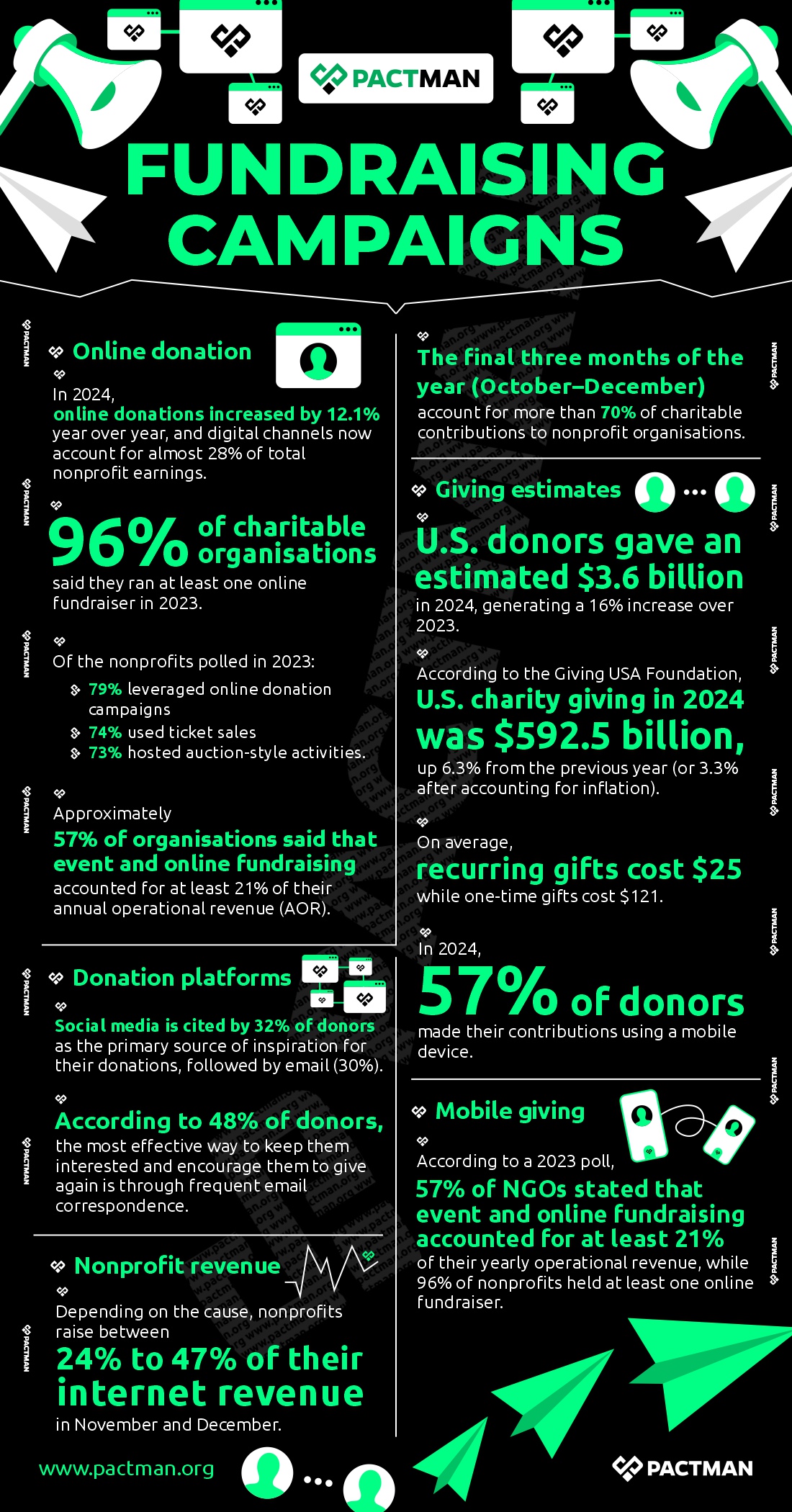
Social media is cited by 32% of donors as the primary source of inspiration for their donations, followed by email (30%). According to 48% of donors, the most effective way to keep them interested and encourage them to give again is through frequent email correspondence.
c. Nonprofit revenue
Depending on the cause, nonprofits raise between 24% to 47% of their internet revenue in November and December. Also, the final three months of the year (October–December) account for more than 70% of charitable contributions to nonprofit organisations.
d. Giving estimates
U.S. donors gave an estimated $3.6 billion in 2024, generating a 16% increase over 2023. According to the Giving USA Foundation, U.S. charity giving in 2024 was $592.5 billion, up 6.3% from the previous year (or 3.3% after accounting for inflation). Also, on average, recurring gifts cost $25 while one-time gifts cost $121.
e. Mobile giving
In 2024, 57% of donors made their contributions using a mobile device. According to a 2023 poll, 57% of NGOs stated that event and online fundraising accounted for at least 21% of their yearly operational revenue, while 96% of nonprofits held at least one online fundraiser.
III
Scaling Fundraising Campaigns: What to Consider for Effective Success
In order to scale effectively, a nonprofit needs to keep its core message, voice, and brand identity the same everywhere. Likewise, the non-negotiable elements include logo, brand colours, fonts, and a high-level promotional strategy (e.g., the general theme or call-to-action). Across the country, this standardisation increases brand confidence and consistency.
Fundraising campaigns
For efficient scaling, the harmony between standardisation and personalisation is essential. In this section, we will consider effective strategies for scaling national fundraising campaigns.
a. Standardise and ‘Productize’ Your Marketing Campaign
The reason your local campaign was successful was that it was effective in one location. Making things operate everywhere is essential for scaling. Hence, it is best to consider your campaign as a “product” that you are prepared to bring to new places.
Design a Playbook for the Campaign: Here is your thorough, step-by-step manual. If you have a local event, it should include a minute-by-minute strategy, as well as suggestions for social media posts and a templated press release. Essentially, this guarantees that it will feel the same regardless of whether the campaign is taking place in California or New York.
Streamline Your Messaging and Brand: Also, your campaign’s “why” must be emotionally appealing and very obvious, but it must also be sufficiently inclusive to appeal to a wide range of communities across the country.
b. Utilise Technology to Increase Productivity
A local spreadsheet is insufficient for managing a national campaign. Likewise, you may grow without having to hire a new crew in every city, thanks to technology.
Set up a centralised customer relationship management system (CRM): This cannot be negotiated. Every city’s donation data must enter a single system. This aids in understanding their “Lifetime Value.” By and large, it constitutes the amount they contribute over time, regardless of where a donor made their initial donation.
Use a Universal Online Platform for Fundraising: For all donations, use a single platform. This streamlines the donor experience and makes it simple to monitor which regions are performing better. Peer-to-peer (P2P) fundraising is a great way for local groups to reach out to their own networks, so be sure to effectively manage it.
c. Identify and Encourage Local Heroes
It is impossible to be everywhere at once. The secret to reaching a national audience is to create a network of driven local leaders who can carry out your strategy.
Prioritise a Phased Rollout: Avoid simultaneously launching in 50 states. For your pilot sites, pick three to five new, diverse cities (such as a major city, a mid-sized suburb, or a rural village). Get feedback and test your playbook with them.
Determine and Examine Local Partners: Seek out reputable companies or well-known people who have similar goals. These “champions” will organise the event, find volunteers, and promote it in their community. They should be given the resources and the playbook, but they should also be allowed to make minor changes that fit the culture of their community.
IV
Gaining Knowledge from the Giants: Examples of Viral Scaling
According to an analysis of successful, high-velocity scaling initiatives, the most successful methods combine concrete, community-specific support with quick digital mobilisation. In this section, we will consider some of the top local fundraising campaigns that scaled nationally and their key success metrics.
Fundraising campaigns
1. The ALS Ice Bucket Challenge
The ALS Ice Bucket Challenge began as a lighthearted local social media campaign in the United States in the summer of 2014. Essentially, the goal was to increase awareness of amyotrophic lateral sclerosis (ALS). In just eight weeks, a campaign that started with a few friends became viral and raised over $115 million for the ALS Association.
To begin with, a peer-to-peer social media challenge served as the foundation for this achievement. Also, the strategic handling of the ensuing capital was the real success. The Board of Trustees of the organisation decided that investing these funds right away in areas that are fundamental to its mission was the best opportunity. This included expanding annual care support by more than 600% over pre-challenge spending, tripling research spending ($89 million dedicated specifically to global research collaborations), and doubling the operating budget.
Scaling Strategies
Social Media Viral Growth: Peer engagement was leveraged in the campaign. By tagging others to participate, participants started a chain reaction.
Ease of Action: It was easy for anyone to become involved: just pour water, record, donate, and upload.
Telling Stories with Feelings: Fun was linked to purpose in the advertising. In every video, there was an entertaining moment of empathy.
Engaging Influencers and Celebrities: The public’s confidence and awareness skyrocketed as prominent individuals like Oprah and Bill Gates joined in.
Key Success Metrics
Raised over $115 million (U.S. ALS Association).
Social Media Reach: More than 17 million videos were created by users.
As a nationwide call to action, the #EndHungerNow campaign mobilised communities, businesses, and individuals to combat hunger together. The campaign effectively addressed food insecurity nationwide, which combined localised delivery with a viral social media strategy.
Also, the program fueled community mobilisation by promoting food contributions and online action sharing. Importantly, the campaign was based on solid local food bank partnerships, which ensured that every donation was promptly converted into support that was specifically needed in the community.
The strategy demonstrates that by connecting neighbourhood support systems and promoting local stories, a national campaign may continue to have a significant influence.
Scaling Strategies
Data-Informed Narrative: Through its “Map the Meal Gap” publications, Feeding America used real-time hunger statistics to illustrate the needs of communities in every county in the United States. People were able to relate to the issue on a personal level thanks to local insights.
Robust Local Collaborations: In keeping with the national message, the organisation gave local food banks the authority to spearhead area campaigns.
Business Partnerships: Collaborations with Walmart, Amazon, and Starbucks increased national prominence and provided financial support.
Social Media and Digital Advocacy: With just one click, anyone could donate, volunteer, or advocate. Thanks to the #EndHungerNow hashtag that brought together online groups around hunger awareness.
All-Year Participation: To keep supporters regularly involved, Feeding America conducts seasonal initiatives as opposed to one-time drives.
Key Success Metrics
Over 4.7 billion meals are distributed annually.
Nationwide network: more than 200 food banks:
Donations totalling over $3.6 billion in food, money, and services each year
Tens of millions were reached by the campaign through both digital and physical media.
Nonprofit Takeaway: The organisation’s foundation of growth includes scalable systems such as consistent storytelling, national branding, local empowerment, and transparent data.
3. Giving Tuesday
Giving Tuesday began in 2012 as a neighbourhood project by the 92nd Street Y in New York City. The goal was to promote giving following the shopping-heavy Cyber Monday and Black Friday. Essentially, the idea was straightforward yet profound: why not create a day devoted to giving back after two days of consumption (Black Friday and Cyber Monday)?
The campaign began as a local partnership between the United Nations Foundation and 92Y. Their mission was not only to raise money but to foster a cultural shift toward social justice and compassion. When it began, only a few community leaders, small companies, and organisations took part. Over time, Giving Tuesday became a worldwide movement that involved dozens of organisations and millions of people in less than five years.
In contrast to typical branded promotions, Giving Tuesday was not “owned” by a single group. Rather, it was a broad invitation for everyone to modify and understand the campaign in their own way, including people, small enterprises, corporations, charity organisations, and educational institutions.
Scaling Strategies
Clear, Simple Concept: Anyone can easily adopt a single day devoted to donating.
Decentralised Participation: This encourages diversity by allowing any contributor or nonprofit to participate.
Strategic Timing: For optimal exposure, it was placed between significant shopping events.
Partnerships: Working together with major corporations like Microsoft and Facebook increased visibility.
Each year, funding is given to tens of thousands of charity organisations.
The #TheGivingTuesday hashtag remains popular worldwide every year.
Nonprofit Takeaway: An idea can become a worldwide phenomenon if it is open-source and widely relevant.
4. St. Jude Children’s Research Hospital “Thanks and Giving” Campaign
Marlo Thomas started this effort as a local awareness campaign aimed at Memphis and the surrounding areas. When it first began, it was a seasonal attraction during Thanksgiving and Christmas. The message’s core concept was straightforward and sincere: “As we express gratitude for our children’s health, let’s also show compassion for those who do not.”
This concept struck a deep chord with families, particularly during the holiday season, which is a time for giving and thankfulness. It started off as a local awareness campaign and eventually became one of America’s most successful national cause-marketing initiatives.
The mission of St. Jude is strong and unambiguous: “No child should pass away at birth.” St. Jude never sends bills to families, not for lodging, food, travel, or medical care. Every dollar donated goes toward providing free, top-notch care for kids with life-threatening conditions. The goal of the “Thanks and Giving” campaign was to:
Raise money to pay for continued medical care and research.
Increase public knowledge about St. Jude’s distinctive financing strategy.
Encourage both individual and corporate involvement by providing easily accessible donation locations.
Not only did the “Thanks and Giving” campaign spread across the country, but it was also a masterwork of integrated fundraising strategy.
Scaling Strategies
Retail Partnerships: To receive donations at checkout, the organisation partnered with retailers including Domino’s, Best Buy, and Target.
Annual Branding Consistency: The “Thanks and Giving” theme was adopted as a yearly custom.
Celebrity Storytelling: Heartfelt accounts from patients and their families sparked compassion and giving. Also, social media and advertisements were coordinated during the holiday season.
Millions of small donations were gathered at the point of sale.
Consistent yearly increase of 5-7 per cent in donor participation
Nonprofit Takeaway: A campaign’s public awareness can be anchored by solid business partnerships and a yearly message that is consistent.
5. Red Nose Day (Comic Relief USA)
Initiated in the UK, Red Nose Day began as a small trial project backed by NBC and Walgreens before expanding to the U.S. in 2015. It swiftly spread throughout the country as a campaign to eradicate child poverty. Its straightforward but effective goal was to raise funds and awareness for those living in poverty by using comedy and entertainment.
The concept began as a modest campaign when it first came to the US in 2015. Afterwards, it rapidly grew into a nationwide event that raises millions of dollars every year for underprivileged kids and families. In contrast to conventional charity campaigns, Red Nose Day humorously approached a serious topic. The recognisable red clown nose, which represents joy, optimism, and solidarity, served as the campaign’s focal point.
The message was “by having fun and being silly, you can make a real difference.” It stood out for its blend of compassion and excitement. Even more, people were able to take part without being overpowered by pleas based on guilt. The crimson nose was proudly worn in offices, TV shows, and schools as a sign of generosity.
Lastly, the fact that anyone could enter a local Walgreens, purchase a red nose for $1, and immediately support the cause was a brilliant example of accessibility. All in all, partnerships provided the campaign legitimacy nationwide and increased its visibility to millions of people.
Scaling Strategies
Effective branding: The red nose is an entertaining and easily identifiable fundraising symbol, which is an example of iconic branding.
Retail Engagement: By selling red noses at the register, Walgreens turned into a fundraising centre.
Integrating Entertainment: National programs showcasing comedians and celebrities were televised by NBC.
Transparency: Consistent reporting on the impact and amount of funds raised contributed to the development of trust.
Around the world, more than 25 million kids volunteered.
Over 100 million TV viewers and web impressions per year.
Collaborations with more than fifty NGOs that promote housing, health, and education.
Nonprofit Takeaway: When used carefully, humour and entertainment can transform generosity into a happy national occasion.
Conclusions
From a successful local fundraising effort to a long-lasting nationwide campaign, there are several steps involved in replication and adaptation. The main takeaway for charity organisations is that high donor loyalty indicators, especially a high RDR, and proven financial efficiency must be the primary factors in the choice to scale.
The goal of scaling fundraising campaigns is to create a community around a common purpose, not only to raise funds. Authenticity, clear messaging, and quantifiable influence were all united in local initiatives that eventually became national movements.
Nonprofits should aim to build long-term trust by starting small and scaling wisely. When your narrative is compelling and your systems are open and honest, the next logical step is national expansion. All in all, a small campaign can become a national movement once people believe they are part of the mission. As your nonprofit expands, keep your goal global but your heart local.
In the current nonprofit environment, organizations are increasingly relying on technology to enhance donor interaction, ensure compliance, and streamline operations. The Pactman Nonprofit CheckPlus API […]
TABLE OF CONTENTS Introduction Overview of Nonprofit Grant Options Critical Statistics on Nonprofit Grants in the U.S. Nonprofit Grants in Washington Nonprofit Grants in Alabama […]
TABLE OF CONTENTS Introduction Nonprofit Funding Gaps in Africa Critical Statistics on Nonprofit Grants Local vs International Nonprofit Grants in Africa: A Comparative Analysis Overview […]
California is at the forefront when it comes to climate change action in the United States. Through their passionate and active policies, clean energy funding, […]
Education nonprofits are effective change agents. Individual lives as well as communities can be influenced through education. Additionally, it helps close the gaps, open up […]
Homeless charities provide a haven for individuals who cannot afford to procure homes or fend for themselves. Ireland is a country faced with homelessness, just […]