How to Transition from Transactional Giving to Strategic Partnerships
Cersai Stark
I
Introduction
Successful philanthropy demands a shift from transactional giving to strategic partnerships. This transforms the foundation from a simple source of funding into a force multiplier by utilizing all of its resources—financial, intellectual, and social—to expedite the work of its grantees. Likewise, three non-negotiable pillars (time, trust, and non-monetary value) are the foundation of successful strategic partnerships.
strategic partnerships
Foundations can go from “funding good projects” to “reshaping systems for durable change” through strategic partnerships. One message is becoming more and more evident throughout the charitable landscape: cooperation is more important for impact than cash.
In this article, we will consider how foundations and organizations can switch from transactional giving to strategic collaboration.
II
Critical Statistics on Strategic Partnerships
In this section, we will consider critical statistics on strategic partnerships and its impact on the nonprofit sector.
a. Collaborative philanthropy
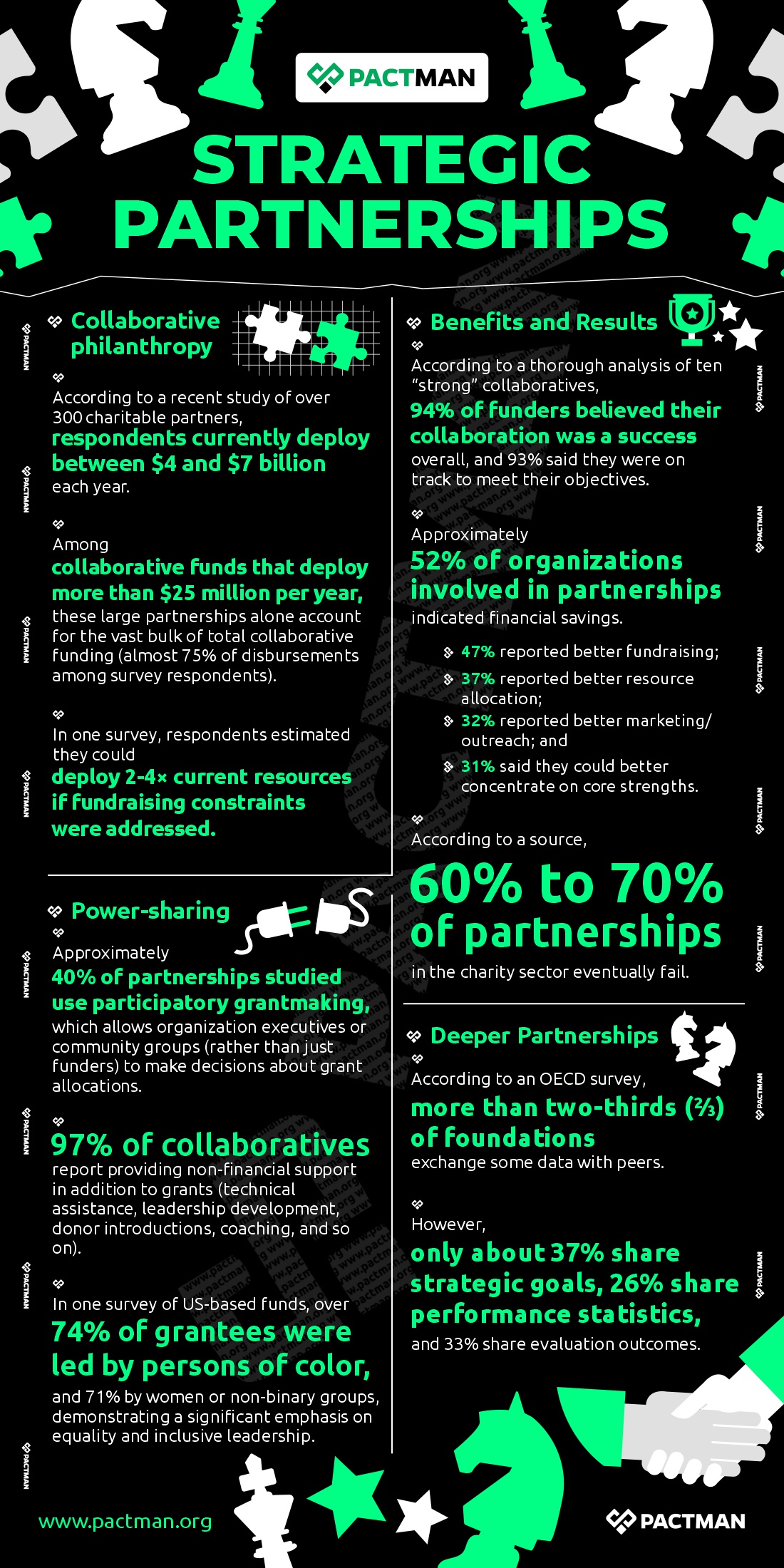
According to a recent study of over 300 charitable partners, respondents currently deploy between $4 and $7 billion each year. Also, nearly half of the partnership funds in the survey were established after 2010, indicating a significant increase in the usage of pooled / partnership-based grantmaking over the last decade.
Among collaborative funds that deploy more than $25 million per year, these large partnerships alone account for the vast bulk of total collaborative funding (almost 75% of disbursements among survey respondents). In one survey, respondents estimated they could deploy 2-4× current resources if fundraising constraints were addressed.
Strategic Partnerships
b. Deeper Partnerships
According to an OECD survey, more than two-thirds (⅔) of foundations exchange some data with peers. However, only about 37% share strategic goals, 26% share performance statistics, and 33% share evaluation outcomes.
c. Power-sharing
Approximately 40% of partnerships studied use participatory grantmaking, which allows organization executives or community groups (rather than just funders) to make decisions about grant allocations. Furthermore, 97% of collaboratives report providing non-financial support in addition to grants (technical assistance, leadership development, donor introductions, coaching, and so on).
The majority of collaboratives also track and disclose grantee leadership demographics. In one survey of US-based funds, over 74% of grantees were led by persons of color, and 71% by women or non-binary groups, demonstrating a significant emphasis on equality and inclusive leadership.
31% said they could better concentrate on core strengths.
Despite the potential, many partnerships fall short of expectations. According to a source, 60% to 70% of partnerships in the charity sector eventually fail. This highlights the need for resources, attention, and alignment for strategic collaborations to be successful.
Grants offered annually with no long-term assistance
Prioritizes activities over outcomes
While transactional giving can be useful for emergency relief or small-scale community projects, it is insufficient for challenges such as school reform, poverty reduction, climate resilience, and healthcare access.
strategic partnerships
Strategic partnerships, on the other hand, are long-term, collaborative approaches in which foundations and grantees work as equal stakeholders to achieve common goals. The key aspects are as follows:
Joint planning and visioning
Shared responsibility for results
Integrating learning and data exchange
Flexible funding
Commitments that span multiple years
Mutual transparency
Invests in organizational capabilities rather than initiatives.
In essence, strategic partnerships elevate the foundation’s position from financier to strategic partner, from “writing checks” to driving system-level reform.
Transactional Giving
Strategic Partnerships
Short-term project grants
Multi-year, long-term collaboration
Compliance-driven
Co-created goals and shared accountability
Funders act alone
Funders act as connectors
Grants focus on outputs
Investments focus on systems change
Each nonprofit works in isolation
Ecosystem-level collaboration
Also, transactional giving frequently focuses on quantifiable, easily measurable results (e.g., number of meals delivered, number of persons trained). It operates on brief cycles (e.g., one-year grants). Although beneficial, this strategy may result in:
Grantee Burnout: Organizations take too much time to apply, report, and modify programs to meet changing funder priorities, which takes time away from carrying out their missions.
Short-Term Mindset: It deters grantees from pursuing the intricate, long-term, and possibly crucial innovation required for systemic transformation.
Separate Attempts: Similar, disorganized projects may be funded by several foundations, losing out on opportunities for scale and synergy.
On the other hand, strategic partnerships create an atmosphere where organizations may invest in their core competencies, think large, and work well together.
IV
How Foundations Can Become Strategic Alliances
The shift to strategic partnerships begins within the foundation. This demands a fundamental change in risk tolerance, procedures, and culture.
strategic partnerships
a. Shift from “Due Diligence” to “Due Connection”
Verifying financial stability, historical performance, and compliance are the main goals of transactional due diligence. However, the goal of strategic “Due Connection” is to evaluate:
Alignment of Principles: Does the grantee’s leadership style and organizational DNA fit the foundation’s change-oriented vision?
The Grantee Special Asset: What skills, practical knowledge, and connections does the grantee have that the foundation needs to accomplish a common objective?
Organizational Well-Being, Not Just Program Results: Evaluate the grantee’s internal procedures, personnel management, and leadership. These are the key components of long-term sustainability.
b. Substitute Learning & Adaptation for Monitoring
Secondly, change the approach to one that emphasizes strategic learning and candid feedback rather than demanding lengthy, inflexible reports that are centered on outputs.
Adopt Developmental Evaluation: By utilizing real-time feedback loops, the grantee and the foundation may jointly determine what is and is not working, enabling mid-course adjustments. This is an important component of shared risk.
Prioritize Progress Against Strategy, not Compliance Against Budget: Frequent check-ins should focus on strategic discussions regarding the efficiency of the selected strategy and not financial audits.
c. Add Value Outside of the Check
The source of a strategic partnership’s real leverage is when the foundation chooses to share its distinctive non-financial assets.
Access to Networks: Introduce the grantee to legislators, business executives, and possible co-funders who can expedite their work.
Data and Research: If the nonprofit cannot afford to purchase policy research that is pertinent to its purpose, grantors can choose to commission it and distribute it.
Strategic Expertise: As made popular by programs like the Venture Philanthropy model, second-level foundation employees, such as HR, finance, or communications, can assist the grantee in developing their internal capacity.
d. Concentrate on Systemic Reform
Furthermore, strategic partnerships need to address a problem’s structure as well as its symptoms. This frequently refers to funding:
Policy and advocacy work: Supporting initiatives to amend laws and rules that are obstacles for underrepresented groups.
Field-building: Funding cooperation between several groups tackling a common problem (e.g., establishing shared data platforms or industry standards)
Fundamental Operating Support: Granting the grantee unlimited funding so they can make investments in their administration, personnel, and technology—the vital infrastructure needed for long-term, high-impact work.
e. Get Through the Difficulties
Lastly, foundations must embrace a new degree of vulnerability and accountability as part of the difficult transition to strategic partnerships.
Steer clear of the Funder-Imposed Strategy: Co-creation is required for a partnership. Hence, the grantee must spearhead the tactical and programmatic plan due to its on-the-ground experience, while the foundation provides the overall objective. The grantee’s practical experience and technical know-how are given priority in the most successful partnerships.
Control Power Dynamics: Foundations need to make a concerted effort to balance the power dynamics. This may entail less formal meetings, frequent visits to the grantee’s location, and a “how can we help you” approach rather than a “show us your numbers” demand.
Assess the Relationship’s Quality: Leverage anonymous surveys or third-party check-ins regularly to gauge how the grantee feels about the collaboration. Do they feel encouraged, or are they just being watched? One key performance indicator (KPI) is how well the relationship is going.
Conclusion
The next step in successful philanthropy is to shift from transactional giving to strategic partnerships. By utilizing all of its resources (financial, intellectual, and social) to expedite the work of its grantees, the foundation shifts from a simple source of funding into a force multiplier. The idea of strategic partnership is evolving from a specialized philanthropy model to the standard operating framework for any organization looking to bring about significant, systemic change.
Also, strategic partnerships will become increasingly interdependent in the future. The degree of integration, the scope of the ecosystem, and the common dedication to addressing issues at their core will determine success rather than the quantity of the award. Foundations can go beyond supporting worthwhile initiatives to driving systemic reforms that address the most pressing issues facing our society by investing in trust, committing to long-term collaboration, and co-creating shared strategies.
1 response to “How to Transition from Transactional Giving to Strategic Partnerships”
[…] starts with several responsive actions. However, top-performing organizations are moving toward a transformational model that integrates equity into every aspect of their operations, especially in a period of growing […]
In the current nonprofit environment, organizations are increasingly relying on technology to enhance donor interaction, ensure compliance, and streamline operations. The Pactman Nonprofit CheckPlus API […]
TABLE OF CONTENTS Introduction Overview of Nonprofit Grant Options Critical Statistics on Nonprofit Grants in the U.S. Nonprofit Grants in Washington Nonprofit Grants in Alabama […]
TABLE OF CONTENTS Introduction Nonprofit Funding Gaps in Africa Critical Statistics on Nonprofit Grants Local vs International Nonprofit Grants in Africa: A Comparative Analysis Overview […]
As a climate change leader, Virginia establishes its position by implementing forward-thinking policy measures through renewable power investments and nature protection initiatives. The government of […]
The state of Illinois stands out as a climate change leader through its dedicated green legislation, its allocation of renewable energy financing and its distinctive […]
When you want to donate, consider the best charities to donate to. Various charity groups in Jamaica work to improve education, healthcare, the environment, and […]










1 response to “How to Transition from Transactional Giving to Strategic Partnerships”
[…] starts with several responsive actions. However, top-performing organizations are moving toward a transformational model that integrates equity into every aspect of their operations, especially in a period of growing […]