The importance of quantifying social impact is self-evident in the charity sector. Also, this is one of the crucial factor to consider when seeking some of the best charities to donate to.
Best Charities to donate to
The fundamental purpose of the charity sector is to provide public benefit, improve the lives of people, develop communities, and positively impact society. As a result, finding respectable charities to donate to is an excellent way to contribute to societal growth.
Charities, in general, are particularly positioned to solve societal issues such as rising social and racial inequality. Furthermore, charities can help bridge disparities and bring people together through their activities. Hence, philanthropic efforts must be recognized and respected regardless of where and to whom they are directed.
Our assistance to the industry enables these organizations to carry out their missions, attain their full potential, and relieve the world of various social challenges.
II
The Impact of Charities
Charity organizations play an important role in society’s development and stabilization by offering key services that contribute to socioeconomic development. Likewise, nonprofit leaders are typically the “voice of the people.” They serve and help to ensure smooth communication with communities.
Best Charities to donate to
These organizations know how to grasp their communities’ needs and understand how to meet them. Generally, this is largely a result of their strong ties based on community relationships and detailed local expertise. Strong and well-resourced charities that are connected in their efforts to influence their communities can help foster development and new opportunities.
Presently, nonprofits are being challenged to do more with less in an era of increasing demands and dwindling government resources. This, in turn, put extra strain on their already limited resources.
In addition, public and private funding for charities typically focuses on program creation and expansion rather than fundamental infrastructure, organizational growth, and leadership development. The most efficient NGOs spend as little money as possible on overhead. This includes staff pay, property rent or mortgage, operating expenses, marketing charges, and other fees involved with running the organization.
The majority of donor contributions go directly to the organization’s intended audience. Accordingly, charity organizations must make their budgets public to maintain their tax-exempt status.
By and large, charitable organizations frequently encourage donations by directing contributors to a single benefit. Some humanitarian groups, for example, allow individuals to sponsor a single kid, student, or instructor. Similarly, some wildlife organizations promote the symbolic adoption of specific species, such as polar bears, pandas, or penguins. This is because single recipients elicit more sympathy and care than several beneficiaries. Hence, focusing on one beneficiary can be a successful fundraising technique.
III
Critical Statistics on Charitable Activities
In this section, we will consider critical statistics on global charities and their impact.
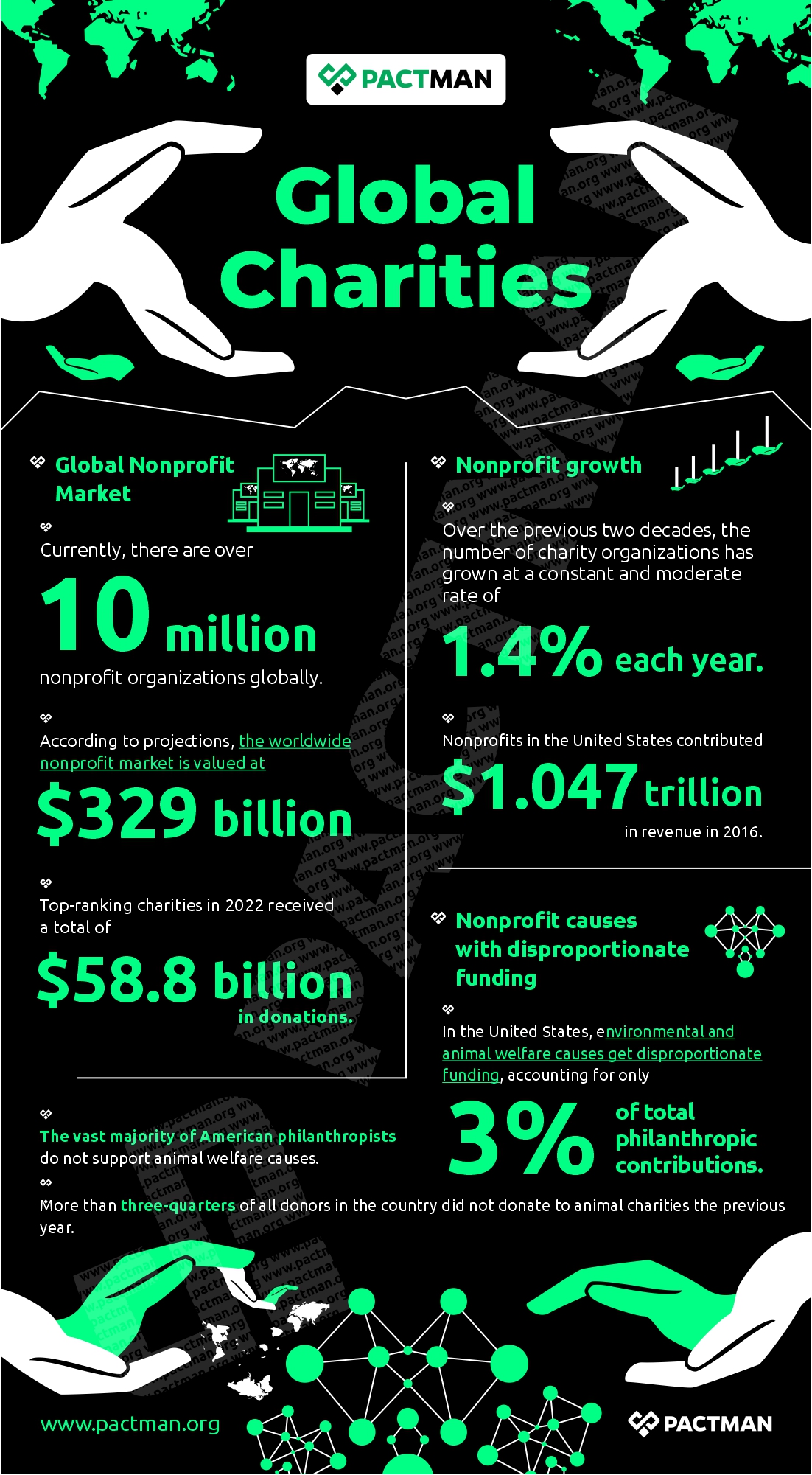
Over the previous two decades, the number of charity organizations has grown at a constant and moderate rate of 1.4% each year. Although this is an agreeable pace, it pales in contrast to the overall growth in nonprofit revenue. Nonprofits in the United States, on the other hand, contributed $1.047 trillion in revenue in 2016.
Americans have traditionally been and continue to be generous people. The country has historically relied on private charity to support a wide range of purposes, including humanitarian relief and assistance to the destitute.
In 2016, Americans provided a record $390 billion to charitable organizations through a combination of individual giving and philanthropy from estates, corporations, and foundations.
Infographics on charities to donate to
3. Disproportionate funding
In the United States, environmental and animal welfare causes get disproportionate funding, accounting for only 3% of total philanthropic contributions. The vast majority of American philanthropists do not support animal welfare causes. More than three-quarters of all donors in the country did not donate to animal charities the previous year.
4. Nonprofit performance
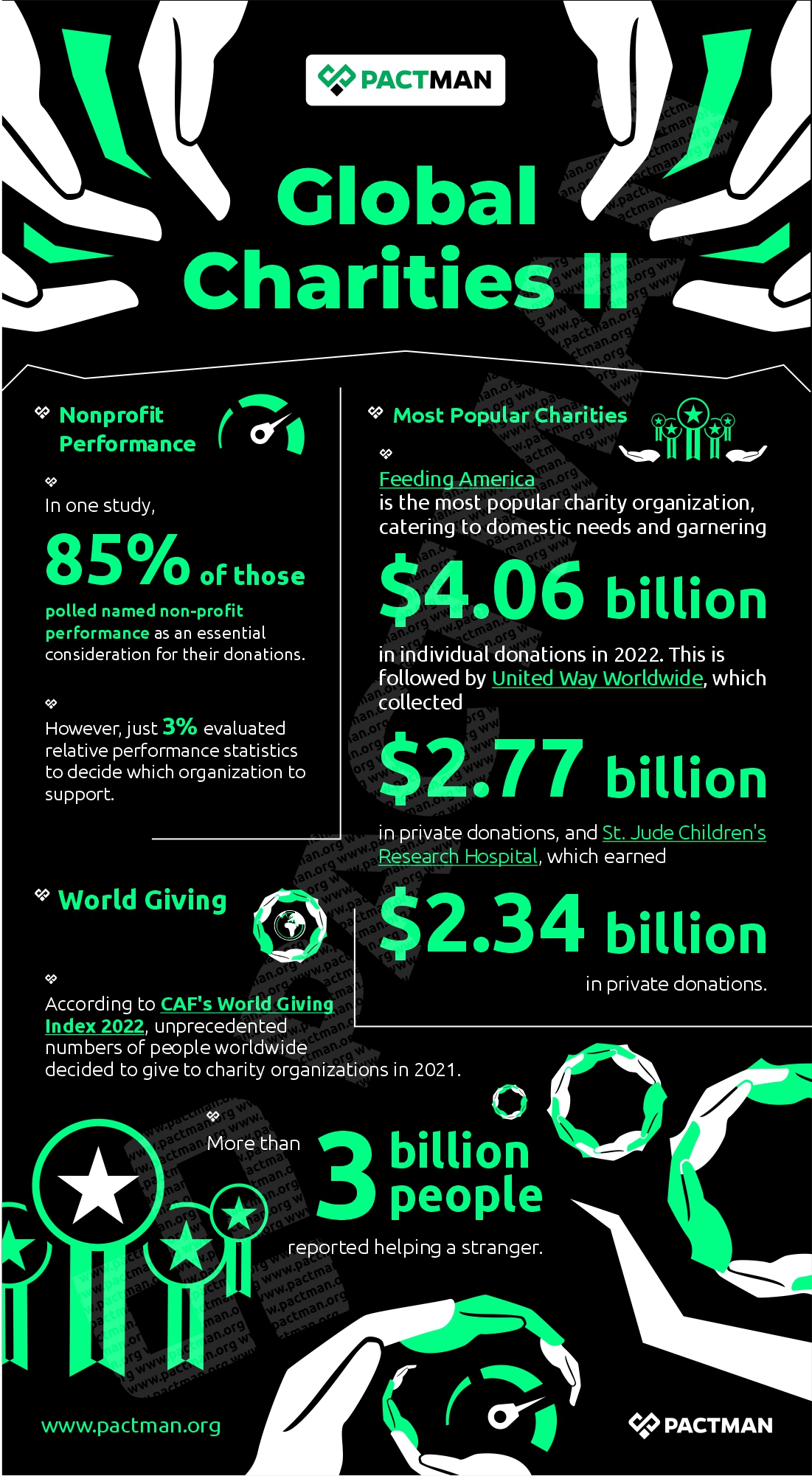
In one study, 85% of those polled named non-profit performance as an essential consideration for their donations. However, just 3% evaluated relative performance statistics to decide which organization to support.
According to CAF’s World Giving Index 2022, unprecedented numbers of people worldwide decided to give to charity organizations in 2021. Also, more than 3 billion people reported helping a stranger.
IV
Good charities to donate to: What makes a good charity?
When seeking respectable charities to donate to, there are four categories to consider: purpose, impact, practice, people, and finance & operations. Also, within each of these domains, there are several crucial questions to examine. We will address them in the sections that follow.
However, it is best to note that there is no hierarchy—every aspect of the framework must be considered. Furthermore, for the charity to be as effective as possible, these sections must collaborate.
Best Charities to donate to
a. Purpose
When considering any charity, the first step is to learn how it seeks to impact the world based on its mission. A charity is defined by its social purpose, regardless of how large it is or what field of endeavor; the goal is to effect change. For some, such as heritage or nature organizations, ‘change’ may imply preserving something or averting unwelcome change. Others, such as social justice activists, may be concerned with changing attitudes, policies, or legislation. Hence, the question should be: Is the vision and mission of the charity meeting a need?
By and large, every charity has a vision for how the world should be. The purpose of a charity is the difference it wishes to make in contributing to this vision. This, in turn, drives the charity’s actions. Although it may appear to be self-evident, there are frequently real contradictions between organizational and mission goals. Everything the charity does, including its brand, messaging, and culture, should stem from and be consistent with its objective.
To begin with, making an impact frequently requires ambition and the guts to take risks. This is general, whether it involves attempting a novel strategy, advocating for an unpopular cause, or making difficult decisions about where to focus. The greatest influence will be achieved by trustees and managers who look beyond their organization’s concerns to its larger purpose.
Also, rather than simply treating symptoms, ambitious charities strive for long-term transformation and work to address core issues. Some charities are beginning to take a ‘systems change’ approach to bring about long-term change by changing underlying structures and supporting mechanisms.
b. Impact Practice
The best charities are motivated by their impact—the long-term effect they have on the issue or the individuals with whom they work.
Impact practice refers to the cycle of actions centered on results: planning how to attain a goal while delivering, assessing, and learning for the future. Good impact practice assists organizations in becoming better. Also, creating and executing an appropriate measuring strategy is a critical step toward becoming a more productive and impact-driven organization.
Good impact practice entails using information to analyze, learn, and improve, as well as acting on what the information provides. By and large, this is a constant process. It includes assessing the information gathered (does it tell the charity what it needs to know?) as well as the findings (is there anything the charity should do as a result?).
If outcomes fall short of expectations, the charity will want to know why and alter its operations, assumptions, or overall strategy. The best organizations use data to inform decision-making at all levels and are willing to adapt to what the evidence shows them. A track record of applying expertise to fine-tune activities and being unafraid to attempt new tactics are trademarks of a forward-thinking organization.
c. People
Also, a charity is made up of people—staff, volunteers, and trustees. Likewise, strong leadership, sound governance, and supportive management may create a team more than the sum of its members.
Being unduly reliant on a single individual (whether a volunteer or a staff member) can be an especially serious issue for smaller organizations, where recruiting and retention can be difficult. Large organizations, on the other hand, present unique challenges. Effective communication among employees, as well as ensuring a shared vision and a consistent culture, can be more challenging with a large or distributed team.
Good leadership articulates a consistent vision and ensures that a strategy is put into action and that the organization can develop and adapt as needed. Leadership is not solely the responsibility of the CEO. The chair, board, and management are all members of the leadership team.
Also, the leadership team must have the abilities and expertise to carry out their responsibilities. In addition, they must successfully communicate with people both inside and outside the organization. Leaders should prioritize the charity’s objective, which may require difficult choices and decisions.
The finest leadership teams focus on strengthening the organization by promoting leadership among staff or volunteers. They also assist in creating an environment where individuals can (and want to) give their all. Good leadership is especially vital during times of transition and change.
d. Finance and Operations
Finances enable charities to focus on their mission. Hence, there is a need to be realistic about the climate in which charities operate: resources are limited, and money frequently comes with strings attached.
A large number of donors prefer to limit contributions to a specific project, activity, or position. This restriction is legally binding, and charities are breaking the law if they spend restricted funds on anything other than what they were intended for.
Maintaining financial security is a constant effort, and unlimited cash, which can be used however the charity sees fit, is like gold dust. Unrestricted funding allows charities to be more responsive, agile, independent, and forward-thinking. Hence, we encourage funders to grant it whenever feasible.
To begin with, all charities must create yearly accounts and make them public upon request. Most organizations also post accounts on their website, which is standard procedure. A large number of charities use management accounting systems to match expenditures and work within the available finances.
Forthwith, the audited accounts will approximate reality: a steady unrestricted income from regular donors, a large number of modest grants, or contract revenue when work is paid in arrears, among others.
Also, looking ahead is just as crucial as looking back. Budgets, forecasts, and forward cashflows provide insight into the charity’s future prospects.
Financial security enables an organization to know whether income exceeds spending and how predictable both are. It also reveals the strength of the balance sheet, and hence the type of financial cushion the charity has; and its future outlook.
Essentially, the ability of the organization to manage income changes, whether short-term or long-term, is crucial. These considerations have an impact on its ability to maintain operations and plan for the future. Finally, charities are supposed to create reserves while also spending on activities.
V
Top Charities to Donate to Globally
In this section, we will consider some of the most impactful charities to donate to. These organizations stand out for their global impact and financial transparency.
Best Charities to donate to
a. Habitat for Humanity
Habitat for Humanity seeks to empower people in the world’s poorest communities to tackle housing difficulties. The foundation aims to provide the necessary assistance so that everyone can have a safe place to live. As a result, the organization seeks efficient methods for making cheap housing available.
In addition, Habitat for Humanity works with local communities to identify available housing alternatives, as housing needs vary by area. Other housing assistance includes construction, repair, and home renovations. Future homeowners get to work alongside volunteers and pay a low-interest mortgage.
Furthermore, Habitat for Humanity contributes to the energy efficiency of structures and the provision of water and sanitation solutions. The organization also assists with disaster resolution while providing housing loans. The group persuades local, national, and international governments, as well as intergovernmental bodies, to prioritize housing and other housing-related concerns.
2. African Wildlife Foundation
African Wildlife Foundation is an African-based global conservation organization. The group is dedicated to the preservation of species and their habitats. The foundation, by presenting a distinct vision of African-led conservation, focuses on solutions that provide opportunity for people. However, this is achieved not at the expense of species and their ecosystems.
The organization believes that Africa requires immediate and direct attention to conservation and development while the continent is still in its early stages of economic development. As a result, the organization seeks to support African governments and people to navigate the current economic upheaval while preserving a significant and representative inheritance of wildlife and wild areas.
3. Church World Service (CWS)
CWS prioritizes a single goal: to build a world where there is plenty for everyone. The organization seeks to create a society in which everyone has access to food, a voice, and a secure place to live.
CWS has been active for more than 75 years to make its vision a reality. Hence, thousands of refugees and other new neighbors have been welcomed into CWS communities over the years. Similarly, the charity has supported numerous needy families and given voice to individuals who were once silenced.
Church World Service was established in the aftermath of World War II. Overall, seventeen Christian faiths came together “to do in partnership what none of us could hope to do as well alone.” The CWS family arranged more than 11 million pounds of food, clothing, and medical supplies during the early days of war-torn Europe and Asia.
Following that, the group began to accept refugees wishing to establish new lives in the United States in safety. CWS relocated over 100,000 refugees in its first ten years. The organization’s programs continue to grow and adapt with time, while also emphasizing teamwork and hospitality. Without a doubt, CWS stands out as one of the best charities to donate to globally.
4. Water for People
Water For People is a global nonprofit that works in Latin American, Asian, and African countries to address the global water crisis. The group provides long-term access to clean water and sanitation services to communities. Essentially, the goal is to make the world a place where everyone has access to safe drinking water for the rest of their life.
To fulfill its objectives, Water for People collaborates with local governments, businesses, and individuals to provide clean water and sanitation systems in their areas. Furthermore, the organization works to ensure that communities have the resources they need to sustain those systems now and in the future.
Water for People continues to provide access to safe drinking water, sanitation solutions, and hygiene education to millions of people in nine different nations. The group delivers long-term water and sanitation services by connecting and empowering governments, businesses, and citizens.
5. Planet Aid
Planet Aid is known to accept both good- and bad-condition clothing. As a result, people can donate and recycle old clothing while ensuring they do not end up in landfills.
Planet Aid reported that it collected 70 million pounds of materials in 2020. The organization has established a streamlined approach for keeping clothes out of landfills by dispersing its trademark yellow container in strategic spots.
Every pound of clothing salvaged from landfill saves roughly 3-4 pounds of CO2. As a result, for every 90 million pounds of clothing collected, Planet Aid successfully prevents 300-400 million pounds of CO2 from entering the environment. This is accomplished by ensuring that every pound of clothes has a positive impact on the environment.
Donated apparel is sold and recycled. Afterwards, they are sent to underprivileged countries. All sales proceeds are allocated to combat poverty in these communities.
Conclusion
To sum up, charities devote a significant amount of time and effort to establishing effective initiatives. These organizations are viewed as valuable and worthy of public support when they choose to uphold and sustain the norms of public trust and address the growing demands of their communities.
The charity sector is regarded as a powerful tool and avenue for addressing human needs while simultaneously doing good. As a result, their influence on the government, economy, and society is tremendous. Similarly, charities have the opportunity, and possibly even the responsibility, to bridge societal gaps.
In the current nonprofit environment, organizations are increasingly relying on technology to enhance donor interaction, ensure compliance, and streamline operations. The Pactman Nonprofit CheckPlus API […]
TABLE OF CONTENTS Introduction Overview of Nonprofit Grant Options Critical Statistics on Nonprofit Grants in the U.S. Nonprofit Grants in Washington Nonprofit Grants in Alabama […]
TABLE OF CONTENTS Introduction Nonprofit Funding Gaps in Africa Critical Statistics on Nonprofit Grants Local vs International Nonprofit Grants in Africa: A Comparative Analysis Overview […]
Most organisations prefer Asana as their management tool. It is especially useful for planning a client’s work, such as developing and updating a content calendar […]
As a climate change leader, Virginia establishes its position by implementing forward-thinking policy measures through renewable power investments and nature protection initiatives. The government of […]