


I
Introduction
The focus of global climate action is frequently mitigation, or lowering greenhouse gas emissions. However, adaptation and climate resilience are already top priorities for many communities, particularly in low- and middle-income nations. By and large, this is crucial to managing heat, erratic rainfall, floods, droughts, ecosystem degradation, and related social and health shocks.

A finance gap results from public funding and national budgets frequently failing to meet all requirements for climate resilience and adaptation. Hence, foundations and charitable actors play a special role because they can be more adaptable, patient, and mission-driven than many public or private investors. In situations where traditional funding is insufficient, grantmakers can accelerate impact by proactively leveraging philanthropic funds.
This article investigates how grantmaking organizations can effectively invest in climate resilience rather than only carbon reduction.
II
Addressing the Crucial Gap in Climate Resilience
Funding for climate resilience is ineffective if it fails to address the underlying societal issues that determine who is most vulnerable. To address structural injustices, philanthropy must employ rigorous, data-driven strategies. Research consistently demonstrates that many marginalized communities, such as Black and Latino-majority cities and neighborhoods, are more vulnerable to the effects of climate change. By and large, this is due to underlying social vulnerability, such as poverty, lack of access to transportation, and crowded housing, and not direct physical exposure to climate hazards.

Consequently, these socioeconomic variables compound risk, meaning an effective resilience investment must target both the hazard and the structural injustice concurrently. The extent and urgency of the need are disproportionately affected by the catastrophic effects of climate hazards, which range from droughts, floods, and high heat to coastal storms and sea level rise. Likewise, conventional public financing and private investment often lack the scope and adaptability necessary to respond effectively.
One crucial benefit of philanthropy is the fact that foundations and grantmakers are frequently in a better position than private investors to leverage opportunities, finance long-term adaptation, assist regional innovators, and make investments in preventive measures that may not produce immediate financial returns but have significant social and ecological value.
III
Critical Statistics on Climate Resilience
In this section, we will consider critical statistics on climate resilience and its impact across the globe.
a. Climate risk
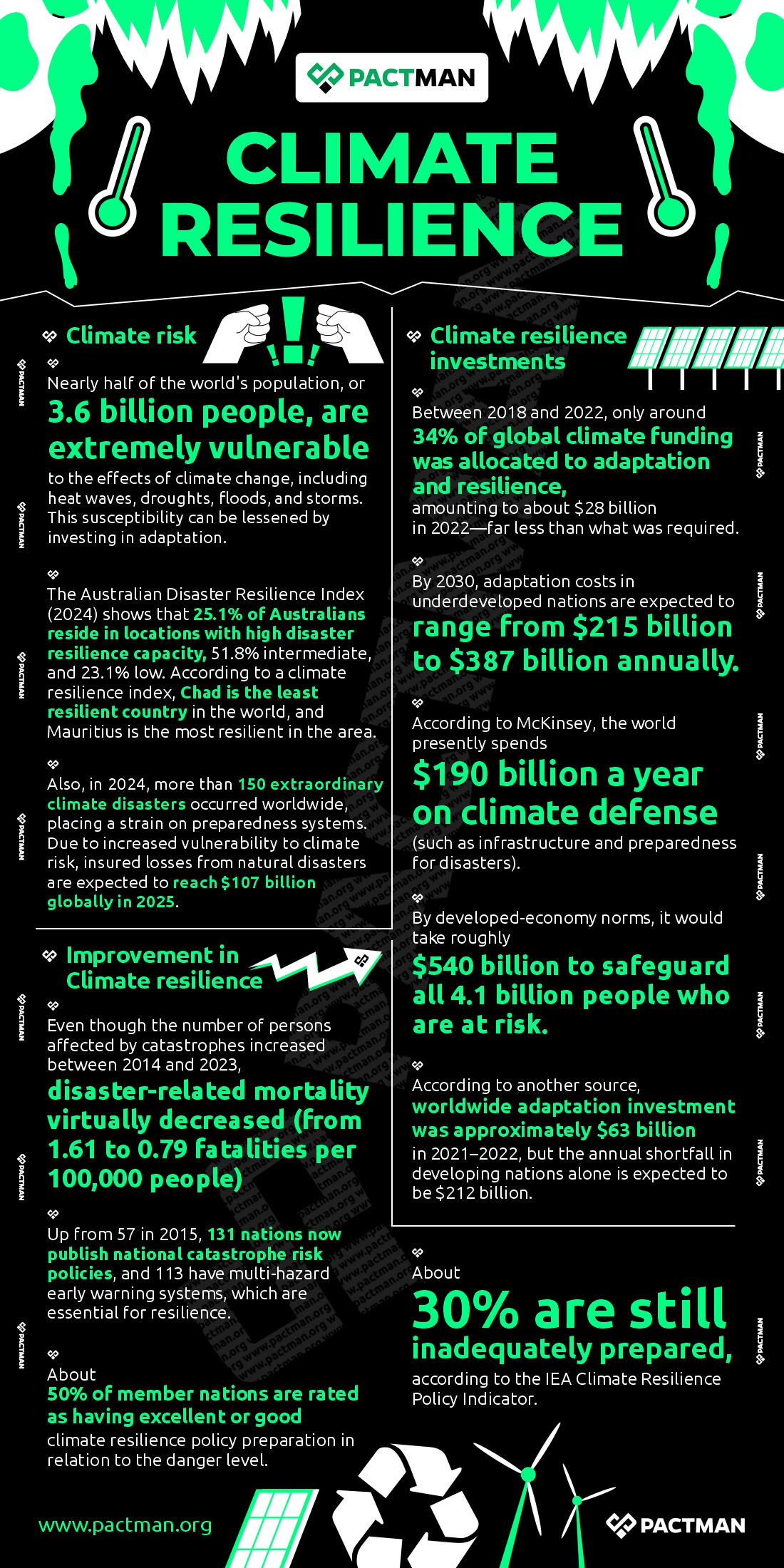
Nearly half of the world’s population, or 3.6 billion people, are extremely vulnerable to the effects of climate change, including heat waves, droughts, floods, and storms. This susceptibility can be lessened by investing in adaptation.
The Australian Disaster Resilience Index (2024) shows that 25.1% of Australians reside in locations with high disaster resilience capacity, 51.8% intermediate, and 23.1% low. According to a climate resilience index, Chad is the least resilient country in the world, and Mauritius is the most resilient in the area.
Also, in 2024, more than 150 extraordinary climate disasters occurred worldwide, placing a strain on preparedness systems. Due to increased vulnerability to climate risk, insured losses from natural disasters are expected to reach $107 billion globally in 2025.
b. Climate resilience investments
Between 2018 and 2022, only around 34% of global climate funding was allocated to adaptation and resilience, amounting to about $28 billion in 2022—far less than what was required. By 2030, adaptation costs in underdeveloped nations are expected to range from $215 billion to $387 billion annually. According to McKinsey, the world presently spends $190 billion a year on climate defense (such as infrastructure and preparedness for disasters).
By developed-economy norms, it would take roughly $540 billion to safeguard all 4.1 billion people who are at risk. According to another source, worldwide adaptation investment was approximately $63 billion in 2021–2022, but the annual shortfall in developing nations alone is expected to be $212 billion. This indicates that climate adaptation finance is still insufficient.
c. Improvement in Climate resilience
Even though the number of persons affected by catastrophes increased between 2014 and 2023, disaster-related mortality virtually decreased (from 1.61 to 0.79 fatalities per 100,000 people) This is partly due to better early warning systems and risk mitigation techniques.
Up from 57 in 2015, 131 nations now publish national catastrophe risk policies, and 113 have multi-hazard early warning systems, which are essential for resilience. Also, about 50% of member nations are rated as having excellent or good climate resilience policy preparation in relation to the danger level. Likewise, about 30% are still inadequately prepared, according to the IEA Climate Resilience Policy Indicator.
IV
Measuring Success: Metrics, Adaptive Learning, and Systems Change
Traditional linear evaluation models are inadequate for assessing climate resilience. By and large, this is due to its inherent complexity, unpredictability, and extended time horizons. Hence, foundations must support organizational structures that emphasize iterative learning and flexibility.

A. Addressing Uncertainty through Adaptive Management
Large-scale climate change projects suffer complicated ecological issues, diverse stakeholders, and differences about the optimal course of action. In such volatile situations, attempting to stick strictly to a multi-year predetermined plan will inevitably fail. Adaptive Management (AM) offers the strategic framework required for these contexts.
AM is a critical approach to decision-making that actively encourages learning-by-doing in the face of considerable uncertainty and conflict. Throughout the implementation phase, this framework mandates that managers keep a close eye on project outcomes and utilize the data to improve goals and management options. For foundations, this means replacing the paradigm of preset solutions and “plan the work and work the plan” stewardship with an iterative and dynamic planning approach.
A fundamental operational impediment to successful AM is the failure to adequately involve stakeholders and manage complicated social dynamics. Long before the technical benefits of adaptive decision-making can be realized, a project may be headed for failure if different federal, state, local, and tribal partners with strong opinions about resource management cannot agree.
Foundations must consequently allocate dedicated financing to social science capacity, sophisticated stakeholder engagement, and collaborative mechanisms to ensure that these complex projects successfully gain multi-jurisdictional buy-in. For programs that are highly inventive, experimental, or structured as communal impact efforts, Developmental Evaluation (DE) is the preferred methodology. In developmental evaluation, program teams and foundation strategists work together with evaluators. During the early stage of testing, learning, and adaptation, this external viewpoint helps the foundation adjust its strategy by using real-time data to support continuing strategic decisions. This “dialogue” style ensures that data is immediately actionable and takes grantmaking beyond retroactive, summative review.
b. Initiating Systemic Change
In order to address climate resilience uncertainty through systemic change, society must fundamentally rethink how it perceives risk, structures development, and protects human and environmental health. Uncertainty is no longer an exception but rather a defining feature of our era in a world where climate impacts are growing in scope, speed, and unpredictability.
Also, uncertainty is not a justification for passivity. Rather, it is an appeal for systemic change, a reworking of the structures that influence our governance, economy, health, and environment. In order to become a common, integrated basis for human security and sustainable development, climate resilience must transcend individual initiatives. Given the increasing threats associated with climate change, incremental changes will not be adequate.
Systemic transformation entails altering the incentives, institutions, and behaviors that characterize civilizations. It necessitates:
- Whole-of-government strategies that coordinate infrastructure, health, education, finance, and climate initiatives.
- Engagement of the entire community, including the private sector, youth, civic society, and communities.
- Long-term goal based on intergenerational equity that goes beyond political cycles.
The profound disparities that influence vulnerability must also be addressed by systemic reform. As we all know, the effects of climate change are not distributed equally. For the most part, they both mirror and exacerbate already-existing social, economic, and gender inequalities. Consequently, fragility will increase rather than decrease if uncertainty is addressed without addressing injustice.
Policies that lower poverty, increase access to healthcare and education, guarantee secure housing and infrastructure, and protect everyone’s rights and dignity are essential to a resilient future. In addition to being a concept, leaving no one behind is a practical requirement for group resilience.
Leveraging Knowledge
The change in the production and use of knowledge is equally important. Strong climatic data, environmental and health monitoring, and the integration of traditional, scientific, and local knowledge are all necessary for managing uncertainty. Hence, precaution, adaptability, and learning should be the guiding principles for making decisions in the face of uncertainty, acknowledging that policies must change as circumstances do. Scenario planning, adaptive management, and ongoing review allow society to take action in the face of imperfect information.
Also, investing in research and innovation increases the options available for future resilience.
In the absence of systemic change, resilience initiatives continue to be dispersed, reactive, and inadequate to address the scope of the problem. Climate change’s uncertainty forces us to take swift, brave, and coordinated action. Presently, systemic change needs to be driven by the collective will. We can convert uncertainty into opportunity, safeguard the most vulnerable, and ensure a healthier, safer, and more resilient future for current and future generations by changing our systems—how we govern, fund, create, care for, and collaborate.
V
Climate Resilience Implementation Blueprints: Prioritizing Equity and Local Leadership
Sustainable climate resilience must be developed from the ground up; it cannot be imposed from above. Furthermore, prioritizing equality and leveraging local expertise are critical to the success of philanthropic resilience programs.

a. The Locality Principle: Establishing LLA as the Standard
It is crucial to remember that those who are closest to the dangers are in the best position to recognize, develop, and put into practice workable solutions. Indigenous communities, local people, and community-based organizations (CBOs) are always the first to respond to disasters. Therefore, they have the most detailed understanding of their strengths and weaknesses. Likewise, foundations must implement a philosophical and practical change toward Local Humanitarian Leadership (LHL) to leverage this expertise.
By and large, this approach transfers power to local players, validating their knowledge and minimizing the transactional friction that is frequently associated with major foreign contributions. Also, Locally Led Adaptation (LLA) requires foundations to radically alter their funding procedures. This entails:
- Using flexible and iterative program design,
- Involving local actors in decision-making from project inception to project completion, and
- Making targeted investments in the technical capacity building of local partners.
While foundations tend to choose large-scale, easy-to-manage grants, the most successful climate resilience outcomes are locally tailored. As a result, a successful strategy emphasizes scaling local learning and replication rather than merely increasing the size of individual initiatives. Foundations can accomplish this by collaborating with existing governance institutions, regional collaborations, and municipal alliances to reduce administrative burdens while retaining local control over execution.
b. Climate Resilience Case Studies of Power Shifting
Real-world examples demonstrate how this power-shifting strategy fosters true climate resilience.
-
- Climate Justice Resilience Fund (CJRF): The CJRF plan expressly encourages “bottom-up” community-led efforts in climate-vulnerable areas, including the Bay of Bengal and East Africa. Essentially, the fund aims to improve water access, livelihood sustainability, food security, and food sovereignty by empowering women, youth, and Indigenous peoples. Also, the CJRF operationalizes power shifting by providing flexible, multi-year grants—such as the recent $200,000 awards given to network-building initiatives—that prioritize capacity and network support over strictly constrained project objectives.
- Direct Funding and Capacity Building (EJ4Climate): In North America, initiatives like the CEC EJ4Climate Grant Program place a high priority on giving funds directly to CBOs and Indigenous communities in high-risk locations. The initiative seeks to promote environmental justice by enabling communities to seek local solutions and form the cross-sector collaborations required to address environmental and health risks brought on by climate change. This direct funding mechanism guarantees that resources go to the players who can quickly and effectively execute change.
- Collaborative Local Planning: Effective local adaptation planning exemplifies the strength of varied collaborations. For instance, projects supported by programs like California’s Adaptation Planning Grant Program (APGP) effectively bring together several governmental-level groups (city, county, special districts), non-governmental groups, and tribes. Projects like the City of Berkeley’s amendment to its General Plan expressly require co-creation with the community. This helps guarantee that resilience strategies and the metrics used to assess progress reflect fair outcomes.
VI
Climate Resilience Strategies for Future-Proofing Philanthropic Portfolio
Foundations can embrace three fundamental mandates based on the examination of funding shortfalls, implementation difficulties, and strategic opportunities to optimize their influence in climate resilience:
a. Mandate 1: Give Priority to Long-Term Capital
Building systemic resilience is a generational endeavor. Likewise, the funding horizon of foundations must be adjusted appropriately. Sustained funding is essential for resilience programs to overcome initial challenges and have a significant systemic influence. Foundations must prioritize long-term financing commitments over short-term, constrained grant cycles.

- Breaking Down Complexity for Execution: While retaining a vision of whole-system change, resilience challenges should be divided into focused projects with precise, measurable targets. This modular approach improves execution, simplifies relationship management, and allows successful models to be shared throughout the philanthropic ecosystem.
b. Mandate 2: Promote Catalytic Finance and Collaborative Insight
To address the multi-billion-dollar adaptation gap, organizations should leverage and prioritize collaboration.
- Unlock Reliable Private Capital: In order to provide the financial tools required to reduce the risk associated with private sector involvement, philanthropy must wisely leverage its balance sheet. Transactions must be actively structured using blended finance models, first-loss guarantees, and concessional equity. This helps convert promises into multi-year, dependable funding streams required for climate resilience infrastructure.
- Enhance Collective Understanding: Also, funders need to shift from solitary endeavors to teamwork. By participating in funder collaboratives such as the Adaptation & Resilience Collaborative for Funders (ARC), institutions can establish connections, exchange ideas, and enhance their joint charitable endeavors. It is essential to increase common awareness of where adaptation financing is going to close enduring regional and sectoral inequalities.
c. Mandate 3: Make Investments in Equitable, Revolutionary Solutions
The most successful resilience initiatives address both climate risk and social inequities.
- Target High-Risk, Integrated Solutions: Foundations should prioritize adaptation expenditures in places with the highest climate risks. Simultaneously, they should integrate a climate resilience lens into all current portfolios. This is particularly for those relating to health, food security, and economic systems, to build the underlying capacity for local adaptation. Shifting funding patterns and bringing together governmental and charitable funders to build cross-sectoral strategies are crucial for implementing locally driven adaptation.
This partnership must prioritize building the capacity of Community-Based Organizations (CBOs) and local leaders, recognizing them as critical partners in the development and implementation of climate resilience solutions.
- Promote Inclusive Economic Development: Resilience funding should be used to drive inclusive local economic development, with a focus on closing climate risk gaps based on race and geography. By investing aggressively in locally led, innovative, and catalytic adaptation solutions, philanthropy guarantees that resilience leads to the construction of stronger, more equitable systems in which people may adapt and prosper. Furthermore, present policy and research frequently overemphasize vulnerabilities, ignoring the inherent accomplishments and existing capacities within communities that are already handling climate impacts effectively.
Therefore, foundations ought to encourage the creation of a unique climate resilience index that is sensitive to racial and geographic variations.
Conclusion
The global climate catastrophe is now an operational challenge rather than just a theoretical one. This change calls for a deeper comprehension of resilience as a crucial, long-term goal that calls for risk-tolerant and catalytic funding for foundations and grantmaking institutions. The most populous and frequently extremely vulnerable regions are severely underfunded, indicating that global financing methods are not reaching the most vulnerable places.
As a result, foundations must deliberately prioritize investments in systems that are made expressly to target these critically underserved communities. The flexibility of foundations to function outside of conventional governmental and business silos gives them a distinct strategic edge.