Volunteer organizations are known to rely on volunteers to carry out their missions. By and large, these entities are primary tools for impacting the vulnerable people in society. Essentially, they are made up of grassroots organizations that have strong traditional roots. And their mission is centered on addressing the needs of the communities.
Volunteer organizations
Likewise, volunteer organizations vary substantially in size. While a large number mostly rely on volunteer efforts in performing their services, others are quite large and operate both domestically and worldwide. The impact of volunteers cannot be underestimated as they play a critical role in sustaining the operations of these organizations. Also, volunteers benefit from their acts of service as they tend to gain practical skills and experience.
II
What is a Volunteer Organization?
A volunteer organization is an entity that operates locally or internationally to provide emergency services. They are also known as voluntary organizations, and they fall under the nonprofit sector. Essentially, volunteer organizations rely on the human resources of volunteers to achieve their objectives.
Volunteer organizations
The role of government in establishing a conducive environment for civic engagement or responding to volunteer-led community initiatives can enable volunteers to be more effective in SDG implementation. Also, it can result in more volunteer participation.
On the other hand, the operating environment, which includes the social, legal, and political framework, tends to greatly impact volunteer activities in carrying out poverty-eradication initiatives. Even more, the constitution and legal framework, as well as the social fabric of various countries, are crucial factors that influence the activities and operations of these nonprofit entities.
There continues to be a rising demand for volunteers and an increasing inclination in individuals to give back to society.
III
Characteristics of Volunteer Organizations
Essentially, there are unique characteristics of volunteer organizations that distinguish them from other charitable entities. In this section, we will consider some of these characteristics.
a. Volunteer organizations do not operate to generate profit.
In essence, while these groups may have various sources of profit, it does not constitute their primary goal. Essentially, profits are used to further their missions and objectives and are not distributed to individual shareholders.
b. Volunteer organizations are known to seek external financial resources
Since these nonprofit entities do not generate direct revenue, they tend to rely on financial resources from other industries. Some of these include gifts, government financing, or corporate sponsorship.
Volunteer organizations
c. Volunteer organizations rely on volunteers
Volunteers are the key human resource for volunteer organizations. Likewise, volunteer organizations rely on volunteers to assist in undertaking critical initiatives, making an impact, and furthering a cause. Hence, these individuals provide great help in times of crisis and peace. Also, volunteers help organizations in taking on vital initiatives and in improving their services.
d. Volunteer organizations are effective channels of impact
Lastly, volunteer organizations are known for their impact in reaching out to marginalized people and regions. Their various activities continue to tremendously impact society, the nation, and even the globe.
There are several other distinct traits and characteristics of volunteer groups that enable them to stand out from other institutions. These entities are the pillars of a thriving society and community, and they constitute a crucial need for every nation.
IV
Critical Statistics Worth Considering
In this section, we will consider the various statistics surrounding volunteer organizations that reveal their impact and growth.
a. Partnerships
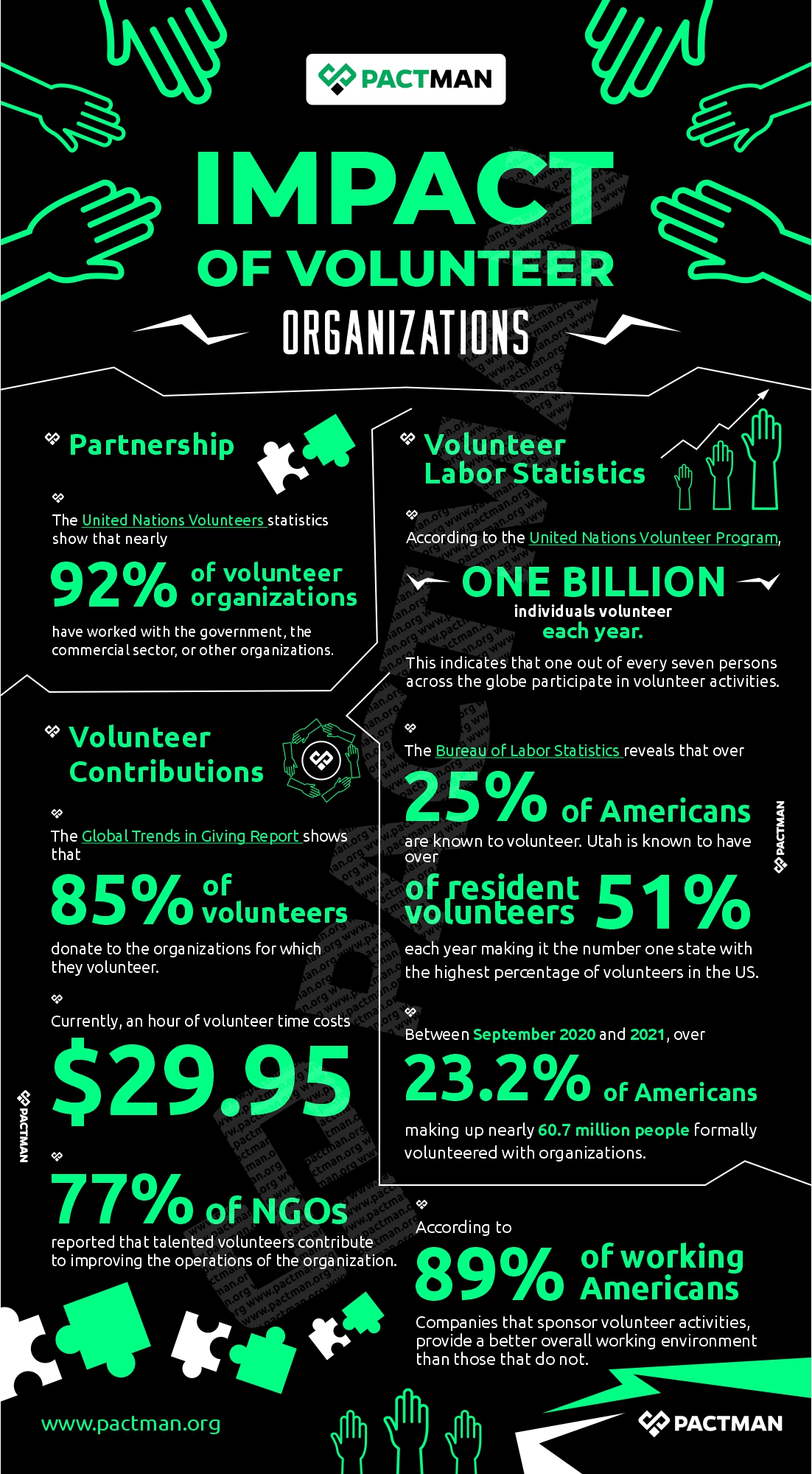
The United Nations Volunteers statistics show that nearly 92% of volunteer organizations have worked with the government, the commercial sector, or other organizations. In many impoverished and rural areas, several public services are still unavailable to residents. However, with the help of volunteer organizations, these entities have been able to address these voids.
Statistics on Volunteer Organizations
b.Volunteer Impact
The Independent Sector report shows that over $200 billion comes from the contribution of volunteers to the US economy. This reveals their remarkable impact not just on society but also on the economy.
c. Volunteer labor statistics
According to the United Nations Volunteer Program, one billion individuals volunteer each year. This indicates that one out of every seven people across the globe participates in volunteer activities. Also, the Bureau of Labor Statistics reveals that over 25% of Americans are known to volunteer. Utah has over 51% of resident volunteers each year, making it the number one state with the highest percentage of volunteers in the US.
Between September 2020 and 2021, over 23.2% of Americans, making up nearly 60.7 million people, formally volunteered with organizations.
d. Volunteer Contributions
The Global Trends in Giving Report shows that 85% of volunteers donate to the organizations for which they volunteer. Currently, an hour of volunteer time costs $29.95. Also, 77% of NGOs reported that talented volunteers contribute to improving the operations of the organization. According to 89% of working Americans, companies that sponsor volunteer activities provide a better overall working environment than those that do not.
e. Volunteer Data
A study of over 3,000 nonprofit workers conducted by Software Advice revealed that 70% of responding organizations believed in the importance of volunteer data in impacting their programs. However, more than half of organizations do not track the impacts of volunteers. 34% of organizations reported that the lack of resources constituted the major impediment to measuring volunteer impact.
Among the 45% of organizations that reported the lack of volunteer impact measurement, 34% disclosed that it was due to the lack of resources and tools. 29%, on the other hand, reported that the lack of skills or knowledge was the major hindrance. Lastly, 25% reported that their primary hindrance was a lack of time among staff members.
V
Benefitsof Volunteering
According to a poll conducted by Johns Hopkins, almost 140 million people in 37 countries engage in volunteer work. This equates to about 20.8 million full-time employees when volunteer organizations are included. Volunteering is a crucial component of community development in general. It brings together people who are passionate about improving their community. As a result, volunteer organizations will continue to rely on volunteers to build successful community programs and outreach.
Volunteer organizations
Thousands of nonprofit organizations rely entirely on volunteer contributions. This is especially true for non-profit organizations. Every year, one out of every four people in the United States participates in voluntary activities, resulting in increased service hours over time. In addition, another study found that between 2020 and 2021, 60.7 million Americans volunteered 4.1 billion hours.
1. Sustainable programs
Without the assistance of volunteers and volunteer organizations, communities would be unable to host large-scale events. Similarly, these events contribute to the generation of cash and other economic benefits for communities. Volunteers are important not just for the success of a community program, but also for making people feel more connected to their community.
2. Social change
Secondly, the goal of eradicating poverty and fostering wealth can not be realized without the participation of millions of volunteers who are properly encouraged and equipped. Volunteers contribute to the expansion of a variety of SDG-related services. When properly supported, volunteering allows some of the poorest, most marginalized, or most vulnerable populations to have access to services in health, education, and many other sectors, ensuring that no one is left behind. Volunteer organizations also provide public services to low-income and rural regions. In general, both parties contribute to community growth.
3. Nonprofit ambassadors
Volunteers donate their time and talents to organizations while also using their existing networks and connections. Without a doubt, volunteers can be the best ambassadors for an organization.
4. Community development
Volunteers make considerable contributions and play an important role in the development of resilient communities. Also, volunteering has a significant impact on long-term development. Volunteers develop solid, mutually beneficial personal and professional relationships by becoming rooted in communities. They have a mutual understanding of experience, abilities, and networks, allowing them to produce locally owned and sustainable solutions. Not to mention, they contribute to long-term capacity building procedures that are culturally and contextually relevant, courteous, effective, and sustainable. Volunteers promote the interchange of skills and knowledge, particularly in the areas of sound development, good governance, and civil society, as well as on more personal and philosophical levels between volunteers and their host organizations and communities.
In addition to having an impact on the gross domestic product, or GDP, the nonprofit sector employs millions of people, provides volunteer opportunities, and offers services.
To summarize, the economic impact of the volunteer sector (also known as the nonprofit or third sector) is substantial yet difficult to quantify. Given the nature of the nonprofit industry and its reporting requirements, accurate and complete figures are difficult to estimate.
Even after staff leave, volunteers can have a long-term impact on communities. Also, whether it’s the money saved by donating hours, the connections that bring organizations together, or the much-needed services provided by volunteers, community service programs have a measurable impact. All activities help to improve community development.
VI
Top Five Volunteer Organizations Globally
Volunteer organizations
a.Global Volunteers
Global Volunteers takes a constructive, innovative approach to overall human and economic development. They leverage the world’s infinitely renewable resource – volunteers – to accelerate change while always working under the guidance of competent local leaders.
Since 1984, the organization has brought genuine human and economic development to hundreds of communities in 35 countries across six continents. Global Volunteers promotes and facilitates volunteers in working with and learning from local people in places all around the world. Essentially, they prioritize the needs, dreams, and plans of the people in a community. Then, they organize volunteers to collaborate with them on their community’s goal of serving adolescents and families.
Global Volunteers works to build, nurture, and sustain the well-being of the world’s children and communities, allowing them to reach their full human potential. The organization was one of the first short-term volunteer organizations to be awarded Special Consultative Status with the United Nations in 1999.
Global Volunteers is committed to laying the groundwork for global peace via mutual international understanding.
b.Catchafire
Catchafire is committed to assisting communities that are systemically disadvantaged and suffer greatly from a recession. The organization is completely dedicated to the needs of organizations and the people they serve. Also, staff members are empowered to provide tailored professional development trainings, community building on the ground, and facilitated peer-to-peer learning. Their expert volunteer network provides professional services such as fundraising, financial planning, human resources, and more.
Catchafire provides nonprofits with 24/7 access to volunteers, regardless of their size, funding, or location. 65% have prior experience working with charities and over a decade of experience strengthening charities through trust and capacity-building skills.
c.Oxfam
Oxfam is a global movement of individuals striving to end poverty. Their program entails addressing the inequity that keeps people poor. During a calamity, they work together to save, protect, and rebuild lives. Also, they assist people in creating better lives for themselves as well as others. Oxfam addresses topics such as land rights, climate change, and gender discrimination.
The movement operates across regions in about 70 countries, with thousands of partners and allies, to help people develop better lives, increase resilience, and protect lives and livelihoods even during times of disaster.
Oxfam is an expert at transferring the goodwill and commitment of people who care into immediate, effective, and long-term change for people experiencing the everyday misery of poverty. The organization is always looking for passionate people to help mobilize their communities in the fight against hunger, poverty, and social injustice.
d.WWOOF
Worldwide Opportunities on Organic Farms (WWOOF) is a global movement that connects visitors with organic farms, promotes cultural and educational exchange, and works to develop a global community that values ecological farming and sustainable principles.
WWOOF allows people to learn about organic food, farming, and culture. As a result, it draws together people with similar ideals and views. WWOOF strives to assist its hosts while also educating guests on what it means to cultivate one’s own food in a sustainable manner.
The organization is on a mission to provide people from all around the world with the opportunity to develop practical skills in organic farming and gardening.
WWOOF was established in the United Kingdom in 1971 and is one of the world’s earliest educational and cultural exchange organizations. WWOOF is now present in over 130 countries (and counting). The organization functions on a local level; thus, if you want to join, please contact the national WWOOF organization directly.
e.Do Something
DoSomething is one of the largest NGOs dedicated solely to young people and social change. The organization has inspired millions of young people in every U.S. area code and 189 countries to take action to better their communities.
DoSomething members work together to take action on issues that affect them and their communities through campaigns and activities.
Also, members’ cumulative participation in volunteering, social change, and civic action programs has made and inspired long-lasting changes across communities. This includes the donation of 1.2 million period products to shelters and those in need since 2016. Also, since 2015, the organization has cleaned up 4.7 million cigarette butts to safeguard the environment and has increased youth voting turnout by 415,222 registered voters.
Members of DoSomething are not only passionate about making a difference in their communities; they are also influential in debates that enhance understanding of the issues they care about.
Conclusion
The majority of volunteer groups have no paid staff and are totally administered by volunteers. Also, some non-profit organizations may only require a few volunteers every year. Others, on the other hand, may necessitate the participation of hundreds of volunteers each day.
Volunteers, as a whole, help their communities by providing critical services that contribute greatly to economic stability and mobility.
Volunteers are a priceless asset, and many charity organizations would be unable to carry out operations, receive funds, or serve clients without their support. Also, the vast majority of board members in philanthropic organization boards are volunteers.
In the current nonprofit environment, organizations are increasingly relying on technology to enhance donor interaction, ensure compliance, and streamline operations. The Pactman Nonprofit CheckPlus API […]
TABLE OF CONTENTS Introduction Overview of Nonprofit Grant Options Critical Statistics on Nonprofit Grants in the U.S. Nonprofit Grants in Washington Nonprofit Grants in Alabama […]
TABLE OF CONTENTS Introduction Nonprofit Funding Gaps in Africa Critical Statistics on Nonprofit Grants Local vs International Nonprofit Grants in Africa: A Comparative Analysis Overview […]
Jewish charities continue to gain ground in numbers. These Jewish charities carry out numerous functions through their passionate endeavours to serve not only the Jewish […]
The term “best charities to donate to” describes impactful nonprofit organisations deserving of your support. This article researches the top nonprofits in Singapore. This article […]
Donating furniture is an excellent way to reduce waste and provide assistance to those in need. Numerous charitable organisations can be considered when you want […]