How to Simplify Your Online Charity Donation Strategy
Cersai Stark
I
Introduction
The irony of affluence characterizes the contemporary state of online charity donation. Donors now have greater access to financial vehicles, giving platforms, and nonprofit data than ever before. However, this abundance has led to a state of philanthropic friction that often impedes decision-making and lessens effectiveness. Finding a cause is no longer as difficult for the modern philanthropist as handling the intricacy of the donation.
Charity Donation Strategy
Fragmented data, administrative burdens, and a lack of a coherent giving thesis frequently cause a reactive posture, where donations are motivated by the immediacy of an appeal rather than the intentionality of a strategy. Now more than ever, the “write-a-check” model’s transactional aspect must be abandoned in favor of a systems-thinking strategy. Essentially, this balances individual values with organizational effectiveness and thorough impact analysis to streamline charitable giving.
II
The Complexity of Modern Philanthropy in Online Charity Donation
It is necessary to precisely identify the causes of a strategy’s complexity before it can be made simpler. Essentially, three factors are the main causes of complexity in philanthropic giving:
Financial inefficiency,
Psychological disengagement, and
Administrative fragmentation.
Charity Donation Strategy
Non-profits often struggle at the organizational level with fragmented information and antiquated databases. This unintentionally makes the donation experience more difficult. Hence, the organization or the donor can’t keep a 360-degree perspective of the relationship when donor data, such as event participation, volunteer hours, and donation history, is dispersed across several systems. This disarray results in impersonal, repetitious outreach that overlooks the donor’s specific connection to the cause.
From the donor’s point of view, this complexity appears as a friction that transforms a charitable deed into a chore. According to research, donors are much more likely to disconnect if they find it difficult to stay active. This may be a result of cumbersome donation forms, a dearth of digital payment choices, or an overwhelming number of disorganized solicitations. This is especially true in emergencies, as donor dispersion results in gaps in service delivery and redundant attempts that squander crucial resources. In such situations, a donor’s lack of a cohesive approach may confuse recipients and reduce the overall efficacy of humanitarian efforts.
a. Operational Cost Of Disorganized Giving
A disorganized charity giving plan has significant hidden expenses for the individual benefactor. Time that could be better used for high-level strategy or community participation is wasted managing numerous tax receipts, answering a never-ending flood of year-end appeals, and trying to manually track the effectiveness of hundreds of minor grants. Additionally, irregular donations frequently result in the loss of substantial tax benefits. Smaller annual donors may find themselves on the edge of the standard deduction, meaning their contributions are no longer tax-deductible.
Source of Complexity
Impact on the Donor
Resulting Inefficiency
Data Fragmentation
Loss of a unified view of historical contributions.
Inaccurate reporting and skewed financial planning.
Administrative Friction
Excessive steps required to manage or update recurring gifts.
Donor lapse and psychological disengagement.
Siloed Communication
Impersonal, non-segmentized outreach from non-profits.
Decreased trust and a sense of being undervalued.
Financial Disorganization
Timing of gifts does not align with tax-optimal years.
Lost opportunities for itemization and deduction maximization.
Security/Compliance Risks
Personal data stored in multiple, potentially insecure systems.
Increased vulnerability to data breaches and privacy issues.
III
Critical Statistics on Charity Donation Strategies
In this section, we will consider critical statistics on charity donation strategies and their impact on the nonprofit sector.
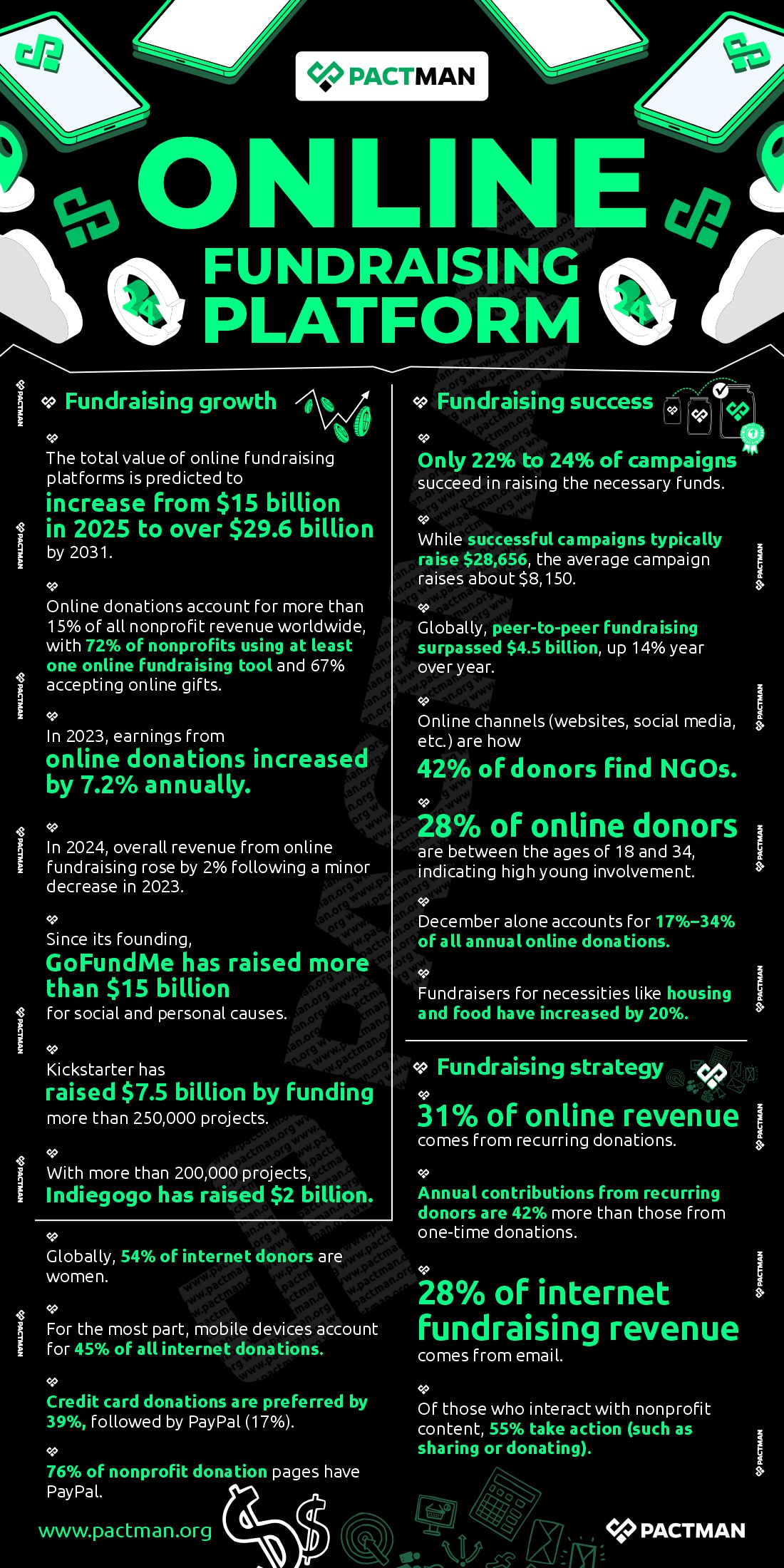
Since its founding, GoFundMe has raised more than $15 billion for social and personal causes. Kickstarter has raised $7.5 billion by funding more than 250,000 projects. With more than 200,000 projects, Indiegogo has raised $2 billion.
Online Fundraising Platform
b. Fundraising success
Only 22% to 24% of campaigns succeed in raising the necessary funds. While successful campaigns typically raise $28,656, the average campaign raises about $8,150. Globally, peer-to-peer fundraising surpassed $4.5 billion, up 14% year over year. Online channels (websites, social media, etc.) are how 42% of donors find NGOs. Also, 28% of online donors are between the ages of 18 and 34, indicating high young involvement.
31% of online revenue comes from recurring donations. Annual contributions from recurring donors are 42% more than those from one-time donations. Also, 28% of internet fundraising revenue comes from email. Of those who interact with nonprofit content, 55% take action (such as sharing or donating). Globally, 54% of internet donors are women.
For the most part, mobile devices account for 45% of all internet donations. Credit card donations are preferred by 39%, followed by PayPal (17%). All in all, 76% of nonprofit donation pages have PayPal.
IV
Methodical Approach to Mission Development
Creating a mission statement requires striking a balance between goal-setting and self-reflection. Rather than just a declaration of what one wants to accomplish, it is a description of what one wants to be as a philanthropist. A values distillation exercise is the first step in the process. In this case, a long list of possible priorities is reduced to three fundamental ideas. The approach as a whole is then unified by these fundamental principles.
Charity Donation Strategy
Here is a five-step process for developing a mission statement that offers a course of action:
Think Back on Guided Questions: List the customs, occasions, and individuals that influenced your viewpoint. What issues do you want to solve in society? Are there specific populations or geographic places that I am especially called to serve?
Describe the “What” and the “How“: Steer clear of general phrases like “helping the needy.” Rather, speak precisely. For example, “Enabling at-risk youth to achieve financial independence through STEM education and mentorship.” This outlines the method as well as the objective.
Set Operational Guidelines: Determine when the impact will occur. Do you plan to leave a lasting legacy, or will you donate all of your funds while you’re still alive? Which would you prefer: numerous smaller, community-based donations or a few major, revolutionary grants?
Draft and Edit: The mission statement should be no more than one to four sentences. It should be clear enough for a third party (such as a potential trustee) to comprehend your objective without additional explanation and recall enough to recite.
Involve Trusted Partners: The mission statement should be a joint effort if giving includes a spouse or family. This creates customs based on common values and guarantees that the next generation is ready to take up the mantle.
V
The “Three Big” Philanthropy Watchdogs
For a quick evaluation, there are primary instruments that provide distinct perspectives on nonprofit health.
Charity Donation Strategy
GuideStar (Candid): Offers openness by making accessible IRS Form 990s, board lists, and income information. It is the gold standard for confirming the financial transparency and tax status of a non-profit.
GiveWell: prioritizes cost-effectiveness. GiveWell’s extensive research on global health initiatives is the main source of information. For example, it can be used to determine “how many lives can I save per dollar.” This instrument evaluates the general health of an organization.
Leadership & Adaptability, and Culture & Community.
The Five-Point Assessment List
In addition to external ratings, donors should search for specific signs of a strong non-profit during their own evaluation:
Clarity of Purpose: Does the organization’s mission statement correspond with its strategic plan and actual programs?
Measurement of Results: Does the nonprofit monitor results (meaningful life change) or outputs (number of persons served)? Organizations that are effective go beyond the story to provide quantifiable outcomes.
Accountability and Trust: Are donors viewed as partners by the organization? Do they give prompt, honest answers to questions?
Devoted Leadership: Are the employees and board members well-qualified? Do the board members personally make financial contributions to the organization?
Financial Sustainability: Does the organization rely on a single significant funder, or do they have a variety of revenue sources? Do they undergo independent auditing?
VI
Top Platforms for Giving and Fundraising
The donating experience can be greatly improved by choosing the ideal platform. Several contemporary platforms provide a single spot for giving and engagement, enabling donors to independently obtain year-end tax returns and follow their whole giving history.
Platform
Best For
Key Simplified Features
Donorbox
Recurring Giving
Fast checkout, AI-powered management, and automated donor communications.
Givebutter
Social/Community Giving
All-in-one fundraising, donor-covered fees, and seamless mobile experience.
GalaBid
Event-Based Giving
Integrated ticketing, silent auction software, and real-time health checks.
Classy (GoFundMe Pro)
Scalable Campaigns
Intelligent “Ask Amounts” based on donor history and intuitive drag-and-drop interfaces.
Bono
Tech-Forward Philanthropy
Blockchain integration for transparency and real-time impact tracking.
Bloomerang
Relationship Building
An “engagement meter” that helps donors see their own dedication to a cause.
Conclusion
Simplifying a philanthropic giving approach is a constant process of alignment rather than a one-time action. By developing a clear giving thesis, choosing the appropriate structural vehicle, and utilizing contemporary financial and technology resources, a donor can transform generosity from a cause of stress to a source of profound fulfillment. This motivates donors to take immediate action to protect their tax advantages and stabilize financing for the causes that are most important to them.
In the end, a more straightforward approach enables the donor to get down to the core of the issue: the desire to improve the world and human connection. For the most part, giving becomes effortless and impactful when it is done with focus and organization.
In the current nonprofit environment, organizations are increasingly relying on technology to enhance donor interaction, ensure compliance, and streamline operations. The Pactman Nonprofit CheckPlus API […]
TABLE OF CONTENTS Introduction Overview of Nonprofit Grant Options Critical Statistics on Nonprofit Grants in the U.S. Nonprofit Grants in Washington Nonprofit Grants in Alabama […]
TABLE OF CONTENTS Introduction Nonprofit Funding Gaps in Africa Critical Statistics on Nonprofit Grants Local vs International Nonprofit Grants in Africa: A Comparative Analysis Overview […]
Climate change remains a recurring challenge, and organisations that address this need are worthy charities to donate to. As temperatures continue to rise with the […]
One of the outstanding charities to donate to are organisations that address global poverty. Their work goes beyond just providing relief to the poor. They […]
When considering charities to donate to, good options are organisations that provide support to children. They are real abodes of hope. Perhaps you have ever […]