Nonprofit organisations work in complex contexts with a variety of stakeholders, limited resources, and varied goals. Hence, performance management is an essential function. However, organisational performance cannot be improved by performance management systems alone. The rating systems employed must be legitimate and dependable to successfully distinguish between different performance levels and guarantee that performance management systems have a beneficial impact on organisational performance.
Performance Management
A few of the several functions of performance management systems in nonprofits are similar to those in the for-profit context. These include translating organisational goals to individual activities, assessing employee engagement, legal mitigation, job design, career planning, and strategic decision-making regarding employee promotion, development and training, compensation, retention, and termination.
Although performance management techniques, such as appraisals, are acknowledged to have benefits, nonprofit organisations’ use of them varies greatly both domestically and abroad.
This article will examine in detail the elements and functions of performance management in nonprofit organisations.
II
What is Performance Management?
Performance management in nonprofit organisations is a methodical approach to planning, tracking, and assessing the performance of individuals, groups, and the organisation at large. Coordinating operational activities with organisational goals guarantees that resources are employed as efficiently as possible to get the intended results.
Performance Management
Essentially, this paradigm encompasses continuous improvement, feedback mechanisms, performance monitoring, and goal planning. Performance evaluations are thought to be an essential part of any system for managing performance. Hence, to guarantee performance improvements, managers and staff must maintain constant contact.
Also, performance management is the ongoing process of identifying, evaluating, and improving both individual and team performance. By and large, the goal is to coordinate performance to align with the organisation’s strategic objectives. Effective performance management, and performance appraisals, in particular, have a favorable impact on managers, staff, and organisations.
For a long time, the for-profit industry has considered performance management and performance reviews essential to good strategic human resource management (SHRM). However, the unique structure of nonprofits may make it difficult to adopt performance management techniques designed for the for-profit industry.
Among the essential components of nonprofit performance management are:
Mission-Centric Objectives: Prioritising the accomplishment of goals related to the organisation’s mission over monetary gains.
Stakeholder accountability: This entails meeting the expectations of board members, funders, and beneficiaries.
Measuring outcomes: For nonprofits, it entails paying more attention to observable social impacts rather than numerical financial figures.
III
Critical Statistics on Performance Management
This article will consider critical statistics on performance management to guide nonprofits in their strategy.
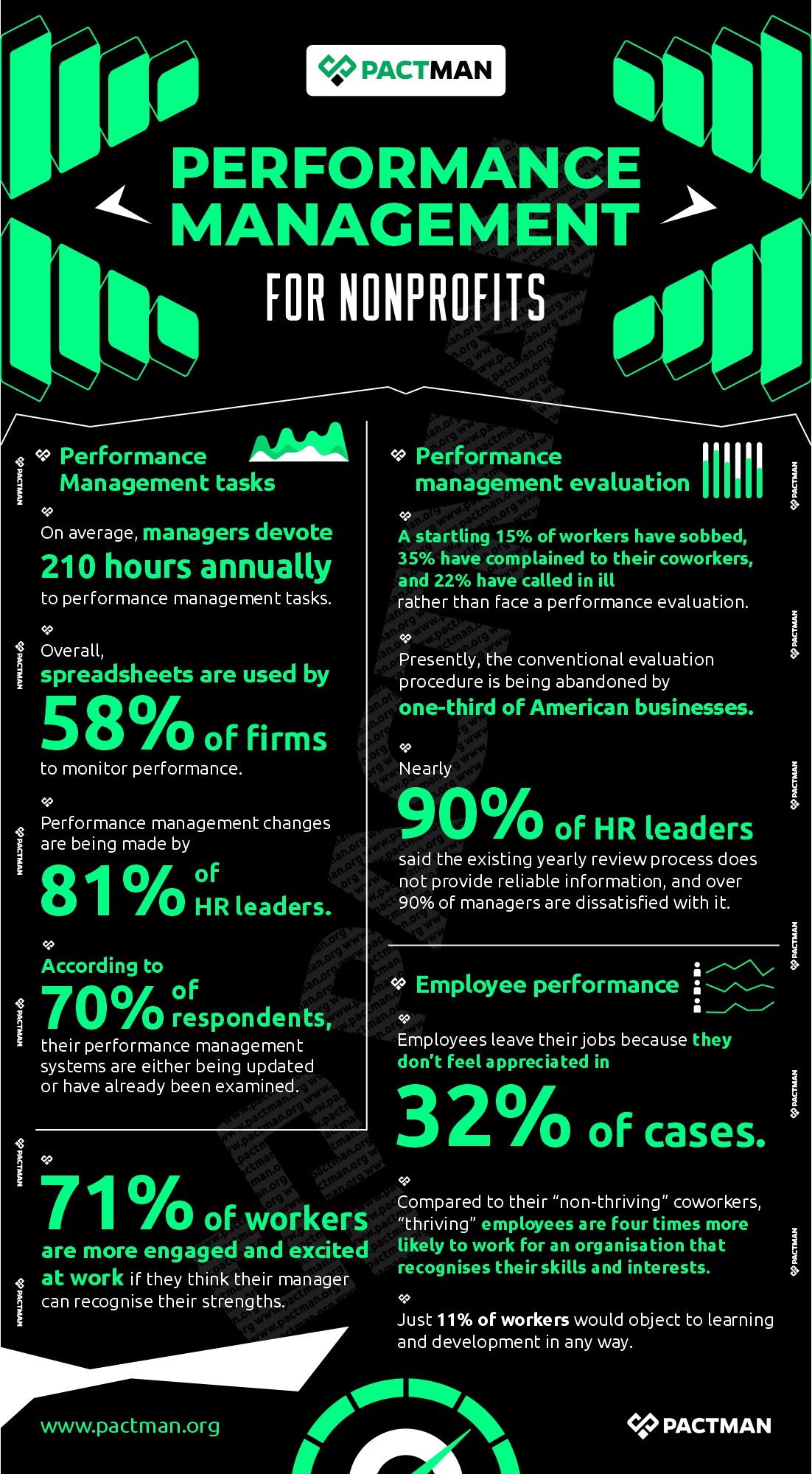
Also, performance management changes are being made by 81% of HR leaders. According to 70% of respondents, their performance management systems are either being updated or have already been examined.
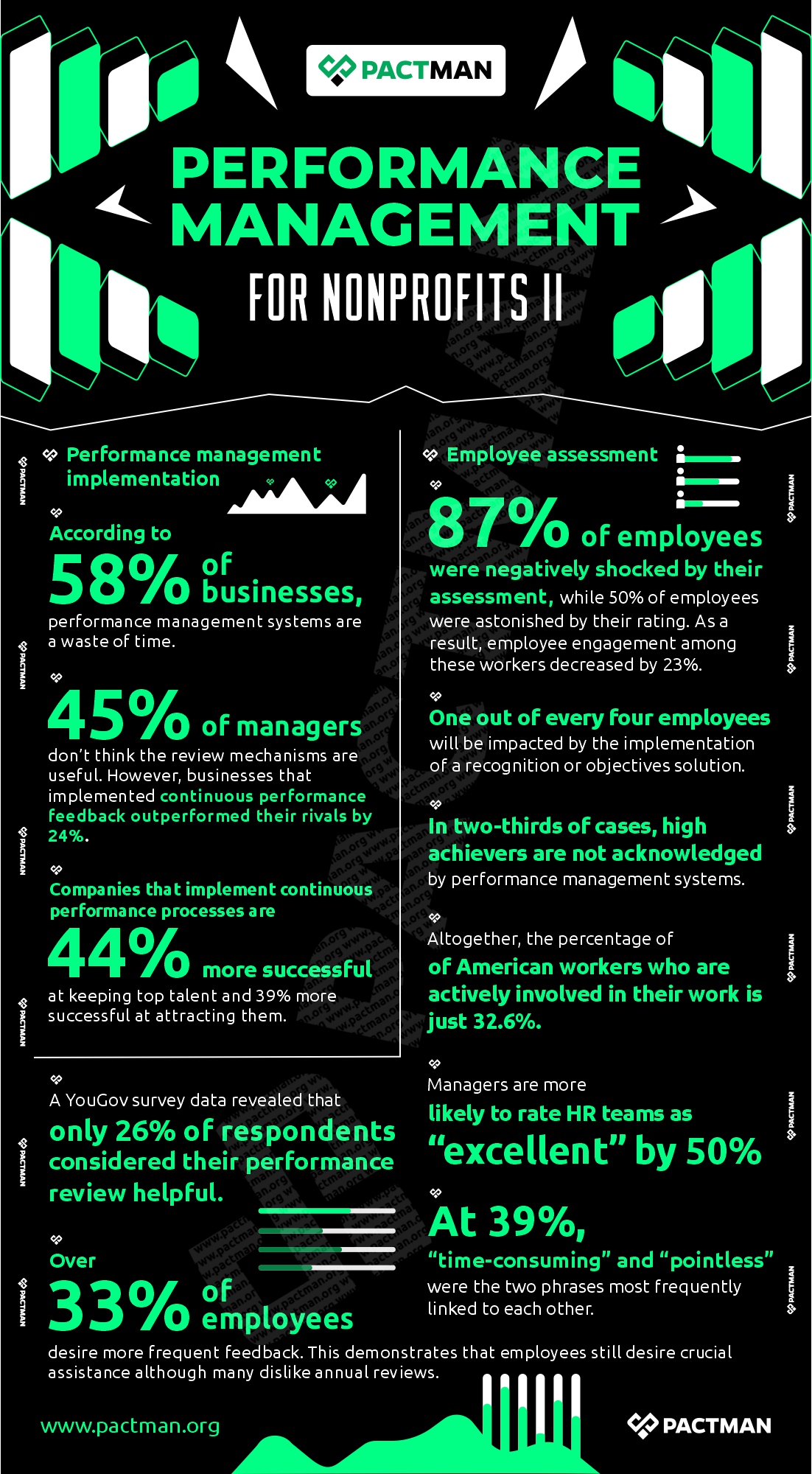
87% of employees were negatively shocked by their assessment, while 50% of employees were astonished by their rating. As a result, employee engagement among these workers decreased by 23%. One out of every four employees will be impacted by the implementation of a recognition or objectives solution.
A YouGov survey data revealed that only 26% of respondents considered their performance review helpful. The Survey examined participants’ associations between various words and their performance evaluation. At 39%, “time-consuming” and “pointless” were the two phrases most frequently linked to each other. Over 33% of employees desire more frequent feedback. This demonstrates that employees still desire crucial assistance although many dislike annual reviews.
IV
Indicators/Metrics of Sound Performance Management
Similar to for-profit businesses, nonprofits must identify their primary success metrics. Although non-profit organisations have a wide range of stakeholders, there is a need to identify critical performance indicators and build performance management systems around them. A few examples of the criteria include the number of clients or customers they serve, program performance, financing increase, participation increases, community awareness increases, and community partnerships.
Nonprofit Management
Also, the mission and goals of the organisation must align with the performance standards of its employees, regardless of the performance indicators used. By and large, the nonprofit’s performance management system is built upon this alignment.
The components of performance management systems include
the development of work descriptions
the establishment of job standards
the function of coaching and supervision for performance and
performance appraisal systems
Also, it is best to use thorough job descriptions as a foundation for performance. Performance standards can then be created in the following stage. By these norms, an employee is guided toward acceptable or even exceptional performance levels. Effective management oversight and coaching are required after performance criteria have been established. This is to guarantee that staff members comprehend the requirements, have the tools necessary to meet them, and can be assessed based on their development.
Afterwards, performance can be evaluated using tools associated with the job description and standards.
V
Elements of Performance Management
This section will examine the three elements of performance management systems for nonprofits which include:
Job performance standards and job descriptions
Performance coaching and supervision; and
Tools and processes for performance evaluation
Nonprofit Management
a. Job Performance Standards and Job Descriptions
Job performance standards and job descriptions outline the extent of the work to be done, the outcomes anticipated, and the performance level needed to do the work satisfactorily for both the organisation and the individual employee. Without a doubt, there is a close relationship between job descriptions and performance standards. One establishes the task that must be performed, while the other establishes the acceptable level of work quality.
Job descriptions
For job descriptions to be a useful part of a performance management system, they must be sufficiently precise to outline the fundamental duties of the position and the particular skills needed for it. Likewise, using job descriptions as a starting point, supervisors and employees can debate the “fit” between the job and the candidate or employee.
Expert management instructors have long maintained that a strong job description is the first step toward increasing productivity. Regretfully, the majority of job descriptions are not intended to inform individuals about their responsibilities, but rather to determine the position’s value. Typically, responsibilities are explained instead of work-related actions.
Job performance standards
Secondly, job performance standards outline the way that an individual’s performance helps the organisation achieve its performance goals. A small set of performance criteria, often ten to twelve indicators, are frequently examined by corporate boards. Since the goals are related to the duties described in the job description, these organisational performance indicators ought to be included in job performance standards.
Also, the formulation of job performance standards is aided by several relevant queries. Every standard ought to be connected to a particular work task. Hence, some questions must be answered. What is the task to be accomplished should be your first question. Next, how should the job be performed? Third, what would excellent or the best possible performance look like? Lastly, what does minimally acceptable performance look like?
The creation of job performance criteria will be aided by these inquiries.
b. Performance Coaching and Supervision
The two main pillars of a performance management system are coaching and supervision. Frederick W. Williamson’s work from the 1880s is where modern ideas of supervision began. There were more disputes between employees and business owners in the 1880s. Although workers were receiving oversight, employers still had to deal with inefficiency, negligent safety, and output drops. Workers were perceived as being indolent, uncooperative, or stupid. As a result, programs for incentives were established, but the outcomes remained unchanged.
According to Taylor’s theory, incentives wouldn’t be effective unless they were combined with worker-friendly, well-planned, and efficient tasks. This theory opined that the purpose of management was to help and encourage the employees. Consequently, managers should specify the precise duties and decide who is most qualified to complete them. With Taylor’s method, management and employees were held accountable for each other’s output.
It can be challenging to go from being solely in charge of one’s work to being in charge of others’ work. In addition to the tasks that need to be completed, supervisors must be aware of the performance standards and the time of completion of those tasks. Three fundamental responsibilities of supervisors are:
to know what has to be done,
who will do it, and
how it will be done.
In addition, organisations need clear accountability structures in order to achieve the required performance levels. Every organisation’s employee possesses a wide range of skills, talents, and abilities. All in all, managers and employees must give the same responses when asked what their jobs entail.
Situational management
In what ways does a supervisor collaborate with the diverse workforce within an organisation to achieve the goals of the organisation? The answer is situational management. By and large, the foundation for productive interactions with a diverse range of employees, each with varying assignments and duties and at varying stages of work readiness, is situational leadership. The theories of reinforcement and behaviour modification serve as the cornerstones of situational leadership.
Situational leadership uses three real-world applications of theoretical ideas as its foundation.
Lastly, the goal of “One-Minute Reprimands” is to address performance that falls short of expectations.
c. Tools and processes for performance evaluation
Managers can assess employees’ performance over time with the use of performance appraisal systems and tools. Performance reviews are often done regularly, but coaching is a process that starts right away and continues over time.
However, an official performance review meeting shouldn’t surprise workers. If the manager-employee relationship has been characterised by effective performance planning, continuous coaching, and supervision, then the performance evaluation process should be viewed by both parties as a review of the events that have occurred during the review period.
To begin with, an employee should receive a clear message from a formal performance assessment about the organisation’s values, the behaviours and contributions that are rewarded, and the performance requirements. This should also explain how effective performance is defined in the organisation.
Employee remuneration is also increased through the official performance review process.
Consequences of inefficient performance evaluation
Oftentimes, managers complain that the performance review processes in their organisations are inefficient. For the most part, ineffective performance evaluation systems have 10 major repercussions:
Employee demotivation
Time waste or decreased production
A strained working relationship between the management and subordinates
Hinders the growth of employees
Irritates managers
Foster’s criticism and unfavourable sentiments
Produces erroneous performance records
Undermines the pay-for-performance relationship
Raises the possibility of employee appeals or legal action and
Undermines the organisation’s HR department’s credibility.
Organisations continue to put off revamping their performance appraisal system despite the challenges posed by inferior performance management systems. There are two primary causes for the redesign: either the organisation is being taken over by a new leadership regime, or there are tensions and discontent with the current structure resulting in an organisational disaster.
Performance appraisal instruments
Oftentimes, managers who feel that their most recent performance reviews are unfair tend to respond more positively to the introduction of a more equitable or procedurally just system than managers who do not. However, managers and supervisors should not be in charge of or responsible for conducting effective performance reviews.
All in all, performance reviews are shown to be more favourable when workers can express associations that are both job-focused and supervisor-focused. It has been shown that employees’ performance reviews are more favourable when they align with their supervisor’s goals or concepts of excellent work and explicit job requirements.
Even when performance standards are fulfilled, performance reviews are less fair when workers are unable to relate to their supervisor’s priorities or viewpoints. This would suggest that the employees can influence or impact the performance review process. In light of these conclusions, how is performance measured accurately in a performance appraisal tool?
1. Test-retest: This is the process of taking the same measurement twice at two different times and comparing the results. If the device is accurate, the outcomes ought to be essentially the same.
2. Alternative Form: This is the use of multiple, identically filled variants of the measurement tools. In this case, similar outcomes with a strong connection point to a trustworthy tool.
3. Split Half: This refers to the technique of splitting an instrument in half and giving each half at two distinct times a high correlation between the two halves suggesting dependability.
4. Internal Consistency: This is the process of looking at how the test alternatives relate to one another.
As can be seen, increasing measurement reliability can lead to more accurate and efficient performance evaluation tools. This in turn can lead to more accurate performance evaluation procedures. However, while it is feasible to create an instrument that measures precisely, it is challenging to identify which data have meaning. The necessity of connecting performance to the organisation’s financial results and ensuring that staff members understand this relationship is more important than the precision of the tool used to measure performance.
In conclusion, the performance management system must include performance standards. Organisational performance and overarching corporate objectives must also be connected to the performance criteria. Managers and staff should use the same organisational language when expressing their perspectives on individual and organisational performance.
Also, employees can perceive the organisational “big picture” as essential to achieving organisational goals if performance appraisal methods are directly tied to organisational success.
Conclusion
Nonprofit organisations need performance management to accomplish their goals and make a significant impact. Hence, to increase their accountability, effectiveness, and efficiency, organisations must carefully plan, track, assess, and refine their operations. By and large, performance management offers distinct opportunities to improve procedures, tackle obstacles, and strengthen relationships with stakeholders. These all contribute to long-term success and constructive societal change.
2 responses to “Nonprofit Guide to Performance Management”
[…] to uphold accountability criteria. In order to properly manage the project, there must be performance management systems that guarantee a timely collection of the required […]
In the current nonprofit environment, organizations are increasingly relying on technology to enhance donor interaction, ensure compliance, and streamline operations. The Pactman Nonprofit CheckPlus API […]
TABLE OF CONTENTS Introduction Overview of Nonprofit Grant Options Critical Statistics on Nonprofit Grants in the U.S. Nonprofit Grants in Washington Nonprofit Grants in Alabama […]
TABLE OF CONTENTS Introduction Nonprofit Funding Gaps in Africa Critical Statistics on Nonprofit Grants Local vs International Nonprofit Grants in Africa: A Comparative Analysis Overview […]
Homeless charities act as guiding lights for those in need. One of their missions is to establish sanctuaries that welcome communities facing distress from around […]











2 responses to “Nonprofit Guide to Performance Management”
[…] to uphold accountability criteria. In order to properly manage the project, there must be performance management systems that guarantee a timely collection of the required […]
[…] continuous performance management by the intermediary is necessary to assess a bond’s progress. In order to avoid a complete […]