


I
Introduction
A basic misconception about organizational growth has historically impeded the goal of scaling social impact or economies of scale in the United States. For many years, the standard method of growing a nonprofit has been a linear, brute-force expansion of programmatic activities. This method assumes that serving more people necessitates a corresponding increase in funds, staff, and physical footprint. However, such an operating paradigm is very unsustainable and often results in localized programmatic failures, severe administrative bottlenecks, and regional dispersion.

The realization of economies of scale is an economic theory wherein an organization lowers its average cost per unit by spreading out fixed operational expenses over a growing amount of output. Essentially, this is what propels growth in the private sector. Many nonprofit executives are still quite sceptical of this idea. They believe that raising productivity will unavoidably result in lower-quality services. However, social sector organizations can consistently reduce unit costs while preserving or even raising the quality of their results. This could be achieved by reorganizing programs to separate fixed administrative costs from variable delivery costs.
II
Critical Statistics on Economies of Scale
In this section, we will consider critical statistics on economies of scale and the impact across sectors.
1. Organizational productivity
According to an OECD report, companies with more than 250 workers in OECD nations generate around twice as much per hour as those with 10–19 workers. Typically, large companies are 75% more productive than medium-sized businesses and 33% more productive than businesses with 100–249 workers.
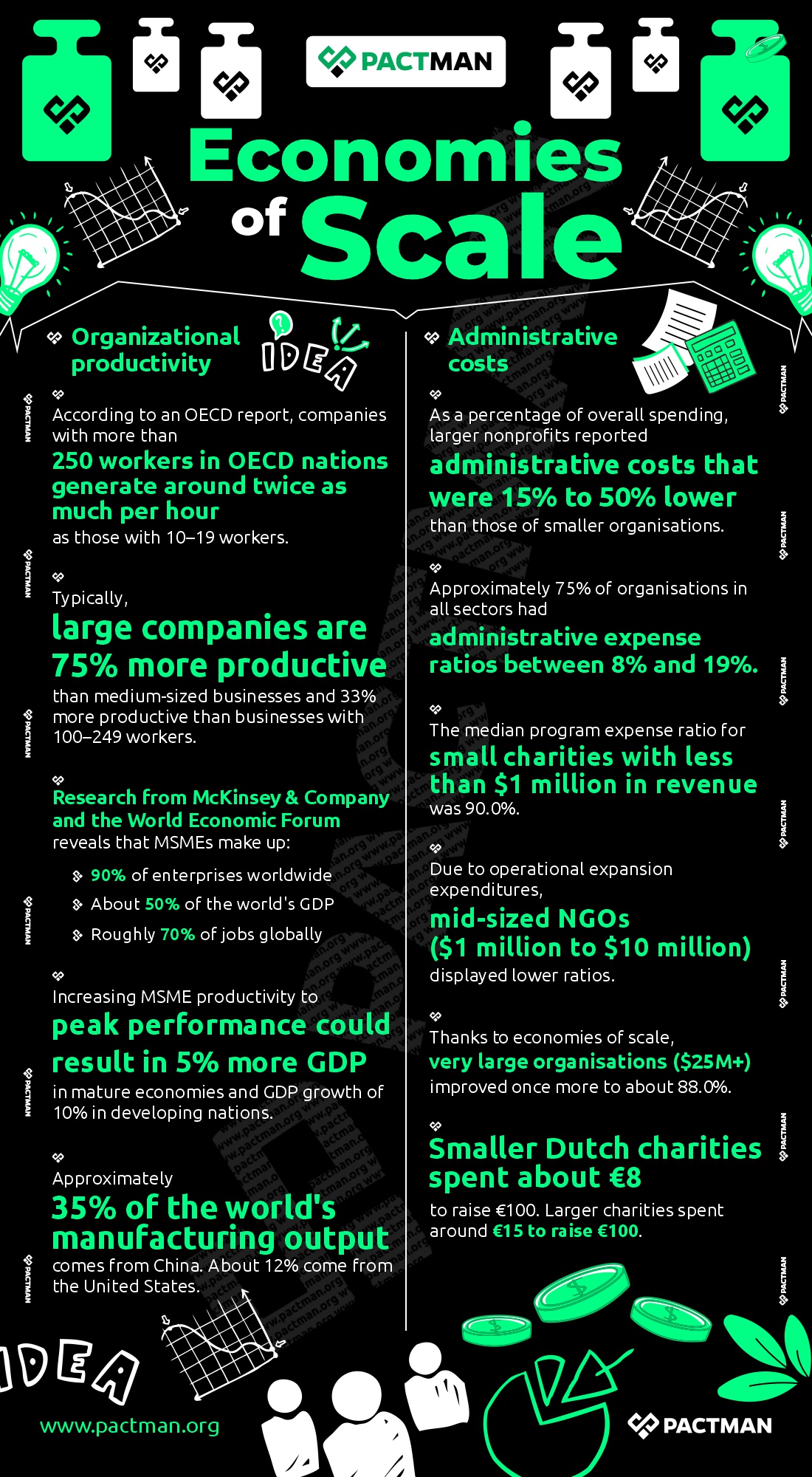
Research from McKinsey & Company and the World Economic Forum reveals that MSMEs make up:
- 90% of enterprises worldwide
- About 50% of the world’s GDP, and
- Roughly 70% of jobs globally
Increasing MSME productivity to peak performance could result in 5% more GDP in mature economies and a GDP growth of 10% in developing nations.
Approximately 35% of the world’s manufacturing output comes from China, and about 12% come from the United States.
2. Administrative cost
As a percentage of overall spending, larger nonprofits reported administrative costs that were 15% to 50% lower than those of smaller organizations. Approximately 75% of organizations in all sectors had administrative expense ratios between 8% and 19%. The median program expense ratio for small charities with less than $1 million in revenue was 90.0%. Due to operational expansion expenditures, mid-sized NGOs ($1 million to $10 million) displayed lower ratios. Thanks to economies of scale, very large organizations ($25M+) improved once more to about 88.0%.
A smaller Dutch charity spent about €8 to raise €100. Larger charities spent around €15 to raise €100.
III
The Economic Mechanics of Scaling Social Impact
The definition of productivity needs to be completely reoriented to apply economies of scale to the social sector. Productivity in conventional company operations is quantified as cost per output, such as the cost of a manufactured good per unit. However, it is deceptive to evaluate an organization based only on its cost per output in a mission-driven setting. True productivity is assessed by the cost per outcome. This evaluates the financial expenditure required to effect a long-term, positive change in a beneficiary’s life.
The Cost-Per-Outcome Dynamic
The cost-per-outcome equation describes the relationship between programmatic delivery, operational efficiency, and social impact.
Cost per outcome = Cost per output/success rate
This formula shows that an organization can improve its productivity and attain economies of scale in two different, non-exclusive strategic ways:
- Either it can lower the direct cost of producing each individual output or
- It can raise its overall success rate, which will turn a larger proportion of routine activities into successful results.
Helping households over the “empowerment line” is frequently the ultimate goal of this equation in the United States. The empowerment line, created by the McKinsey Global Institute, calculates the price of a basic basket of necessities for a modest standard of living, such as housing, healthcare, food, and transportation, so that people can concentrate on long-term self-sufficiency rather than just survival. This threshold is thought to be between $55 and $70 per person per day in the US. Highly coordinated, scalable interventions that address systemic affordability and workforce issues are necessary to reach this degree of economic inclusion.
a. Deepening for Depth versus Replicating for Breadth
Seldom is the route to scale linear. Hence, the conflict between scaling for depth and scaling for breadth must be managed by organizations. Scaling for breadth prioritizes geographic replication and market reach. This is achieved by using economies of scale to lower unit costs by servicing a greater number of beneficiaries across several locations. Conversely, scaling for depth promotes behavioural changes, community empowerment, and systematic policy reforms by addressing the structural underlying causes of social problems.
Instead of picking a single strategy, successful organizations use an emergent, non-linear “zig-zagging” process. In order to prevent expansion from surpassing the organization’s fundamental competencies, executives in this model alternate between expanding operations to reach new markets (breadth) and improving local program delivery to maximize success rates (depth).
IV
Structural and Operational Levers to Achieve Scale
Three main operational levers can be adopted by US organizations to end the cycle of famine and create a highly productive operational foundation.

1. Unifying the Programmatic Engine
Efficiency in operations is based on standardization. An organization’s procedures, training manuals, and curricula are all centralized and easily accessible throughout the network when it standardizes its program model. For instance, Jumpstart, a nationwide nonprofit organization dedicated to early education, standardized all aspects of its programming by gathering instructions into physical playbooks and a centralized digital intranet. Instead of wasting time repeating work, this enables field staff to quickly access tried-and-true instructional plans.
In a similar vein, Teach for America built a strong central database to record and share effective teaching techniques throughout its nationwide network. As can be seen, organizations can significantly cut down on the administrative time needed to carry out programs in two ways.
- By standardizing procedures and
- Preventing program quality from declining as they grow.
2. Managing Cost Drivers and Optimizing Compensation
Secondly, managing main cost drivers, especially personnel and overhead, demands a very disciplined approach in order to build economies of scale. For instance, as student enrollment increases, Year Up, a workforce development organization, keeps a close eye on its overhead ratios. The organization maintains a low cost per output by conducting thorough, site-by-site assessments of training stipend levels. The goal is to ascertain the minimal amount necessary to ensure strong student engagement and employer commitment.
Additionally, paying competitive rates and investing in top-notch employees lowers expensive staff turnover, balancing the early costs of hiring and onboarding.
In the US, where domestic labour is quite expensive, organizations can control administrative costs. This is by using affordable, specialized virtual support for scheduling, routine data input, and donor receipts. By eliminating the practice of paying operations-manager prices for administrative work, this approach frees up internal management to concentrate solely on high-impact strategic issues.
Also, nonprofit executives must understand that although private benefit is expressly prohibited by US tax regulations, organizations are entirely allowed to earn operational surpluses. For long-term sustainability, reinvesting these surpluses into core capacity and competitive compensation is a typical, business-oriented strategy.
3. Group Sourcing and Shared Services
Practically speaking, organizations can obtain instant cost savings by utilizing shared service models and Group Purchasing Organizations (GPOs). GPOs negotiate favourable terms and substantial volume discounts with national suppliers by pooling the purchasing power of several independent organizations. Over 95% of hospitals in the US healthcare system adopt this technique, which regularly saves businesses between 10% and 25% on purchasing expenses.
Furthermore, GPOs manage all aspects of the procurement process, including contract administration, negotiations, and requests for proposals (RFPs). This significantly lowers administrative burden among participating organizations. Consolidating back-office functions (such as payroll, human resources, compliance, and accounting) into a single shared service center facilitates the distribution of fixed operational costs over a much larger budget for regional affiliates or groupings of related organizations.
Higher Achievement, the national youth development nonprofit, effectively moved vital accounting, IT, and communication functions from its local affiliates to a centralized national office during its rapid growth phase, showcasing the effectiveness of a shared services model.
4. The McKinsey OCAT 2.0 Capacity Framework
Nonprofits can assess their operational strengths and pinpoint areas for improvement with the aid of the free, open-access McKinsey Organizational Capacity Assessment Tool (OCAT 2.0). The instrument assesses capacity across ten essential dimensions, organized in a pyramid framework.
To efficiently deploy the OCAT 2.0, organizations follow a standardized five-step timeline:
- Prepare: This involves identifying survey respondents (board members, leadership, and staff) and registering the organization online.
- Complete: Respondents rated the organization’s capability from “clear need for increased capacity” to “high level of capacity” in 10 basic areas.
- Reflect: Analyze survey results to identify operational strengths, flaws, and areas of disagreement.
- Debrief: Lead group talks among staff and leadership to align on results and prioritize capacity building.
- Act: Create and implement strategic goals and activities to leverage strengths and overcome capacity shortfalls.
To increase operational capacity, organizations can shift from a reactive firefighting condition to a proactive, systematic approach by using this tool.
Conclusion
As the nonprofit sector enters a new era, operational intelligence and financial resilience will be just as crucial as actual fundraising. Nonprofits that combine operational competence with a passion for their cause will have a bright future. In the end, economies of scale are not about growing only for the sake of growing. Organizations want to become more intelligent, sustainable, and capable of producing a significant influence on a large scale. Nonprofits that understand how to make the most of every dollar, every relationship, and every operational system in support of their goal will be the ones who prosper in a world with limited resources.