Corporate–Nonprofit Alliances: A New Playbook for Combating Global Warming Effects
Cersai Stark
I
Introduction
The current state of global climate action is increasingly characterized by a move from peripheral corporate social responsibility to the core of strategic operations. Now more than ever, the lines between the private sector’s profit-driven motivations and the nonprofit sector’s mission-oriented objectives have blurred.
Global Warming Effects
In the past, corporate-nonprofit partnerships were typified by checkbook philanthropy. This frequently consisted of small financial contributions intended more for reputation management than for attaining quantifiable ecological results. However, a more integrated approach has become crucial due to the increasing frequency of catastrophic weather occurrences, changing regulatory requirements, and increased stakeholder demand. Since supply chain vulnerabilities and long-term cost pressures are closely related to environmental stability, corporations now view sustainability as a fundamental business case.
Also, nonprofits are transitioning from being grant-seekers to being solution providers. This is especially as institutional donors shift from endless grant cycles to strategic investments. This shift demands a thorough reconfiguration of corporate governance, data transparency, and cross-sector collaboration frameworks. It is not just conceptual but also operational.
This article examines the methods, case studies, and future prospects of this new era of climate alliances. Also, it offers a thorough look at how these collaborations are being operationalized to satisfy the pressing needs of the 2030 net-zero targets.
II
Critical Statistics on Global Warming Effects
In this section, we will consider critical statistics on global warming effects and the response of organizations to addressing the challenge.
a. Climate disasters
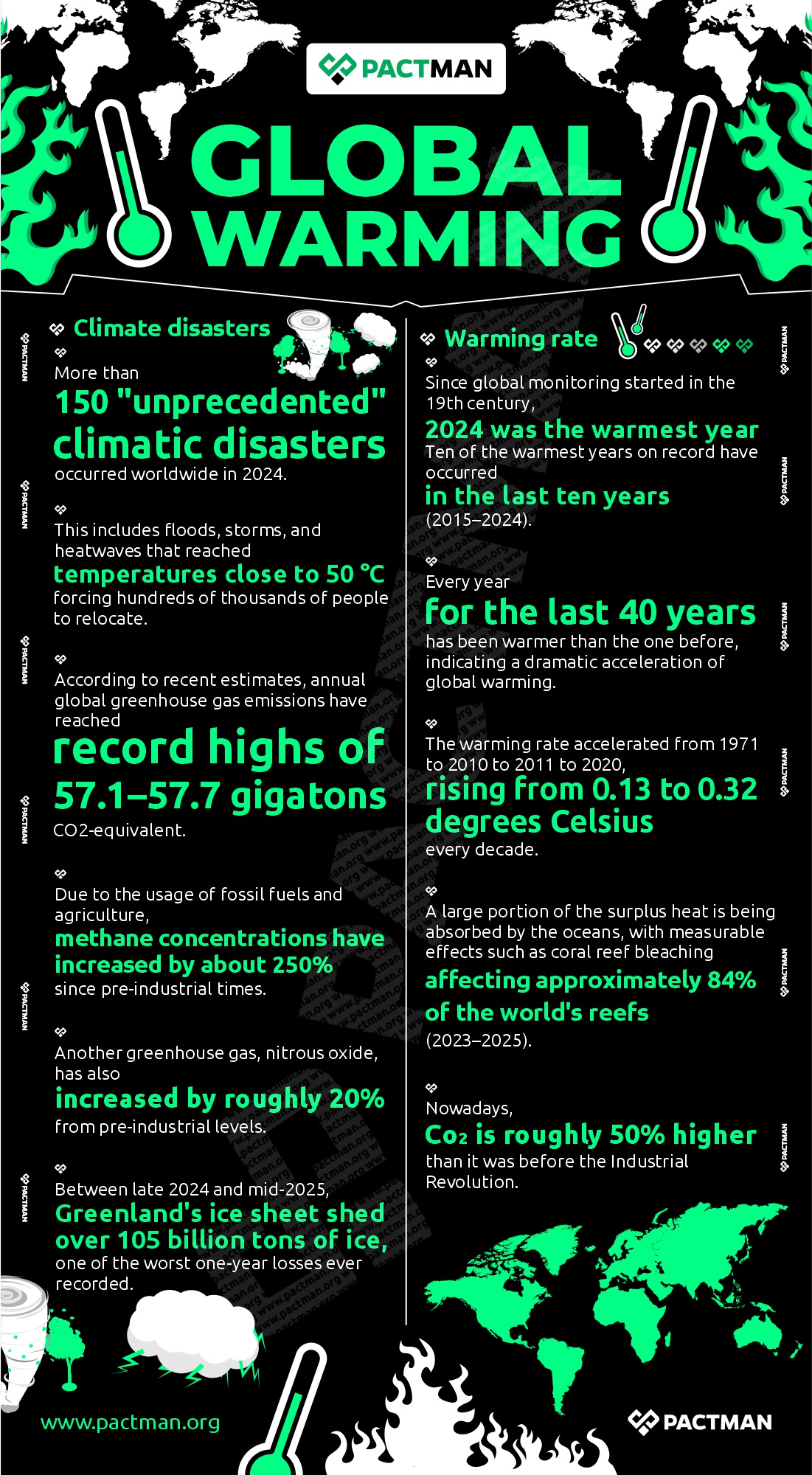
More than 150 “unprecedented” climatic disasters occurred worldwide in 2024. This includes floods, storms, and heatwaves that reached temperatures close to 50 °C, forcing hundreds of thousands of people to relocate.
Since global monitoring started in the 19th century, 2024 was the warmest year ever. Ten of the warmest years on record have occurred in the last ten years (2015–2024). Also, every year for the last 40 years has been warmer than the one before, indicating a dramatic acceleration of global warming. The warming rate accelerated from 1971-2010 to 2011-2020, rising from 0.13 to 0.32 degrees Celsius per decade.
Implementing the New Playbook: Internal Governance and Preparedness for Global Warming Effects
A climate alliance’s success is frequently assessed long before a contract is signed. Likewise, organizations must be operationally prepared to collaborate in addressing global warming effects. This entails establishing a transparent culture, obtaining leadership endorsement, and harmonizing internal systems. Partnerships often falter when sustainability teams function independently without wider organizational support.
Global Warming Effects
1. Board-Staff Collaborations and Governance
Any strategic alliance must have a solid working relationship between the executive leader and the board. Even in the face of setbacks, open and honest information exchange is made possible by regular check-ins and a dedication to a “no surprises” approach. Navigating the uncomfortable aspect of uncertainty that frequently accompanies open-ended collaborative futures requires this degree of internal resilience.
Also, sustainability integration is becoming a top issue in the corporate sector, influencing actual business choices, including capital planning, supply chain strategy, and enterprise risk management. Hence, several companies have adopted a hub-and-spoke approach. In this case, business units and departments like legal, procurement, and finance take the lead on pertinent execution, while a central sustainability team defines the strategy and oversees reporting.
2. Building Trust and Managing Relationships
Secondly, the foundation of the new playbook for addressing global warming effects is authentic relationships. To avoid the error of making a big ask during the first meeting, corporations are encouraged to invest in relationship depth rather than breadth. Hence, conversations should prioritize learning and developing trust over several months because foundations and smart NGOs may quickly recognize transactional strategies.
Governance Element
Practical Application
Strategic Implication
Executive Sponsorship
Briefing executives on strategic value early
Prevents stalls and secures resource buy-in
Hub-and-Spoke Model
Central strategy with functional execution
Scales ESG culture across the organization
Transparency
Open information sharing on progress/failure
Builds donor confidence and public trust
No Surprises Policy
Honest reporting to boards and partners
Maintains long-term institutional health
Also, building policy literacy is becoming crucial for charities to anticipate changes in program scope and funding eligibility. As a result, leaders should be aware of the federal, state, and local regulatory environments that impact their mission delivery as the climate becomes more political. Partners can establish long-lasting partnerships that can adapt to a shifting public health and economic environment, thanks to this internal preparedness and a readiness to accept ambiguity.
IV
The NGO’s Role as a Watchdog and Strategic Advisor
The World Wildlife Fund (WWF) and the Environmental Defense Fund (EDF) collaborated on Project Gigaton, which was essential to its success. These non-governmental organizations contributed their scientific and economic expertise to assist Walmart in establishing the objective, reviewing the research, and assessing emissions paths. Additionally, they engaged large food firms to optimize procedures on millions of acres and identified emissions hotspots, such as the use of nitrogen fertilizer in agriculture.
Global Warming Effects
However, the collaboration also highlights the difficulties with accountability. Project Gigaton uses self-reported data from suppliers and claims credit for preventing emissions that haven’t yet happened. Critics have also pointed out possible conflicts of interest because EDF receives significant funding from the Walton Family Foundation, which is run independently but has strong ties to Walmart. Despite these challenges, the project has served as a strong demand signal for international supply chains, showing how one business may influence entire sectors.
V
Ecosystem Resilience and Water Stewardship: The Coca-Cola and WWF Collaboration
Water is the main way that climate change is felt, whether it is through pollution, flooding, or scarcity. Established in 2007, the Coca-Cola Company and the WWF have a long-standing cooperation that aims to protect freshwater resources and enhance environmental performance throughout the worldwide supply chain.
Global Warming Effect
a. Basin-Level Group Initiatives
The Yangtze, Danube, and Mesoamerican Reef are just a few of the 11 priority freshwater basins that are the focus of this cooperation, which encompasses more than 50 nations. The partnership promotes coordinated efforts to guarantee the sustainable management of these basins by interacting with local governments, businesses, and communities.
Over time, the partnership’s scope has grown to include resilience building and greenhouse gas mitigation. In 2020, the accomplishment of a 25% decrease in the carbon emissions intensity of the “drink in your hand” was a significant turning point. The collaboration was renewed in 2021 with a deliberate focus on the relationship between plastic trash, agriculture, and climate resilience.
Impact Area
Strategy/Mechanism
Outcome/Key Milestone
Freshwater Conservation
Ecosystem restoration & policy support
13,000+ acres of wetlands restored in Danube
Climate Mitigation
Low-carbon operations and bottling
25% reduction in carbon intensity by 2020
Sustainable Ag
bonsucro-based sourcing principles
Shifted practices in 7 sugar mills in Honduras
Plastic Waste
Global plastic footprint measurement
Founding roles in ReSource: Plastic & US Plastic Pact
Climate Resilience
Design/test innovations in reef systems
Pilot
b. Using Natural Solutions to Grow
To increase resilience, the partnership is depending more and more on natural solutions. A ten-year partnership has restored wetlands and floodplains in the Danube River basin. These serve as natural defenses against drought and flooding. Also, the partnership built wetlands in rural villages in China to filter household wastewater. The goal was to prevent pollution of natural streams and provide clean water for agriculture.
The lessons acquired from this partnership are reflected in Coca-Cola’s 2030 Water Security Strategy, which emphasizes returning all of the water consumed in high-risk areas to communities and the environment. To promote local watershed protection and participate in improved basin governance, both organizations must look beyond their own operations. The partnership is a perfect example of how organizations can lead collective action by incorporating the value of nature into their business planning and going beyond water efficiency.
VI
Microsoft’s Approach to Leading the Carbon Removal Market
Emissions reduction on its own is no longer deemed adequate as global warming effects approach critical thresholds. With a pledge to become carbon negative by 2030 and eliminate its past emissions by 2050, Microsoft’s climate policy has developed into one of the most aggressive in the business sector.
Climate change
1. The Carbon Removal Portfolio Approach
Microsoft promotes carbon dioxide removal (CDR) by entering into agreements with project developers to provide superior removal credits. The organization emphasizes that nature is greater than the sum of its parts by using a portfolio strategy that includes both engineered and nature-based solutions.
One important criterion for selection is the longevity of these solutions, or how long carbon is trapped. While low-durability solutions like forestry and soil-based projects are usually only lasting up to 100 years, high-durability options like Direct Air Capture (DAC) and mineralization are anticipated to store carbon for more than 1,000 years.
2. Transformation of the Market via Offtake Agreements
Also, Microsoft is more than just a buyer; it is also a market maker. Hence, Microsoft frequently works directly with suppliers in the early stages of project design because the CDR industry is still in its infancy. The enterprise empowers developers with the financial stability they need to raise funds, hire employees, and construct physical infrastructure by obtaining long-term offtake agreements.
Emerging Technologies and AI: Closing the Impact Gap
Artificial Intelligence (AI) is transforming how businesses monitor emissions, control risks, and expand their influence through corporate-nonprofit partnerships. Due to data centers’ growing energy and water requirements, AI is emerging as a new sustainability challenge as well as a tool to further ESG goals.
Climate Change
a. AI for Climate Action: Predictive and Generative
By evaluating enormous datasets, predictive AI revolutionizes environmental monitoring by accurately predicting future conditions. Crop yields, wildfire threats, and flood patterns can all be predicted months in advance through machine learning models that process several types of data at once. For instance, AI-powered deforestation warnings may now detect illicit logging operations in a matter of days as opposed to months.
By synthesizing massive data sets and matching language with intricate reporting frameworks, generative AI is being utilized more and more to expedite sustainability reporting. AI agents are also assisting organizations in augmenting their workforces. This is achieved by automating tedious operations like updating volunteer shifts and donating tax receipts.
AI Use Case
Practical Application Example
Benefit to Climate Alliances
Disaster Response
Good360 matching donations to needs
Reduces waste and lowers transport carbon
Energy Equity
Groundswell managing solar subscriptions
Streamlines process for low-income households
Supply Chain
WattTime assisting SME energy timing
Democratizes access to emissions reduction
Finance Mobility
Climate Collective analyzing startup data
Connects green tech with needed capital
Emissions Inventory
Climate TRACE satellite algorithms
Pinpoints emissions from 352M facilities
b. Overcoming the Technology Funding Gap
Despite AI’s potential, many NGOs lack the resources, infrastructure, and training necessary to maintain digital advancement. Funders are urged to adopt “pay-what-it-takes” strategies and embrace technology as a fundamental operating expense in order to close this gap. A good example of this includes supporting AI literacy training and the high cost of tech talent, which frequently surpasses conventional nonprofit compensation bands.
Organizations with strong data sets are the ones using AI in the climate industry most successfully. By forming international alliances and creating open-source shared sources of truth, NGOs can guarantee that AI offers practical insights rather than only technological innovation. Another crucial element in preventing AI from widening already-existing socioeconomic disparities is ensuring that excluded areas have access to technology and the internet.
VIII
The New Playbook for Collective Action: Synthesis
Evidence from a variety of industries, including technology, banking, retail, and drinks, all point to the same conclusion: the days of individual action are past. The new corporate-nonprofit partnership playbook is an advanced, data-driven, and operationally cohesive strategy for combating global warming effects. It is distinguished by the following fundamental changes:
Financial Innovation: Using philanthropy as risk capital instead of traditional grants to generate billions of dollars in private investment for climate technology.
Operational Integration: Integrating sustainability into key business processes, such as capital planning and procurement, as opposed to keeping it separate in PR departments.
Scientific Rigor: Verifying each ton of CO2 avoided or lowered using science-based targets and independent third-party verification.
Holistic resilience: Understanding the connections between carbon, water, biodiversity, and social justice to prevent actions from causing new harm.
Technological Acceleration: Bridging data gaps and optimizing the global supply chain for a low-carbon future by utilizing AI and predictive models.
Conclusion
Organizations that adopt this new strategy will be in a better position to generate value and reduce risks as they navigate a volatile and complex market. Since the climate window is closing quickly, solidarity, scale, and speed are now crucial. By fostering genuine connections and producing consistent outcomes, corporate and nonprofit partners can transform climate ambition into quantifiable action. This will address the challenge required to limit global warming below 1.5 °C and safeguard the planet’s health for future generations
In the current nonprofit environment, organizations are increasingly relying on technology to enhance donor interaction, ensure compliance, and streamline operations. The Pactman Nonprofit CheckPlus API […]
TABLE OF CONTENTS Introduction Overview of Nonprofit Grant Options Critical Statistics on Nonprofit Grants in the U.S. Nonprofit Grants in Washington Nonprofit Grants in Alabama […]
TABLE OF CONTENTS Introduction Nonprofit Funding Gaps in Africa Critical Statistics on Nonprofit Grants Local vs International Nonprofit Grants in Africa: A Comparative Analysis Overview […]
The term “best charities to donate to” describes impactful nonprofit organisations deserving of your support. This article researches the top nonprofits in Singapore. This article […]
Donating furniture is an excellent way to reduce waste and provide assistance to those in need. Numerous charitable organisations can be considered when you want […]
California is at the forefront when it comes to climate change action in the United States. Through their passionate and active policies, clean energy funding, […]