

I
Introduction
Foundations and grantmaking organizations work at the nexus of public trust and pressing social needs. Hence, their ability to transfer resources effectively and prove without a shadow of a doubt that those resources reached the intended beneficiaries is essential to their efficiency.

However, institutional failure, data fragmentation, and a recurring “Black Box” issue, where visibility is lost after a donation leaves the central organization, are common problems with traditional philanthropic organizations. Resolving these issues demands a process of optimizing mission impact rather than just attaining compliance.
This guide explains how blockchain and emerging technologies can create a foundation of digital trust. Also, the article highlights how these tools can help significantly reduce administrative friction and completely transform philanthropic accountability.
II
Critical Statistics on Emerging Technologies and Blockchain to Consider
In this section, we will consider critical statistics on emerging technologies and their impact across the nonprofit space.
a. Blockchain technology use
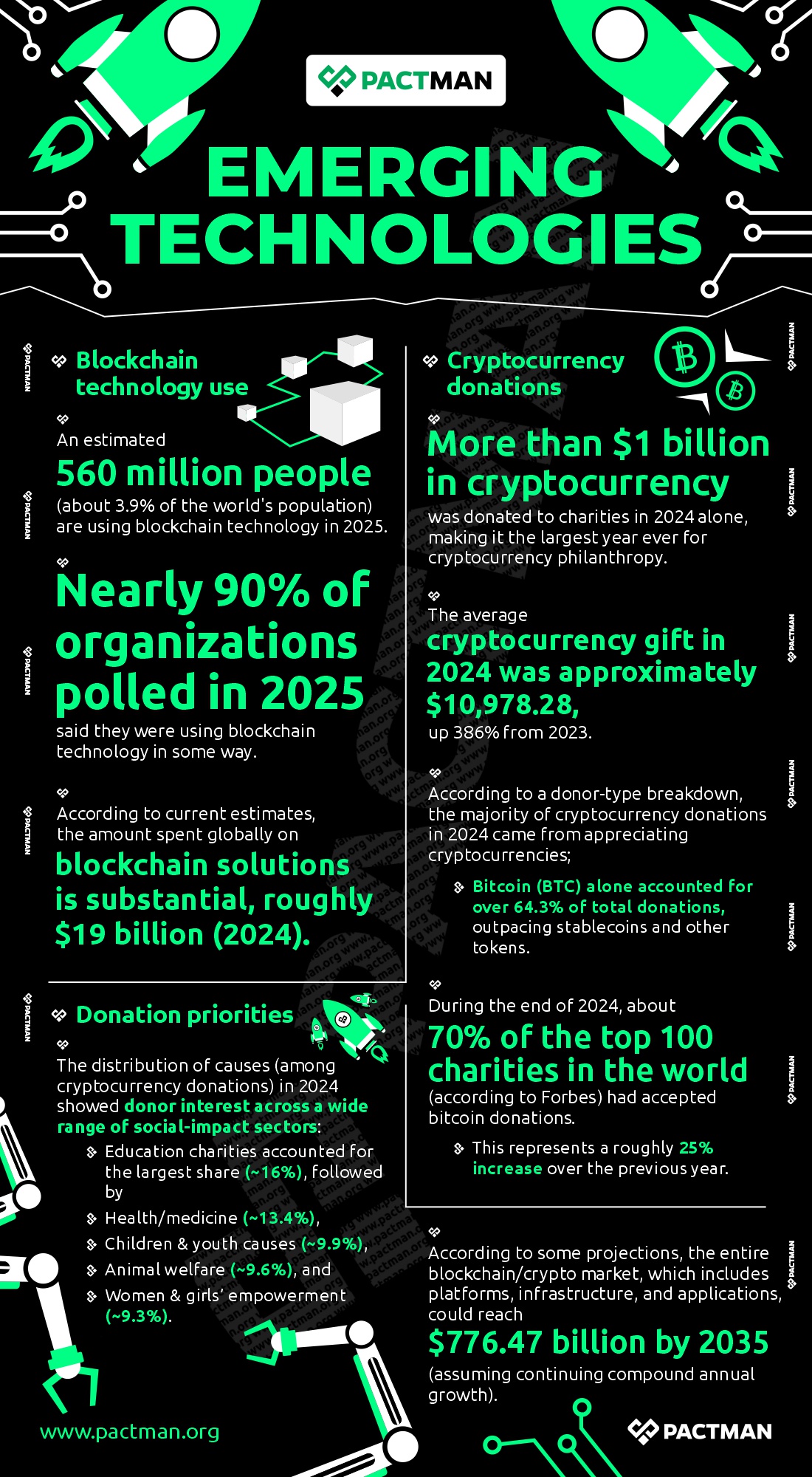
An estimated 560 million people (about 3.9% of the world’s population) are using blockchain technology in 2025. Nearly 90% of organizations polled in 2025 said they were using blockchain technology in some way.
According to current estimates, the amount spent globally on blockchain solutions is substantial, roughly $19 billion (2024).
b. Cryptocurrency donations
More than $1 billion in cryptocurrency was donated to charities in 2024 alone, making it the largest year ever for cryptocurrency philanthropy. The average cryptocurrency gift in 2024 was approximately $10,978.28, up 386% from 2023. According to a donor-type breakdown, the majority of cryptocurrency donations in 2024 came from appreciating cryptocurrencies; Bitcoin (BTC) alone accounted for over 64.3% of total donations, outpacing stablecoins and other tokens.
During the end of 2024, about 70% of the top 100 charities in the world (according to Forbes) had accepted bitcoin donations. This represents a roughly 25% increase over the previous year.
c. Donation priorities
The distribution of causes (among cryptocurrency donations) in 2024 showed donor interest across a wide range of social-impact sectors:
- Education charities accounted for the largest share (~16%), followed by
- Health/medicine (~13.4%),
- Children & youth causes (~9.9%),
- Animal welfare (~9.6%), and
- Women & girls’ empowerment (~9.3%).
According to some projections, the entire blockchain/crypto market, which includes platforms, infrastructure, and applications, could reach $776.47 billion by 2035 (assuming continuing compound annual growth).
III
A Workable Structure for Grantmakers: How to Integrate Emerging Technologies
Integrating modern technology into grantmaking is not a simple digital upgrade. Rather, it is an organizational change that reshapes how decisions are made, how funds move, how trust is developed, and how impact is validated. For many foundations, knowing where to start is more difficult than comprehending the benefits of blockchain, artificial intelligence, or verification APIs.

Hence, this section will provide a thorough, step-by-step adoption framework for grantmaking organizations and foundations. It draws on real-world practice to explain how organizations have successfully integrated emerging technologies into their operational structures.
Essentially, the framework is divided into three phases, each aimed at creating a modern, trust-driven, technology-enabled grantmaking ecosystem.
PHASE 1: Diagnose, Assess, and Modernize the Core Foundation Processes
The first step in implementing emerging technologies is not to purchase tools, but to identify the structural inefficiencies that technology must address. Many grantmakers’ workflows are archaic, with manual verification, inconsistent reporting, delayed data collection, and fragmented systems.
a. Assess operational baselines
This phase begins with a thorough examination of the organization’s existing grantmaking model. Hence, foundations should investigate crucial areas:
- How long does it take to review a grant application?
- How is due diligence conducted?
- What is the degree of transparency provided to funders, communities, and board members?
- What is the level of manual reporting expected from grantees?
- How is impact data collected and validated?
b. Create the Trust Gap Map
This trust map identifies specific sources of mistrust, whether between funders and grantees, donors and foundations, or communities and implementing partners. For example, funders may have concerns about how intermediaries manage program budgets. Also, grantees may question how decisions are made or why some applications are denied. Even more, donors may have limited visibility into the eventual impact of their gifts.
Mapping these difficulties allows foundations to pinpoint the precise locations where emerging technologies such as blockchain for transparency, APIs for verification, and geospatial tools for monitoring can eliminate friction.
c. Modernize Data Infrastructure Before Adopting Technology
No emerging technology will operate well with a shaky infrastructure. Thus, at this stage, groups should begin to strengthen:
- Data Governance
- Standardized Reporting Templates
- Clear impact metrics
- Digital documentation workflows
By and large, this foundation ensures that future technological adoption does not collapse due to inconsistency in data.
PHASE 2: Launch Emerging Technology Solutions for Maximum Value
Once the internal landscape has been identified and modernized, there is a need to introduce emerging technologies through targeted pilot programs that address specific trust or efficiency hurdles. This phase is not about large-scale transformation; it is about concentrated exploration with demonstrable outcomes.
a. Blockchain Pilots for Transparent Fund Disbursement
Foundations and grantors frequently start with blockchain because it addresses one of the most pressing issues: a lack of real-time financial transparency. A foundation, for example,
- May use blockchain wallets to transfer funds to ten to twenty grantees.
- Require grantees to keep a tamper-proof ledger.
- Allow donors and internal auditors to see a clear flow of funds.
Essentially, the purpose is not to replace existing banking systems, but to demonstrate that blockchain can boost trust while reducing administrative overhead.
b. Use Verification APIs to automate Due Diligence
Rather than manually verifying IRS BMF, OFAC lists, revocation lists, or state-level records, grantmakers can start using verification APIs to automate nonprofit validation. During a pilot phase:
- Applications can be automatically checked for tax-exempt status.
- Sanctions checks can be performed in real time.
- Revoked or flagged entities can be discovered right away.
Several donor-advised fund platforms have implemented this technique, lowering grant approval time from weeks to less than 24 hours.
c. Consider Geospatial Tools for Monitoring High-Risk or Remote Projects
Thirdly, geospatial tools are very useful for infrastructure, agriculture, and community development grants. A pilot could involve verifying:
- The building of a school using satellite photography
- Crop yield enhancements with before-and-after land mapping
- GPS-based check-ins allow field workers to visit
These tools streamline field verification expenses while also providing objective validation.
d. Implement AI for application screening
AI models can be used to classify a small set of applications by:
- The risk level
- The proposed project aligning with strategic aims
- Previous performance of the organization
All in all, this saves reviewer workload and identifies applications that require further investigation.
PHASE 3: Develop an Integrated, Technology-Enabled Grantmaking Ecosystem
Following successful trials, organizations work to establish a unified technological stack in which each tool interacts with the others. This phase represents a structural change in how the foundation functions.
a. Create a Unified Grantmaking Dashboard
This dashboard will serve as the foundation’s operating system. It combines blockchain transaction data, verification API outcomes, AI-based risk scores, geospatial monitoring maps, grantee reporting inputs, and automated compliance checks. More importantly, the goal is to provide end-to-end visibility across the grant lifecycle from application submission to fund disbursement and field-level impact.
b. Standardize Smart Contracts for Milestone-Based Disbursement
Secondly, smart contracts enable foundations to disburse cash based on pre-determined milestones. For example,
- Once geospatial tools have verified that a training facility has been established, the next tranche of financing is released.
- The final payment is made after the grantee’s result data is submitted and validated.
This strategy ensures accountability without adding unnecessary reporting requirements for grantees.
c. Implement Real-Time Impact Measurement
Real-time field updates are available via mobile data capture, IoT devices, and automated dashboards. Impact measurement moves from retrospective reporting to continual verification.
d. Establish a Central Data Lake for Learning
Lastly, an integrated data system helps foundations identify effective program models.
- Compare the historical performance of awardees.
- Identify early warning indications of project failure.
- Optimize funding portfolios.
Hence, this puts the foundation on par with top-tier private-sector enterprises that adopt analytics for strategy.
Conclusions
Emerging technologies are more than just tools. They make the philanthropic industry more responsible, effective, and human-centered. The goal of this change is to improve the integrity, efficiency, and speed of the work that grantmakers are designed to do, not to replace human judgment with technology.
Also, emerging technologies offer the biggest opportunity in decades to update grantmaking procedures and unleash impact on an unprecedented scale. Over time, emerging technologies will not just modernize operations. They will enable nonprofits to finally deliver on their promise of egalitarian, responsible, and revolutionary impact.