How to Leverage Digital Tools and Automation in Grant Processing
Cersai Stark
I
Introduction
For NGOs, foundations, and donors, adopting digital tools is about more than just staying current with technology. Rather, it’s about gaining more time, increasing accuracy, and eventually making a bigger social impact. Organizations run significant operational and regulatory risks when they don’t maintain proper records in the areas of spending, project progress, or stakeholder correspondence.
Digital tools
Furthermore, siloed information remains a major problem. Real-time visibility into the grants pipeline, status, and related budgets will not be feasible for teams when data is dispersed or stored on separate network drives. Moreover, teams struggle to stay abreast of budgets and address sluggish approvals in the absence of defined protocols or automated procedures. This severely impairs their capacity to manage risks across all grants.
As can be seen, manual procedures have hidden costs that are quantified in lost opportunities as well as funds. Hence, this article serves as a comprehensive guide, explaining how grantmaking organizations can intentionally utilize automation and contemporary digital tools to enhance organizational impact, streamline the grant lifecycle, and foster stronger relationships with grantees.
II
Critical Statistics on Digital Tools and Automation
In this section, we will consider critical statistics on digital tools and automation.
a. General workflow automation across sectors
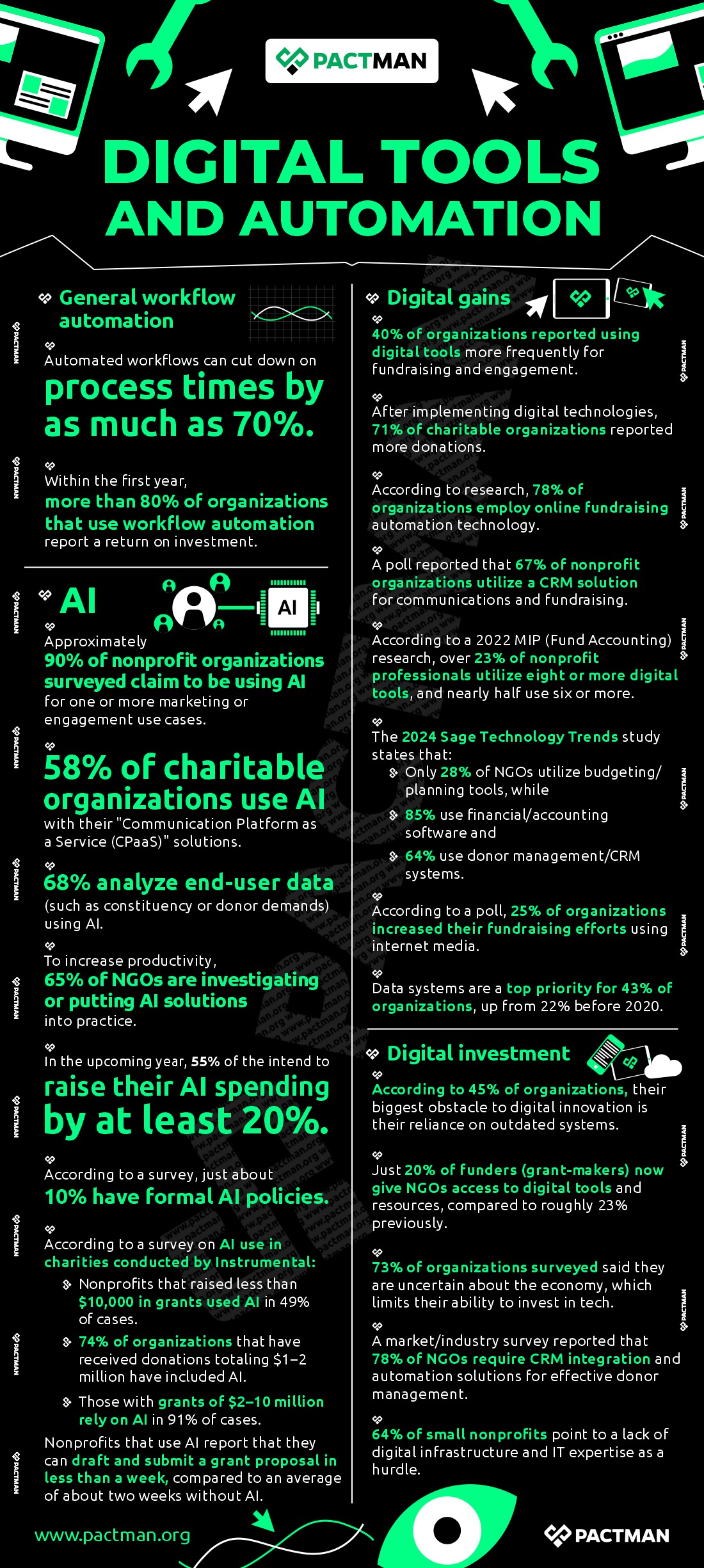
Automated workflows can cut down on process times by as much as 70%. Within the first year, more than 80% of organizations that use workflow automation report a return on investment.
Only 28% of NGOs utilize budgeting/planning tools, while
85% use financial/accounting software and
64% use donor management/CRM systems.
According to a poll, 25% of organizations increased their fundraising efforts using internet media. Furthermore, data systems are a top priority for 43% of organizations, up from 22% before 2020.
c. AI
Approximately 90% of nonprofit organizations surveyed claim to be using AI for one or more marketing or engagement use cases. Also, 58% of charitable organizations use AI with their “Communication Platform as a Service (CPaaS)” solutions. 68% analyze end-user data (such as constituency or donor demands) using AI.
Also, although AI and automation are being used by many organizations, most of them lack explicit governance and regulations. For example, according to a survey, just about 10% have formal AI policies.
Nonprofits that raised less than $10,000 in grants used AI in 49% of cases.
74% of organizations that have received donations totaling $1–2 million have included AI.
Those with grants of $2–10 million rely on AI in 91% of cases.
Nonprofits that use AI report that they can draft and submit a grant proposal in less than a week, compared to an average of about two weeks without AI.
Even more, 73% of organizations surveyed said they are uncertain about the economy, which limits their ability to invest in tech.
A market/industry survey reported that 78% of NGOs require CRM integration and automation solutions for effective donor management. Also, 64% of small nonprofits point to a lack of digital infrastructure and IT expertise as a hurdle.
III
How to Plan Your Digital Adoption Strategy
It takes careful planning to adopt new technology. Nevertheless, a methodical approach guarantees high user adoption and effective alignment with the foundation’s objectives.
Digital tools
1. Outline Your Current Procedure
A thorough self-assessment is a crucial first step in digital adoption. From pre-application to closeout, organizations must outline their present grant administration process, recording all touchpoints. By and large, this process map makes it easy to find the precise tools required to consolidate and simplify administration.
During this audit phase, actively identifying bottlenecks and pain spots is essential. This entails asking internal employees for input on what they believe to be administratively cumbersome and following up with previous grantees to learn about their experiences. Frequently, this finding identifies the main problems, including dependence on decentralized network drives or ineffective sequential stages.
Lastly, the organization can establish quantifiable, well-defined improvement goals before implementation. The automation project’s success will be determined by these baseline criteria, which can include
lowering the average time-to-award cycle period,
increasing applicant satisfaction ratings, or
decreasing the grant error rate.
2. Choose the Appropriate System for Non-Technical Employees
Flexibility, high user uptake, and functionality, particularly among non-technical staff, must be given top priority in the selected digital tools. Basically, the system must provide a customizable workflow that enables the organization to specify and set up every stage of its distinct grant life cycle.
To begin with, seek features that reduce manual intervention. This is achieved by incorporating conditional logic into forms and processes, which automatically adjust the process based on variables like grant size or application type. By and large, the key to high adoption is usability. The system needs to have a clear interface and be intuitive and user-friendly.
Additionally, centralizing data and correspondence, removing the headache of managing many sources, and improving internal coordination all rely on integrated communication and collaboration solutions.
3. Prioritize Cost and Return on Investment (ROI)
Generally speaking, the price of grant management software ranges from $1,000 to $15,000 per year. However, this is contingent on the size and complexity of the organization. Per-user pricing is a common feature of pricing models; basic personal plans cost between $10 and $30 per user per month, while enterprise solutions necessitate customized estimates.
This investment’s Return on Investment (ROI) serves as its rationale. Hence, ROI for NGOs is evaluated using a cost-benefit approach that emphasizes the net value realized. Quantitative advantages, including lower administrative costs, more accuracy, and more staff time for strategic work, sometimes exceed overall expenses.
Also, total benefits can significantly outweigh costs, producing a positive net benefit.
Crucial Digital Tools to Take into Account
Grantmakers can leverage the following digital tools, which are considered effective for nonprofits:
Automating the Grant Lifecycle (Award and Post-Award Phases)
During the award and post-award stages, financial accuracy, timeliness, and regular outcome tracking are necessary. By and large, funding is accelerated, and accountability is guaranteed by automation in these areas.
Digital tools
Award Phase: Boosting Funds and Guaranteeing Accuracy
Major bottlenecks that formerly required sequential completion are dramatically eliminated by digital systems’ ability to allow work to proceed simultaneously, such as programmatic, legal, and financial reviews. Due to the funding cycle being accelerated, grantees are able to commence their mission work sooner, which directly boosts philanthropic velocity and community impact.
Digital tools also offer better financial management and integration. Grant budgets, expenses, and balances can be tracked in real time with the help of reliable GMS solutions.
Furthermore, fast and accurate accounting and fund management are ensured by the seamless integration of financial data, which is often facilitated by connections with programs like QuickBooks Online. This centralization creates the required payment records, controls spending, and expedites grant payment procedures.
For instance, automation eliminates the requirement for grant managers to serve as the main information gatekeepers. This is achieved by enabling finance staff to instantly get payment approvals.
Post-Award Management: Monitoring Development and Impact
After the grantee starts working and the funds are taken out, the post-award phase, which usually lasts one to five years, commences. In addition to assessing the performance of the current project, efficient post-award management is essential for guiding future funding choices and fostering enduring partnerships with donors.
Centralized Grantee Portals serve as an ongoing hub for collaboration in modern GMS. The portal keeps track of all documents and correspondence, guaranteeing that all exchanges between grantees and foundation employees are kept in one place rather than on separate computers. Grantees can submit all necessary programmatic, financial, Key Performance Indicator (KPI), and other relevant reports in one place within the GMS, which also simplifies grant reporting.
Through the use of real-time data, this reporting process simplification aids the foundation in continuously monitoring grant performance, enabling the team to analyze long-term impact and make well-informed decisions.
Conclusion
In summary, digital tools and automation provide the infrastructure required for grantmaking organizations to satisfy the growing expectations for efficiency and transparency. Through the implementation of a unified Grant Management System, foundations can transition from manual processes, which are prone to errors, data silos, and compliance issues, to a model of philanthropy that is driven by data.
For any foundation or donor looking to increase its impact, there is a need to prioritize systems that provide flexible workflows and strong audit capabilities. Also, organizations must invest in a GMS solution (Grants Management System), thoroughly map out current procedures, and secure full staff commitment through training.
4 responses to “How to Leverage Digital Tools and Automation in Grant Processing”
[…] processes, ensure compliance, and optimize impact, the Pactman Nonprofit CheckPlus API is a strategic tool. Its extensive verification features, automation capabilities, and RESTful design enable […]
[…] if the primary focus is on an area of the 17 goals, practitioners are encouraged to employ tools that require them to evaluate their influence on all 17 goals. As a result, a thorough map of […]
In the current nonprofit environment, organizations are increasingly relying on technology to enhance donor interaction, ensure compliance, and streamline operations. The Pactman Nonprofit CheckPlus API […]
TABLE OF CONTENTS Introduction Overview of Nonprofit Grant Options Critical Statistics on Nonprofit Grants in the U.S. Nonprofit Grants in Washington Nonprofit Grants in Alabama […]
TABLE OF CONTENTS Introduction Nonprofit Funding Gaps in Africa Critical Statistics on Nonprofit Grants Local vs International Nonprofit Grants in Africa: A Comparative Analysis Overview […]
Education nonprofits are effective change agents. Individual lives as well as communities can be influenced through education. Additionally, it helps close the gaps, open up […]
Homeless charities provide a haven for individuals who cannot afford to procure homes or fend for themselves. Ireland is a country faced with homelessness, just […]
Homeless charities act as guiding lights for those in need. One of their missions is to establish sanctuaries that welcome communities facing distress from around […]










4 responses to “How to Leverage Digital Tools and Automation in Grant Processing”
[…] Current data: Funders keep an eye on events and results as they happen using dashboards, APIs, and digital reports. […]
[…] processes, ensure compliance, and optimize impact, the Pactman Nonprofit CheckPlus API is a strategic tool. Its extensive verification features, automation capabilities, and RESTful design enable […]
[…] is a social process that involves leaders’ feelings, prejudices, and self-interests rather than just being an […]
[…] if the primary focus is on an area of the 17 goals, practitioners are encouraged to employ tools that require them to evaluate their influence on all 17 goals. As a result, a thorough map of […]