What Is Social Entrepreneurship? Comparing Nonprofits, NGOs, and Social Enterprises
Cersai Stark
I
Introduction
The traditional dichotomy between the for-profit business world and the charitable sector is rapidly dissolving. This has given rise to a sophisticated middle ground that seeks to marry market-driven efficiency with a relentless commitment to societal welfare. At the heart of this transformation is the question: What Is Social Entrepreneurship? It is not merely a buzzword but an evolving paradigm of organizational behavior where business practices are systematically utilized to address pressing social, cultural, or environmental issues.
What Is Social Entrepreneurship
Unlike traditional commercial ventures, where the primary objective is the maximization of shareholder wealth, social entrepreneurship prioritizes the creation of social value, a concept that focuses on long-term institutional change rather than just the temporary provision of goods or services.
To understand what social entrepreneurship is, one must look at it as a transformative force. While commercial entrepreneurs are driven by market opportunities to create financial value for themselves and their customers, social entrepreneurs are mission-driven individuals who identify large-scale social problems and apply the principles of innovation and strategic thinking to solve them. These individuals are often described as unreasonable because they refuse to accept the status quo of systemic inequality. Rather, they strive to disrupt existing structures in areas such as education, healthcare, and environmental sustainability.
II
Core Characteristics and Motives in Social Entrepreneurship
The construction and pursuit of social value are characterized by visionary thinking and a virtuous behavioral dimension. Social entrepreneurs exhibit balanced judgment when navigating the extreme complexity of conflicting goals, such as maintaining financial viability without sacrificing their social mandate. They are practitioners of what is sometimes called entrepreneurial spirit and business acumen applied to social change. Hence, success is not measured by stock price or dividends, but by sustainable social impact. Essentially, this is the degree to which a systemic problem has been alleviated or solved.
Objective Comparison
Traditional Entrepreneur
Social Entrepreneur
Primary Goal
Profit maximization and market dominance
Social value creation and systemic change
KPIs
Success Metrics
Revenue, market share, ROI
Target Audience
Paying consumers with purchasing power
Social groups, marginalized populations, the environment
Strategic Focus
Competitive advantage over others
Collaboration with related organizations
Motive
Financially driven and self-interested
Mission-driven and altruistic
III
Comparing Organizational Structures: Nonprofits, NGOs, and Social Enterprises
A critical component of understanding what is social entrepreneurship involves distinguishing it from the established models of the nonprofit organization (NPO) and the non-governmental organization (NGO). While these terms are often used interchangeably in casual conversation, they represent distinct legal, operational, and geographical strategies for creating public value.
What Is Social Entrepreneurship
a. The Domestic Nonprofit Organization (NPO)
A nonprofit organization is defined primarily by its non-distribution constraint. This legal principle mandates that no part of the organization’s income may be distributed to its members, directors, or officers as dividends or profit. Instead, any surplus revenue must be reinvested back into the organization’s mission. Nonprofits are typically local or national in scope, focusing on domestic issues such as local arts, education, or community health.
Also, nonprofits rely heavily on a charity-market funding model, which includes private donations, government grants, and fundraising events like donor-calling campaigns and crowdfunding. This dependency on external funding can sometimes lead to instability, as the organization’s survival is tied to the generosity of donors rather than its own revenue-generating capacity.
b. The International Non-Governmental Organization (NGO)
The term NGO refers to a non-profit entity that operates independently from any government, though it may receive government funding. The primary differentiator for an NGO is its operational scope. While a nonprofit might serve a single neighborhood or city, an NGO typically operates across borders to address global humanitarian, environmental, or development issues. For instance, an NGO might focus on global health crises, international human rights, or famine relief in isolated regions.
NGOs are often structured similarly to nonprofits but navigate complex international legal frameworks. They act as monitors for whether institutions are meeting international commitments. Also, they are frequently seen holding governments accountable for human rights protections. Their funding often comes from large international foundations, foreign governments, or multinational bodies like the United Nations.
c. The Social Enterprise: A Hybrid Paradigm
Lastly, the social enterprise represents a distinct evolution as it incorporates earned revenue into its mission. A social enterprise uses business methods such as selling products or services to achieve social good. This model allows the organization to be self-sustaining, reducing or eliminating its reliance on grants and donations.
Social enterprises can take several legal forms: they can be for-profit companies, non-profit entities, or hybrid structures. For-profit social enterprises operate like traditional businesses but prioritize their social mission, often attracting impact investors who seek both a financial return and social impact. These entities can rapidly achieve scale by reinvesting their profits or raising capital from private markets.
IV
Critical Statistics on Social Entrepreneurship
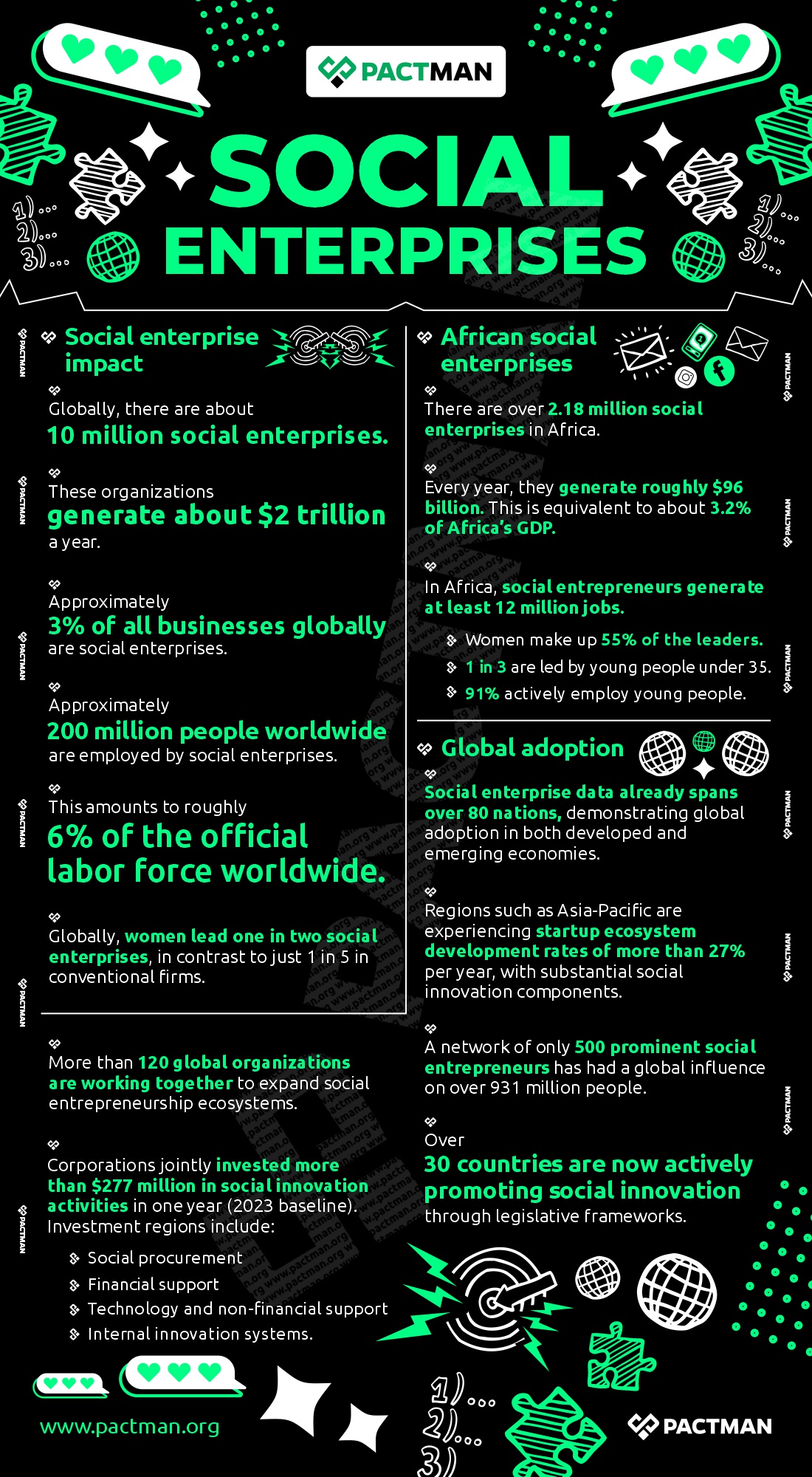
In this section, we will consider critical statistics on social entrepreneurship and its impact across the globe.
According to some estimates, their economic output is comparable to that of big businesses like telecom and fashion. Also, approximately 200 million people worldwide are employed by social enterprises. This amounts to roughly 6% of the official labor force worldwide. Globally, women lead one in two social enterprises, in contrast to just 1 in 5 in conventional firms.
What Is Social Entrepreneurship
b. African social enterprises
There are over 2.18 million social enterprises in Africa. Every year, they generate roughly $96 billion. This is equivalent to about 3.2% of Africa’s GDP.
In order to address the question of what social entrepreneurship is, it is necessary to look at how these organizations manage to survive without conventional economic incentives. A defining characteristic of contemporary social entrepreneurship is the push toward self-sufficiency, which permits increased independence from the changing interests of donors.
What Is Social Entrepreneurship
1. Market Integration and Earned Revenue
In order to generate funds, social entrepreneurs frequently employ conventional business techniques. For instance, a chain of thrift stores called Donate Applique gathers worn goods, sells them to customers, and donates half of the proceeds to nearby shelters. The remaining 25% go to shareholders, and the other 25% go into business growth. Also, the service-based business model, like Vibe Music, is another popular model. It gives music lessons at market prices but provides significant discounts to underrepresented groups to ensure accessibility.
Perhaps the most renowned example of market integration is the One-for-One concept, which was made popular by businesses like TOMS shoes. Every consumer transaction made under this approach immediately results in a donation to a person in need. Even more, this strategy has shifted. Instead of only donating shoes, TOMS now donates one-third of its net annual revenues to a charitable giving fund, demonstrating a more sophisticated approach to impact and financial health.
2. The Function of Government Assistance, Grants, and Donors
Also, NGOs and traditional charities still rely on a complex network of donor funding. Among these are:
Government Grants: Direct financial support for the provision of humanitarian aid or public services.
Corporate Sponsors: Companies that donate funds for marketing or brand alignment.
Individual philanthropy: This refers to modest contributions made by members of the public.
Crowdfunding: Using internet platforms to gather funds from a sizable, geographically distributed group of supporters.
Although these sources offer stability, they frequently have strict reporting requirements and might result in chasing the money, a process known as mission drift, in which an organization modifies its programming to meet the needs of a specific grant.
4. Scalability and Impact Investing
Lastly, for-profit social enterprises possess the exceptional capacity to draw impact investment. These are capital that aims for both a quantifiable social benefit and a financial return. By and large, this is essential for scalable solutions. For-profit social enterprises are more appealing to venture capitalists and private sector investors who wish to support social change while retaining their cash since they can issue shares, unlike NGOs, which are legally forbidden from returning funds to investors.
In addition, a global change in corporate standards is reflected in the growth of the B Corp movement. These are companies that have legally committed to high standards of social and environmental performance, and there are currently more than 10,000 of them in the world. This gives for-profit social entrepreneurs a precise and quantifiable framework to demonstrate their global impact.
Conclusion
Finally, the future of social entrepreneurship demands a shift from small-scale pilots to extensive systemic change. This shift is heavily reliant on technology. For example, social entrepreneurs are able to reach thousands of people with low overhead by using mobile platforms for microfinance or blockchain for transparent aid tracking.
In the end, ethical entrepreneurship offers a different perspective, not merely a different approach to managing a firm. Driven by leaders who just won’t accept no, it is an altruistic endeavour that turns social capital into a force for good in society. The fundamental goal remains: to create a world that is not just more profitable but also more just, whether through a domestic nonprofit, an international NGO, or a hybrid social enterprise.
In the current nonprofit environment, organizations are increasingly relying on technology to enhance donor interaction, ensure compliance, and streamline operations. The Pactman Nonprofit CheckPlus API […]
TABLE OF CONTENTS Introduction Overview of Nonprofit Grant Options Critical Statistics on Nonprofit Grants in the U.S. Nonprofit Grants in Washington Nonprofit Grants in Alabama […]
TABLE OF CONTENTS Introduction Nonprofit Funding Gaps in Africa Critical Statistics on Nonprofit Grants Local vs International Nonprofit Grants in Africa: A Comparative Analysis Overview […]
Education nonprofits are effective change agents. Individual lives as well as communities can be influenced through education. Additionally, it helps close the gaps, open up […]
Homeless charities provide a haven for individuals who cannot afford to procure homes or fend for themselves. Ireland is a country faced with homelessness, just […]
Homeless charities act as guiding lights for those in need. One of their missions is to establish sanctuaries that welcome communities facing distress from around […]