


I
Introduction
In the nonprofit sector, performance management is a complex nexus of strict operational discipline and enthusiasm inspired by a mission. The phrase was first used in the corporate and governmental domains to refer to strategies for accomplishing objectives successfully and efficiently. Presently, its application in the social sector demands a sophisticated comprehension of how value is produced without profit as the major motivator.

At its most basic level, performance management functions as a comprehensive framework that combines everyday operations, strategic goals, regular evaluations, and data analysis with the sole goal of increasing organizational effectiveness. In order to ensure long-term sustainability and social impact, this process is a forward-looking plan that aligns every action with the organization’s goal and vision. Hence, it is more than just an evaluation exercise, looking back at what has been accomplished.
II
The Foundations of Strategic Performance Evaluation
The Baldrige Performance Excellence Program poses a simple, straightforward set of questions to assess a nonprofit’s performance:
- Is the organization doing well?
- Is it improving? and
- How is this known?

In order to address these issues, a systematic framework that maintains the accountability and motivation of all parties involved, including board members, employees, volunteers, and donors, must be established. By converting a mission statement’s abstract goals into concrete actions, this framework offers a clear path to achievement.
The intricacy of the nonprofit sector is defined by a double bottom line. This strikes a balance between social mission fulfillment and financial stability. It also calls for a dynamic and ongoing performance monitoring system. Modern nonprofit performance management is seen as a continuous process of development and strategic alignment. This is in contrast to static management models that might use an annual review as the main point of evaluation.
Planning, implementing, monitoring, analyzing, communicating, and adapting are all part of a continuous improvement cycle that has no set beginning or end. Every choice made in this setting often feels high-stakes, demanding managerial skills that can handle resource limitations while keeping a laser-like focus on the good of the organization.
III
Critical Statistics on Performance Management
In this section, we will consider critical statistics on performance management and its usage and impact.
a. Performance systems
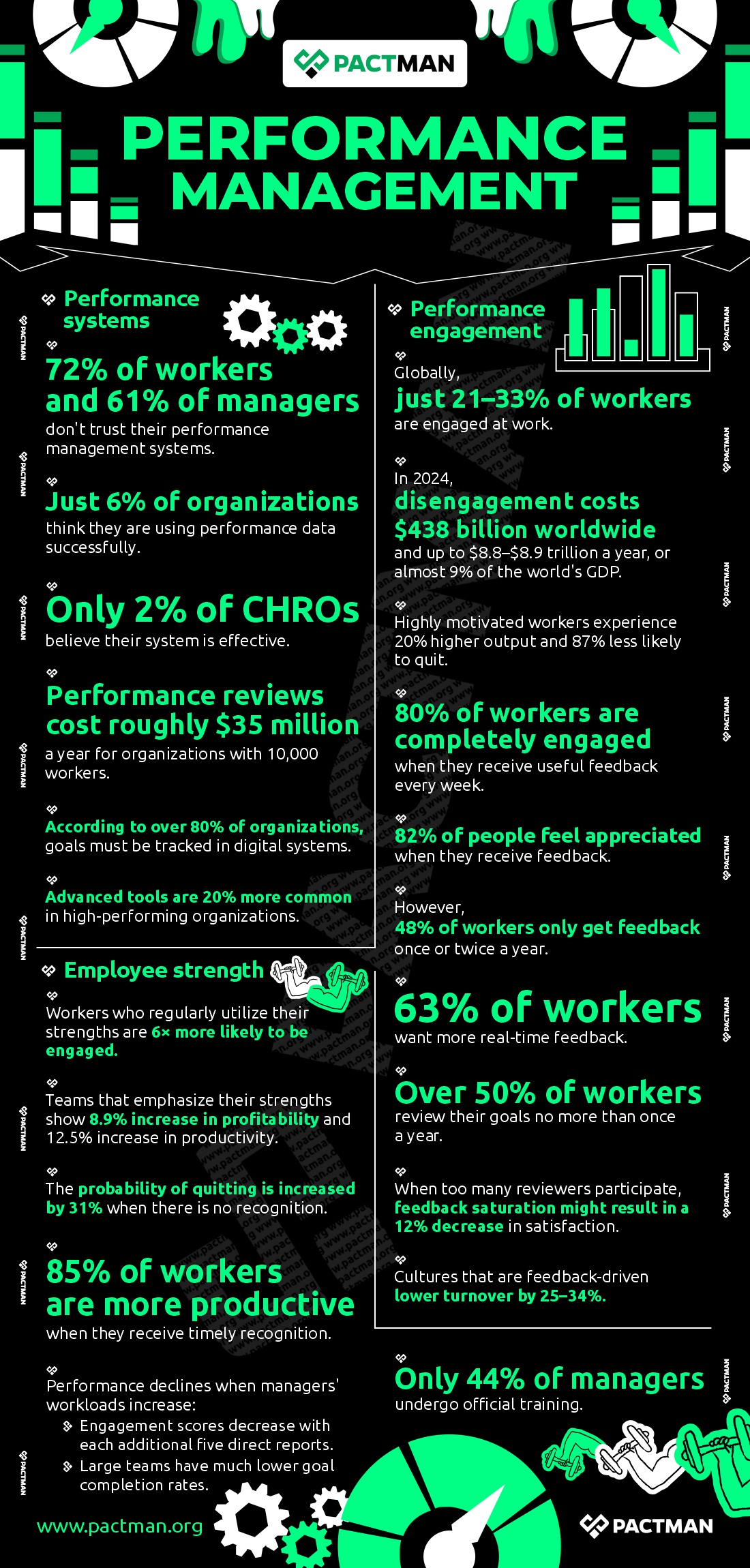
72% of workers and 61% of managers don’t trust their performance management systems. Also, just 6% of organizations think they are using performance data successfully. Only 2% of CHROs believe their system is effective.
Performance reviews cost roughly $35 million a year for organizations with 10,000 workers. According to over 70% of organizations, goals are tracked in digital systems. Advanced tools are 20% more common in high-performing organizations.
b. Performance engagement
Globally, just 21–23% of workers are engaged at work. In 2024, disengagement costs $438 billion worldwide and up to $8.8–$8.9 trillion a year, or almost 9% of the world’s GDP. Highly motivated workers experience 20% higher output and 87% less likely to quit. 80% of workers are completely engaged when they receive useful feedback every week. 82% of people feel appreciated when they receive feedback.
However, 48% of workers only get feedback once or twice a year. Also, 63% of workers want more real-time feedback. When too many reviewers participate, feedback saturation might result in a 12% decrease in satisfaction. All in all, cultures that are feedback-driven lower turnover by 25–34%.
Over 50% of workers review their goals no more than once a year.
c. Employee strength
Workers who regularly utilize their strengths are 6× more likely to be engaged. Teams that emphasize their strengths show 8.9% increase in profitability and 12.5% increase in productivity. On the other hand, the probability of quitting is increased by 31% when there is no recognition.
85% of workers are more productive when they receive timely recognition. Performance declines when managers’ workloads increase:
- Engagement scores decrease with each additional five direct reports.
- Large teams have much lower goal completion rates.
Only 44% of managers undergo official training.
IV
Key Performance Indicators: Determining What Is Important
Key Performance Indicators (KPIs) are the quantitative or qualitative measurements used to monitor progress toward strategic goals. However, KPIs in the charity sector should strike a balance between social impact, operational effectiveness, and financial health.

a. KPIs for Sustainability and Financial Health
Building confidence with donors and the general public requires financial accountability and transparency. To maintain stability and spot early warning indicators of possible hazards, nonprofits must keep an eye on a core set of financial KPIs. Commonly, charity evaluators use the Program Efficiency Ratio as a crucial indicator of organizational health.
Also, nonprofits should be cautious about drastically cutting administrative and fundraising costs. Oftentimes, these overhead costs frequently involve crucial investments in infrastructure and data gathering instruments required for long-term impact assessment.
b. Unconventional KPIs and Social Impact
Secondly, traditional KPIs frequently fall short of capturing the entire extent of a nonprofit’s influence, despite their emphasis on statistics (dollars raised, people served). Hence, unconventional or non-traditional metrics are becoming more popular. This is especially for organizations trying to give their supporters a more captivating story.
This change is demonstrated by the case study of the tiny animal welfare group Paw to the Rescue. The group prioritized gathering funds and saving as many animals as possible in its first year of operation. As they pursued their goals more thoroughly, they came to see that community involvement and pet owners’ emotional health were important but neglected indicators. Through monitoring these qualitative results, organizations can increase overall support and donor retention.
| KPI Category | Metric Example | Strategic Outcome |
| Beneficiary Impact | Improvement in participant self-esteem or skills. | Demonstrates real change in the lives of those served. |
| Community Engagement | Social media amplification and applause rates. | Measures the reach and influence of the organization’s message. |
| Volunteer Engagement | Volunteer retention and satisfaction scores. | Indicates a healthy organizational culture and strong community support. |
| Unconventional Impact | Qualitative stories of beneficiary transformation. | Enhances storytelling capabilities and connection with donors. |
V
Performance Management with a Human Focus
At its core, performance management is a human endeavor. Likewise, it must be created to foster equity, promote trust, and ensure the success of volunteers and staff in mission-driven organizations.

The STARS Goal-Setting Model
Anxiety might result from standard performance systems since they frequently feel transactional or checklist-driven. However, the STARS model is a more successful method, which is based on corporate strategy and individual strengths.
- Strengths-Based: Building momentum by concentrating on an individual’s strengths.
- Trackable: Setting quantifiable, precise goals.
- Aligned: Linking individual objectives to team and organizational priorities.
- Resonates: Making sure the objective has personal significance.
- Stretch: Encouraging advancement without overburdening employees.
By encouraging two-way dialogues that improve manager-staff relationships, this paradigm promotes continual improvement. Also, it acknowledges that workers in nonprofit settings are frequently inspired by the meaningful and motivating nature of their jobs.
VI
Technology and Performance Management Instruments
Implementing comprehensive performance management systems can be challenging for nonprofits due to resource restrictions. Nonetheless, data gathering and analysis are now more affordable and accessible due to the many digital tools.
CRM and Data Management Systems
Nonprofit data management is based on a Customer Relationship Management (CRM) system. It lessens the duplicate crisis and data silos that frequently afflict organizations by enabling the centralization of donor information, volunteer hours, and engagement activities.
| CRM Platform | Best For | Key Features |
| Salesforce (Nonprofit Cloud) | Growth-oriented organizations with complex, customizable needs. | Highly scalable, thousands of integrations, deep reporting capabilities. |
| LiveImpact | Small to mid-sized nonprofits seeking an all-in-one solution. | Combines donor management, case management, and volunteer tools. |
| Little Green Light | Nonprofits focused on pure affordability and ease of use. | Revenue-based pricing, customizable fields, event management. |
| Bloomerang | Organizations prioritizing donor retention and engagement. | Engagement meters, built-in analytics, automatic data hygiene. |
| Givebutter | Small organizations looking for a free, entry-level platform. | Basic email and events; powered by tips and fees. |
Low-Cost Techniques for Gathering Data
For organizations that cannot yet afford a complete CRM, effective performance evaluation can be facilitated by basic digital tools.
- Surveys & Questionnaires: Structured data collection from a geographically dispersed audience is made possible by software like Google Forms, Survey Monkey, and Microsoft Forms.
- Mobile Data Collection: Even when working offline, platforms like Ona and iFormBuilder allow data collection (including photographs and GPS) from faraway locations.
- Analysis and Dashboards: Google Sheets and Microsoft Excel are still effective tools for examining numerical results, like program expenses and participant improvement.
By and large, the most successful firms combine these techniques into a single system. This is achieved by using distinct IDs to connect intake tests to weekly evaluations and long-term feedback. Thanks to this transition from data snapshots to signals of actual change, organizations are able to reorganize their programs based on evidence.
Conclusion
Nonprofit performance management evaluation is a continuous activity that calls for a harmony between qualitative understanding and quantitative rigor. Now more than ever, nonprofits can ensure their services are actually benefiting the community by implementing a cycle of continuous improvement. This includes planning, monitoring, evaluating, and changing.
A nonprofit’s journey toward a better future is fueled by performance management, which is more than just a means of measuring the past. Nonprofits can prosper even in times of scarcity and continue making a significant impact on the world by using data-driven insights and human-centered strategies to address the problems of quality and improvement.