

I
Introduction
A structural revolution is underway in the charitable sector, in which community trust replaces financial capital. Grantmakers and grantees have always had a transactional relationship based on compliance, inspection, and top-down monitoring. However, new data and changing generational expectations indicate that trust is now a useful currency that lowers transaction costs, minimizes risk, and accelerates social impact, rather than a peripheral ethical factor.
Without a doubt, trust-based approaches provide the flexibility needed to handle complex, systemic difficulties. On the other hand, traditional, high-control models frequently inhibit innovation and create a starvation cycle for NGOs.
II
The Economics and Sociology of Community Trust
To understand why community trust has become a new currency, one must first examine its role as a form of social capital. Trust is an unseen currency that makes transactions easier between people who need something from each other. It is more than just a moral feeling.

When it comes to grantmaking, trust serves as a measure of assurance that a nonprofit partner will meet community expectations even without strict, line-item oversight.
a. The Alternative Economic System of Social Capital
Often, community networks function as alternative economic systems in which resources are traded through shared rules, collective labor, and reputation-based reciprocity.
This social capital is often divided into three components, each serving a specific function in the grantmaking ecosystem.
- Bonding capital refers to close-knit relationships within a community that foster trust and early validation.
- Bridging capital refers to the linkages between diverse networks that enable the exchange of skills and partners across institutional boundaries.
- Linking capital to formal institutions, government agencies, and funders is critical for increasing influence.
All in all, effective philanthropy relies on converting intangible social resources into tangible outcomes. Trustworthy connections enable collaborative experimentation, whilst shared mission frameworks serve as templates for program design and evaluation. When grantmakers use these relational assets, they are effectively leveraging a non-monetary currency to encourage social entrepreneurship, especially in resource-constrained situations where traditional financial capital is scarce.
b. The Economic Efficiency of Highly-Trusted Environments
Secondly, the transition to community trust addresses the inefficiencies of the conventional compliance-heavy paradigm. In a low-trust environment, the cost of a grant far exceeds the amount actually distributed. These costs include administrative work for sophisticated programs, financial hardship of strict reporting, and the shadow economy of reclassifying indirect expenses to satisfy arbitrary funding caps.
According to economist Kenneth Arrow, trust is extremely efficient. This saves a great deal of trouble by allowing some reliance on another person’s word. Also, it results in greater strategic flexibility and lower transaction costs.
According to research, nonprofits’ fundraising expenses nearly double when donors split their funds into numerous small donations ($10,000) as opposed to fewer large grants ($100,000). Also, charities would prefer to receive $70 with no restrictions rather than $100 with stringent restrictions. This shows that funder-imposed restrictions could reduce the grant’s intended value by almost half.
III
Critical Statistics on Community Trust
In this section, we will consider the impact of community trust using critical statistics.
a. Community trust in the US and UK
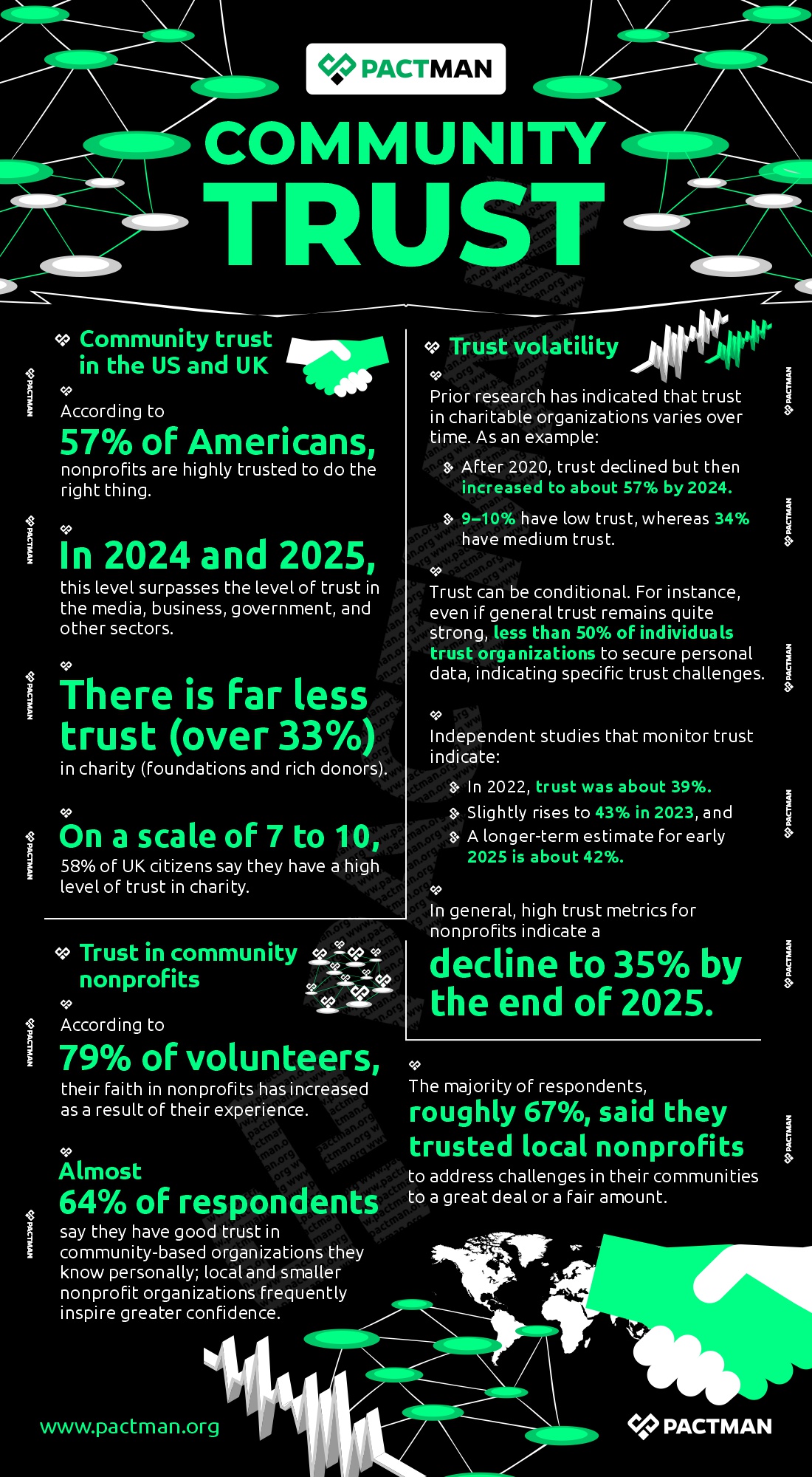
57% of Americans trust nonprofits to do the right thing. In 2024 and 2025, this level surpasses trust in the media, business, government, and other sectors. There is far less trust (over 33%) in charity (foundations and rich donors).
On a scale of 7 to 10, 58% of UK citizens report having a high level of trust in charities.
b. Trust volatility
Prior research has indicated that trust in charitable organizations varies over time. As an example:
- After 2020, trust declined but then increased to about 57% by 2024.
- 9–10% have low trust, whereas 34% have medium trust.
Trust can be conditional. For instance, even if general trust remains quite strong, less than 50% of individuals trust organizations to secure personal data, indicating specific trust challenges.
Independent studies that monitor trust indicate:
- In 2022, trust was about 39%.
- Slightly rises to 43% in 2023, and
- A longer-term estimate for early 2025 is about 42%.
In general, high trust metrics for nonprofits indicate a decline to 35% by the end of 2025.
c. Trust in community nonprofits
According to 79% of volunteers, their faith in nonprofits has increased as a result of their experience. Almost 64% of respondents say they have a high level of trust in community-based organizations they know personally; local and smaller nonprofit organizations often inspire greater confidence.
Also, roughly 67% of respondents said they trusted local nonprofits to address challenges in their communities to a great deal or a fair amount.
IV
The $84 Trillion Demographic Transition
The greatest intergenerational wealth transfer in history is intrinsically tied to the rise of communal trust as a currency. More than $84 trillion is anticipated to be transferred to younger generations between now and 2046. Likewise, an increasing portion is shifting to impact-oriented vehicles, family foundations, and donor-advised funds (DAFs). Millennials and Gen Z are redefining how philanthropic funds are distributed, managed, and evaluated.

1. Institutional Loyalty vs. Issue-Driven
Younger donors are essentially issue-driven, in contrast to older generations, who frequently show allegiance to large institutions. Also, a primary focus of their philanthropy includes causes such as racial justice, social equity, mental health, and climate resilience.
These donors believe that confidence is acquired through demonstrable community-level outcomes and open governance, rather than inherited through an institution’s historical reputation. They are much more willing to support causes that clearly align with their personal values than those that increase brand visibility.
2. Participation is the New Standard of Engagement
Secondly, participation is the new currency for millennial donors. They advocate for participatory philanthropy, which entails direct involvement in the activity being financed through volunteering, donor advisory councils, site visits, or joint grantmaking. This generation sees itself as activists and holistic agents of social change rather than passive benefactors. They require plain-language explanations of how funds are spent and expect impact claims to be verifiable via digital feedback loops.
The advent of digital-first philanthropy has made technology essential to these benefactors. Social media platforms function as discovery engines and accountability tools, with user-generated content and peers being trusted more than official company videos.
While AI and data automation handle back-office responsibilities for analyzing donor behavior, true trust is still built through human interaction, whether at a community event or in a one-on-one chat.
3. Time Dollars and Co-Production: Strengthening Reciprocity
Alternative currencies, such as Time Dollars, are being used to operationalize community trust alongside traditional institutional grantmaking. Time Dollars are a currency created to record, maintain, and reward transactions in which neighbors aid neighbors. This strategy, known as co-production, repositions persons who may not be productive in the traditional market economy as valuable contributors to society.
- Creating Social Capital on an Hourly Basis: In a Time Dollar system, individuals receive credits for services like child care, cooking, or home renovation. Afterwards, these credits can be used to get assistance or sign up for clubs that provide savings on necessary services. This process creates social capital one hour at a time by strengthening reciprocity and trust. It emphasizes that we need each other and supports the idea of value beyond what money can buy.
V
Including Time Money in Charitable Contributions
Governments and foundations have begun experimenting with transforming grants into Time Dollar loans that community organizations must return. This makes it possible to provide community-based services at a cost that is beyond the reach of typical government budgets. By shifting unilateral acts of generosity into reciprocity, philanthropy can turn charity into a stimulus for the recipient’s self-validation and participation.
a. An analysis of the Whitman Institute’s expenditures
The trust-based movement uses The Whitman Institute (TWI) as a core case study. In 2011, TWI decided to disburse its entire endowment by 2022. This was driven by the conviction that attempts to improve equity are more successful when funders actively reduce power disparities.
b. Feedback as an Initiator of Change
The trust-based philanthropy foundation was born in 2013 when grantees told TWI that the way the foundation showed up (its relational approach outside of grant funds) had a big impact on their organizational well-being. As a result, the Trust-Based Philanthropy Project was established, a collaborative effort to make the industry more authentic and inclusive.
c. The Sunset Date’s Reasoning
Rather than coming up with innovative ways to preserve endowments, TWI board members viewed the spend-out as a chance to redistribute them. They suggested that the stage belongs to the next generation. Hence, foundations should abandon their opposition to endings, arguing that perpetuity is a standard they should regularly review. TWI effectively formalized six interconnected principles of trust. Currently, these concepts have been expanded into the 4D framework used by the industry.
Conclusion
As can be seen, the transition from transactional to relational philanthropy is marked by the adoption of community trust as the new currency in grantmaking. It acknowledges that a funder’s control is less valuable than the knowledge and adaptability of communities in a complex and uncertain world. Redistributing power and adopting a mutual accountability paradigm will allow the industry to confront the structural injustices it has long supported.