


I
Introduction
When it comes to leadership and governance, grantmaking organizations must decide whether to serve as adaptive stewards of equity or retreat into the safety of status-quo management in the current era of closed-door philanthropy. Oftentimes, traditional avenues for social change are increasingly restricted by political and legal backlash.

According to research, the most frequent cause of leadership failure in the social sector is portraying adaptive challenges as technical problems that can be resolved with a checklist of quick fixes. However, it primarily calls for significant changes in culture and values. Foundations must create a governance structure that is as adaptable and interconnected as the communities they support.
For the most part, adaptive leadership and governance provide a distinct strategy by prioritizing systems thinking, learning, adaptability, and shared power. This article outlines the practical imperative of adaptive leadership and governance and how foundations might gradually operationalize these concepts.
II
Critical Statistics on Leadership and Governance
In this section, we will consider critical statistics on leadership and governance across organizations.
1. Leadership burnout
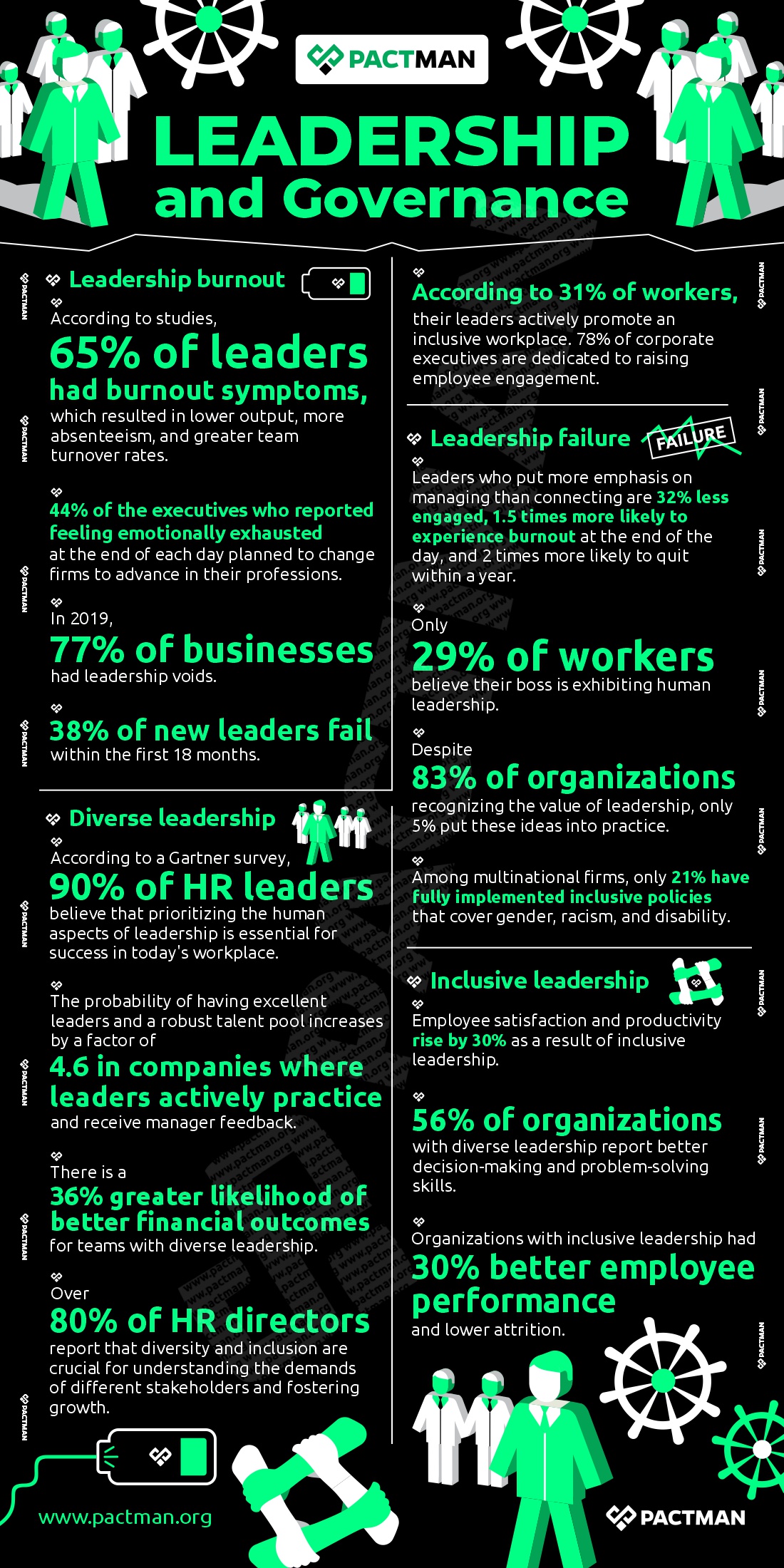
According to studies, 65% of leaders had burnout symptoms, which resulted in lower output, more absenteeism, and greater team turnover rates. 44% of the executives who reported feeling emotionally exhausted at the end of each day planned to change firms to advance in their professions.
In 2019, 77% of businesses had leadership voids. Also, 38% of new leaders fail within the first 18 months.
2. Diverse leadership
According to a Gartner survey, 90% of HR leaders believe that prioritizing the human aspects of leadership is essential for success in today’s workplace. Even more, the probability of having excellent leaders and a robust talent pool rises by 4.6 times in companies where leaders actively practice and receive manager feedback. There is a 36% greater likelihood of better financial outcomes for teams with diverse leadership.
Over 80% of HR directors report that diversity and inclusion are crucial for understanding the demands of different stakeholders and fostering growth. Also, according to 31% of workers, their leaders actively promote an inclusive workplace. 78% of corporate executives are dedicated to raising employee engagement.
3. Leadership failure
Leaders who put more emphasis on managing than connecting are 32% less engaged, 1.5 times more likely to experience burnout at the end of the day, and 2 times more likely to quit within a year. Only 29% of workers believe their boss is exhibiting human leadership. Despite the fact that 83% of businesses recognize the value of leadership, just 5% of businesses really put these ideas into practice.
Among multinational firms, only 21% have fully implemented inclusive policies that cover gender, racism, and disability.
4. Inclusive leadership
Employee satisfaction and productivity rise by 30% as a result of inclusive leadership. 56% of businesses with diverse leadership report better decision-making and problem-solving skills. Also, organizations with inclusive leadership had 30% better employee performance and lower attrition.
III
The Technical vs. Adaptive Trap in Leadership and Governance
The first step in updating grantmaking strategy is to identify the two categories of difficulties that leaders encounter: Technical issues are easy to identify and frequently have well-defined fixes from specialists. Examples include making changes to a budget line item or a grant application portal. On the other hand, adaptive challenges are “challenging” difficulties whose definition is disputed and whose resolution necessitates a change in deeply ingrained attitudes and actions. Treating diversity, equity, and inclusion in grantmaking as a technical issue (e.g., by hiring a DEI officer or establishing a demographic quota) frequently fails because it ignores the underlying unspeakables, such as the power dynamics and hidden mental models that sustain inequity.

Leaders who practice adaptive leadership must get on the balcony, that is, take a break from the day-to-day dance of operations to spot opportunities for systemic change and opposition patterns. Top-down hierarchical control and stagnant planning are hallmarks of traditional governance. However, complex ecosystems call for adaptive governance, a dynamic strategy that prioritizes adaptability and iterative learning.
1. Inverting the Pyramid:
In a traditional organization, the board is at the top, and decision-making authority descends. The frontline, those closest to the communities they serve, are positioned at the top of adaptive organizations. Foundations can respond to economic shocks up to twice as quickly as the national average by granting decision-making authority to teams that have access to the most recent data.
2. Polycentric Leadership
The foundation of adaptive governance is polycentric leadership, in which power is distributed among several positions and levels as opposed to being concentrated in one office. DEI Councils are governance frameworks that connect the executive team to Employee Resource Groups (ERGs) in order to detect non-inclusive policies early on. Also, trust-based decision groups ensure that interventions are socially acceptable by allowing local stakeholders to co-design solutions.
IV
Leadership and Governance Strategy as a Journey
Organizations can better traverse the challenges of diversity, equity, and inclusion by adopting a “Strategy as a Journey” perspective. By and large, this is a significant change from traditional, once-a-year planning cycles to a dynamic, continuous discussion. Oftentimes, strategic sessions fall into the hockey stick trap in many foundations. This firmly projects a short-term decline in performance as a result of investment, followed by a stunning climb in success that seldom occurs in reality.

a. Dissecting the Social Side of Strategy
Strategy is a social process that involves leaders’ feelings, prejudices, and self-interests rather than just being an intellectual endeavor. In the strategy room, choosing the greatest choices for equity is frequently subordinated to winning promotions or safeguarding resources. The journey attitude overcomes these internal social dynamics by using an outside view benchmark data from thousands of other organizations to determine the actual likelihood of a strategy working.
b. The Eight Strategic Changes
To maintain a strategy as a journey, foundations should implement these eight useful changes:
- Transition from the calendar-driven budget season to a continuous dialogue: This includes rolling 12-month plans and ongoing milestone reviews.
- From Getting to Yes to Debating Real Alternatives: Leaders should discuss several strategic options with various risk and investment profiles rather than rushing acceptance for a single vetted strategy.
- From Peanut-Buttering to Picking the 1-in-10s: Quit distributing resources sparingly throughout all departments. According to data, discovering a few big moves, high-probability opportunities, and providing them with all the resources they require leads to breakthrough performance.
- From Approving Budgets to Making Big Moves: Rather than merely establishing spending caps for the upcoming year, strategic sessions should concentrate on innovative projects that can propel the company up the Power Curve of performance.
- Transitioning from Budget Inertia to Liquid Resources: Ensure funding is flexible and liquid. Compared to organizations that transfer resources more slowly, those that reallocate at least 50% of their capital movements over ten years generate much more value.
- Transition from Sandbagging to Open-Risk Portfolios: Establish a culture that welcomes measured risk-taking. Even if a big move fails, organizations should still reward the quality of effort as long as it was a part of a controlled portfolio of risks.
- From You Are Your Numbers to a Holistic View: Rather than focusing solely on immediate financial results, performance should be assessed using a wide range of measures, including qualitative indications of diversity, equity, and inclusion.
- From Forcing the First Step to Long-Term Planning: To create immediate momentum, the strategy should compel the first tangible action step within six months rather than concentrating on lofty, five-year ambitions that never materialize.
The journey
Note that budget-shifting is the strategy. One important lesson to be learned from this approach is that a strategy is never really complete until the budget has changed. Many foundations don’t reallocate the finances required to put their strategies into practice, leaving them as a collection of aspirational ideas on paper.
The journey should ensure that resources are constantly transferred to the areas where they can most effectively contribute to the objective. Grantmaking organizations can transition from timid plans to audacious, data-driven initiatives that significantly improve their social impact by approaching leadership and governance as an ongoing strategic journey.
Conclusion
In summary, adaptive leadership and governance demand a move away from the dreaded hockey stick, which is the promise of future achievement that never materializes. Rather, strategy needs to be seen as an ongoing process with several checkpoints. Foundations and grantmaking organizations can become ecosystem builders rather than just check-writers by institutionalizing leadership and governance through inclusive leadership practices, participatory governance, and advanced impact measurement. This change guarantees that the influence of equity work is a long-lasting structural basis for the future rather than merely a one-time event.