How to Create a Nonprofit Digital Marketing Strategy
Cersai Stark
I
Introduction
Creating a digital marketing strategy is now a crucial part of an organization’s survival and mission fulfillment in a time characterized by economic volatility, changing generational giving habits, and a swift digital change. Rigid, multi-year planning must give way to agile, data-driven frameworks that emphasize real connection and technology integration to make this shift.
Digital Marketing Strategy
The development of a digital marketing strategy is an ongoing, iterative process that must be based on an organization’s goals while utilizing the most recent behavioral and technology insights. Nonprofits can create enduring connections with supporters and advocates by fusing the emotional impact of narrative with the accuracy of data-driven analytics.
II
Strategic Underpinnings and the Development of Visionary Planning
A thorough internal and external diagnostic procedure is the first step in creating an effective digital marketing strategy. Previously, organizations relied on setting five-year strategic plans. However, the modern environment demands a more flexible strategy known as strategic visioning. This involves combining quarterly operational adjustments with long-term goals.
By and large, this approach enables nonprofits to respond to current market fluctuations while addressing societal problems that cannot be resolved within a typical fiscal cycle. Examples of such situations include environmental degradation or health disparities.
The core of every successful marketing strategy demands a comprehensive articulation of the organization’s “why.” This prioritizes the essential reason for its existence and the specific change it aims to bring about in the world. A well-defined mission statement acts as a strategic compass, directing all marketing initiatives and guaranteeing that outreach initiatives are grounded in the organization’s fundamental principles. Effective mission statements are defined by their clarity, conciseness, and lack of technical jargon. Essentially, the length should span 10 to 20 words to optimize memorability.
Element
Strategic Purpose
Ideal Characteristics
Mission Statement
Defines current activities, who is served, and how.
Concise (10-20 words), jargon-free, actionable.
Vision Statement
Describes the desired future state after success.
Inspirational, long-term, impact-focused.
Organizational Values
Establishes the ethical and operational boundaries.
Transparent, community-led, consistent.
Executive Summary
Provides a high-level overview for stakeholders.
High-level, goals-oriented, comprehensive.
Also, organizations must conduct an audit of past performance before deciding on a future route. This entails examining campaign expenses, direct mail response rates, and the degree of engagement from previous digital campaigns. Metrics include average gift amounts, cost per dollar collected, and donor retention rates. This must be assessed in a comprehensive performance audit carried out with complete neutrality.
To maximize ROI, this data-driven method seeks high-impact areas where resources can be redirected.
III
Critical Statistics on Digital Marketing
In this section, we will consider critical statistics on digital marketing to guide strategy planning.
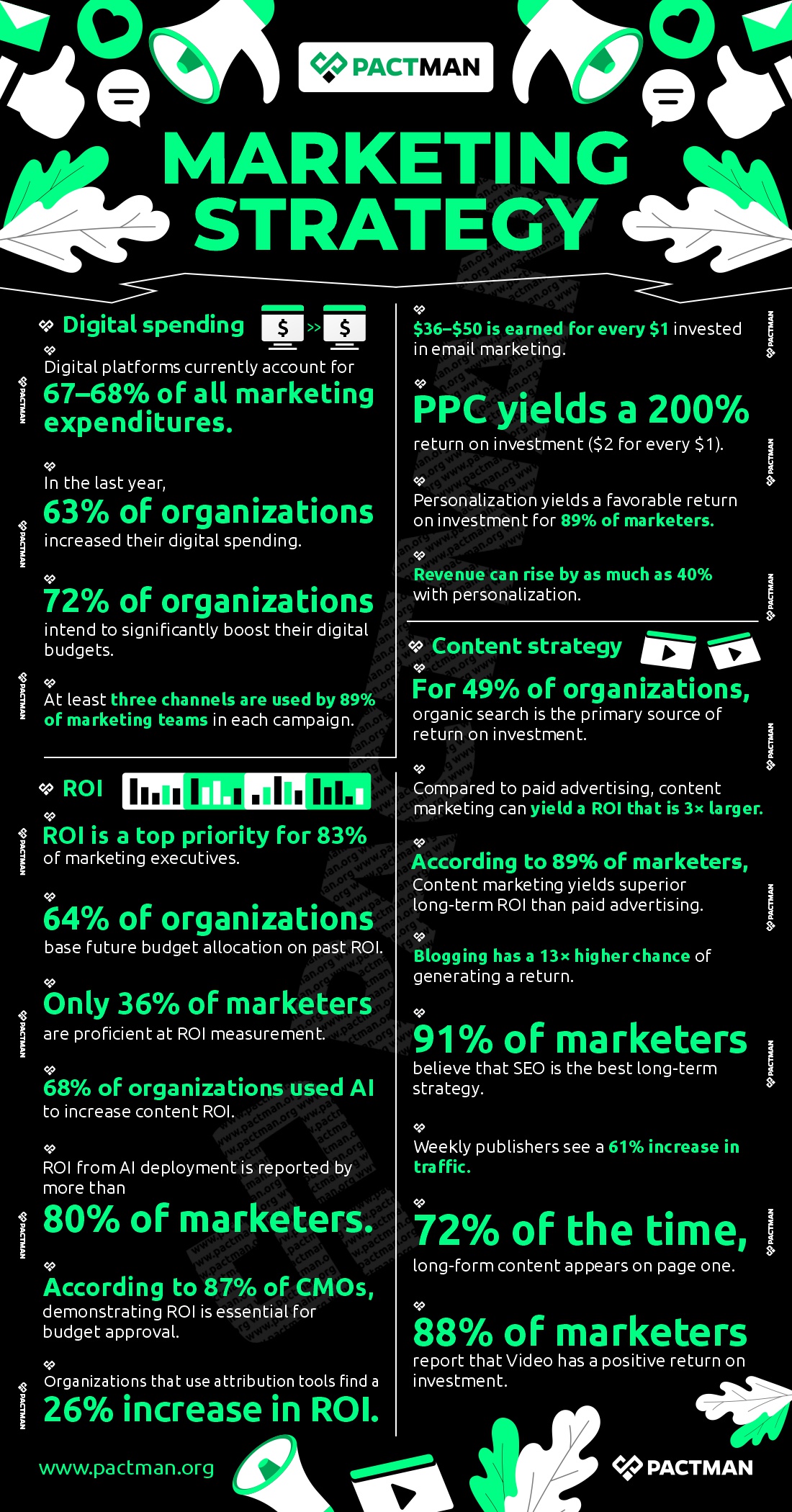
Presently, the primary parameter influencing strategy choices is ROI. ROI is a top priority for 83% of marketing executives. Even more, 64% of organizations base future budget allocation on past ROI. However, only 36% of marketers are proficient at ROI measurement.
68% of organizations used AI to increase content ROI. ROI from AI deployment is reported by more than 80% of marketers. According to 87% of CMOs, demonstrating ROI is essential for budget approval. Organizations that use attribution tools find a 26% increase in ROI.
For 49% of organizations, organic search is the primary source of return on investment. Compared to paid advertising, content marketing can yield an ROI that is 3× larger. According to 89% of marketers, content marketing yields superior long-term ROI than paid advertising.
72% of the time, long-form content appears on page one. 88% of marketers report that Video has a positive return on investment.
IV
Diagnostic Techniques: Situational Analysis and Performance Audits
For the diagnostic stage of developing a digital marketing strategy, the SWOT analysis (Strengths, Weaknesses, Opportunities, and Threats) remains a crucial tool. External elements like new economic trends or the growth of rival NGOs are compared to internal factors like a committed volunteer base or an inspiring success story.
Digital Marketing Strategy
A nonprofit’s weakness can be a small following or scarce resources, while a strength might be hitting key performance indicators or igniting robust social media debates.
Opportunities frequently result from outside trends, such as the availability of new technological tools like AI or an increase in public interest in a certain cause.
Threats, on the other hand, include outside obstacles like rival NGOs vying for donors’ funds or economic downturns that make donors cut back. In order to stand out in a crowded ecosystem, an organization must carve itself a specialized niche by highlighting its unique assets and approach.
Another crucial element is market analysis, which calls on the organization to evaluate the state of the economy, the regulatory landscape, and more general societal trends. For instance, the “dollars up, donors down” era suggests that although overall giving may be rising, it is concentrated among a smaller number of wealthier donors. Consequently, this puts the long-term viability of organizations with small donor bases at risk.
Analysis Type
Focus Area
Key Questions
Internal Audit
Past performance and resources.
What worked last year? Which channels had the highest ROI?
SWOT Analysis
Strategic positioning.
What sets us apart? What external factors could slow us down?
Market Analysis
External environment.
What are the current economic and regulatory trends?
Prospect Research
Potential donor pool.
Who has the financial ability and interest to support us?
a. Goals Architecture: The SMART Framework and KPI Alignment
The SMART framework (Specific, Measurable, Achievable, Relevant, and Time-bound) must be applied to turn a broad purpose into concrete results. Vague goals, like increasing awareness, are inadequate for contemporary strategic execution. However, goals like “increasing online donations by 20% within the next 12 months through targeted social media and email campaigns” are more quantifiable.
Also, Key Performance Indicators (KPIs) must be chosen with organizational priorities in mind. These KPIs frequently include social media engagement levels, email open rates, and website conversion rates for digital-first marketing. Deeper financial measures, such as donor retention rates and the cost per dollar raised, are necessary to evaluate the strategy’s overall health.
To guarantee scalability, nonprofits must choose high-impact strategies based on quantitative performance data. By and large, this entails an ongoing cycle of goal-setting, data-driven insight-seeking, and strategy modification. A donation page’s low conversion rates, for instance, may indicate that it is not mobile-optimized. This will demand a tactical change to streamline forms and enhance the mobile experience.
SMART Component
Definition
Example Application
Specific
Clearly defined goal.
“Acquire 500 new monthly recurring donors.”
Measurable
Quantifiable success indicator.
“Tracked through CRM donation records.”
Achievable
Realistic given resources.
“Based on a 15% increase over last year’s growth.”
Relevant
Aligned with mission.
“Supports long-term financial sustainability for the mission.”
Time-bound
Defined deadline.
“By the end of the fiscal year.”
V
Calendars, Workflow, and Alignment: Putting the Strategy into Practice
As can be seen, the shift from strategy to execution demands careful preparation and a methodical process. Managing timetables, keeping track of deadlines, and ensuring a consistent flow of varied content all rely on a thorough marketing calendar. Strategically, organizations can utilize the calendar to take advantage of crucial occasions, like Giving Tuesday. Also, it provides a great way to maintain regular communication, which fosters donor confidence and establishes your professional reputation.
Digital Marketing Strategy
Defining team responsibilities is essential for organizational efficiency in order to ensure that each team member is aware of their position in the marketing plan. Otherwise, low staff morale and resource waste may result from disarray. Trello and ClickUp are two tools that can help keep things organized and ensure nothing gets overlooked.
Another essential element is stakeholder alignment, which includes key funders, employees, marketing committees, and board members in the planning process. Building the credibility required for long-term support requires being open and honest with funders about accomplishments, difficulties, and financial details. An organism maintains its agility and effectiveness through regular meetings to review progress and modify strategies based on performance data.
Workflow Component
Strategic Purpose
Recommended Tool
Content Calendar
Planning and consistency.
Hootsuite, Buffer, Yeeboo Template.
Project Management
Defining roles and tasks.
Trello, ClickUp, Slack.
Digital Assets
Organizing copy and visuals.
MemoryFox, Canva, Notion.
Analytics Hub
Tracking KPIs in real-time.
Google Analytics, Looker Studio.
Stakeholder Portal
Alignment and communication.
Monday.com, Salesforce CRM.
Conclusion
Retention, personalization, and radical openness must become the sector’s top priorities as it navigates the “dollars up, donors down” period and rising economic instability. Nonprofits may optimize their impact on the communities they serve and secure their long-term viability by embracing digital transformation and cultivating genuine connections.
Setting SMART goals and creating comprehensive supporter personas are the next steps in a strong plan. This starts with a comprehensive audit and SWOT analysis to find a distinct niche. A balanced budget, the strategic application of AI and automation tools, and an organized workflow overseen by project management software and content calendars are all necessary for the omnichannel implementation of this plan.
Organizations that can maintain flexibility, think large, and remain steadfastly dedicated to their basic “why” while adjusting their “how” to the changing needs of a global audience will be successful in the years and beyond.
In the current nonprofit environment, organizations are increasingly relying on technology to enhance donor interaction, ensure compliance, and streamline operations. The Pactman Nonprofit CheckPlus API […]
TABLE OF CONTENTS Introduction Overview of Nonprofit Grant Options Critical Statistics on Nonprofit Grants in the U.S. Nonprofit Grants in Washington Nonprofit Grants in Alabama […]
TABLE OF CONTENTS Introduction Nonprofit Funding Gaps in Africa Critical Statistics on Nonprofit Grants Local vs International Nonprofit Grants in Africa: A Comparative Analysis Overview […]
I Introduction Form 990 is eventually required of all nonprofit leaders. It appears once a year, seems bureaucratic, but quietly accomplishes a crucial task: it […]
The Muslim charity organisations generally assist needy Rwandans and create unity among Muslim fellows. Rwanda has a small but growing Muslim population in a country […]
Muslim charity organisations in Mauritius are active and help in various areas, such as helping poor people, providing education, providing health care, and supporting disaster-affected […]