How to Sustain Diversity, Equity, and Inclusion Impact When Funding Cycles End
Cersai Stark
I
Introduction
Diversity, equity, and inclusion enhance impact, improve decision-making, and align charitable funds with actual community needs when integrated into a grantmaking strategy. While inclusion guarantees involvement and voice, equity deals with fairness and access. Crucially, DEI does not advocate for a reduction in standards. It is about eliminating prejudice, expanding access, and matching funds to real-world situations.
diversity, equity, and inclusion
Foundations committed more than $11 billion to racial equity initiatives between 2020 and 2022. This commitment was sparked by global social justice movements and increased awareness of systemic imbalances. But as the first multi-year grant cycles come to an end, the industry is confronted with a major funding cliff. According to new statistics from 2024 and 2025, some donors are subtly abandoning their commitments to diversity, equity, and inclusion, citing financial strains, donor fatigue, and a more divisive political and legal environment. Also, a crucial issue that many foundations face is how to methodically and sustainably transition from DEI intent to DEI execution.
Grantmaking organizations now face the problem of institutionalizing diversity, equity, and inclusion ideals so that their influence extends beyond the first cash disbursements. In order to safeguard the future of equity through structural integration and responsible exits, this article offers an expert-level strategy on how to sustain diversity, equity, and inclusion even after the funding cycles.
II
What Is Diversity, Equity, and Inclusion (DEI)?
Diversity, Equity, and Inclusion, or DEI for short, is a term that is frequently used in American corporations, educational institutions, government initiatives, and charitable groups. DEI may seem abstract, political, or perplexing to someone unfamiliar with the American system. In actuality, it is a useful concept based on opportunity, justice, and involvement.
diversity, equity, and inclusion
DEI, in simple terms, is about ensuring that individuals from diverse backgrounds are represented, treated fairly, and involved in choices that impact their lives. It is helpful to examine each component of diversity, equity, and inclusion one at a time and then consider how they interact to gain a comprehensive understanding of the concept.
Diversity
Immigration, history, and societal development have all contributed to the United States’ great diversity. But not every group has had equal access to political power, employment, housing, or education. The goal of diversity initiatives is to ensure that organizations don’t just represent historically dominant groups but also the larger community.
However, diversity by itself does not ensure justice or a sense of belonging: herein lies the role of equity and inclusion.
Equity
Fairness is the essence of equity. It acknowledges that people may require varying degrees of assistance to attain comparable results because they do not all begin from the same position. This is a straightforward method of thinking about equity: Giving people the tools they need to succeed. Equity recognizes real-world differences and works to compensate for disadvantages imposed by history, systems, or circumstances.
Inclusion
Inclusion entails both belonging and engagement. Diversity asks who is present, whereas inclusion asks Are people respected, heard, and capable of contributing? An organization may be diverse but not inclusive. For example, a corporation may hire people with diverse backgrounds but dismiss their thoughts. A classroom may have pupils from various cultures, yet fail to create an environment in which everyone feels comfortable speaking. Inclusion ensures that diversity is valued rather than tolerated.
As can be seen, DEI functions as a system, not as individual concepts. If one component is absent, the system fails. Diversity without equity can appear shallow. Equity without inclusion may feel transactional. And inclusion without diversity may still silence crucial voices.
III
Critical Statistics on Diversity, Equity, and Inclusion
In this section, we will consider critical statistics on diversity, equity, and inclusion and their impact.
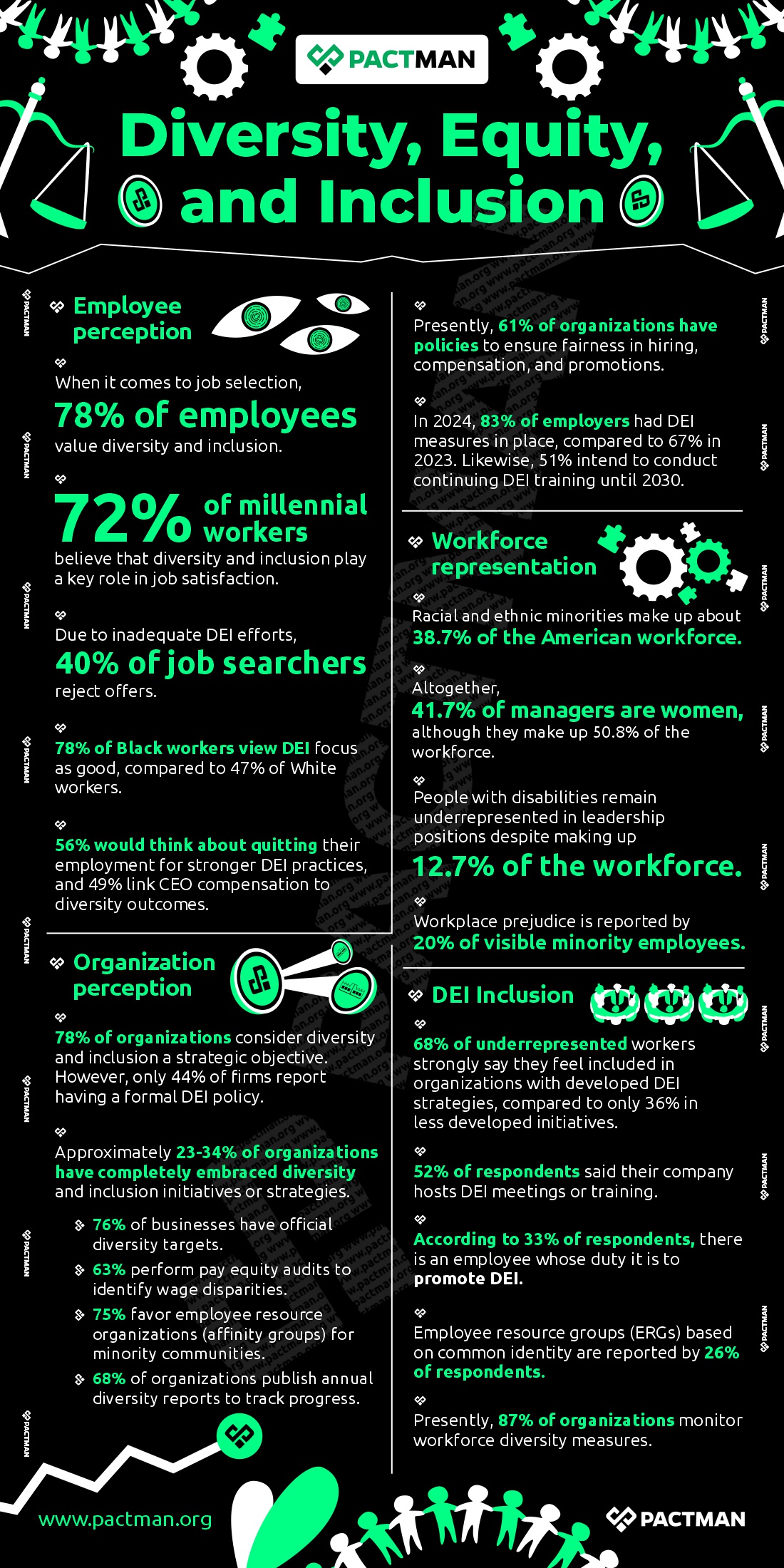
1. Employee perception
When it comes to job selection, 78% of employees value diversity and inclusion. Also, 72% of millennial workers believe that diversity and inclusion play a key role in job satisfaction.
Due to inadequate DEI efforts, 40% of job searchers reject offers. Even more, race, gender, and political affiliation all have a substantial impact on how people view DEI. For instance, 78% of Black workers view DEI focus as good, compared to 47% of White workers.
56% would think about quitting their employment for stronger DEI practices, and 49% link CEO compensation to diversity outcomes.
76% of businesses have official diversity targets.
63% perform pay equity audits to identify wage disparities.
75% favor employee resource organizations (affinity groups) for minority communities.
68% of organizations publish annual diversity reports to track progress.
Presently, 61% of organizations have policies to ensure fairness in hiring, compensation, and promotions. In 2024, 83% of employers had DEI measures in place, compared to 67% in 2023. Likewise, 51% intend to conduct continuing DEI training until 2030.
3. Workforce representation
Racial and ethnic minorities make up about 38.7% of the American workforce. Altogether, 41.7% of managers are women, although they make up 50.8% of the workforce. Also, people with disabilities remain underrepresented in leadership positions despite making up 12.7% of the workforce. All in all, workplace prejudice is reported by 20% of visible minority employees.
4. DEI Inclusion
68% of underrepresented workers strongly say they feel included in organizations with developed DEI strategies, compared to only 36% in less developed initiatives. Also, 52% of respondents said their company hosts DEI meetings or training.
According to 33% of respondents, there is an employee whose duty it is to promote DEI. Even more, employee resource groups (ERGs) based on common identity are reported by 26% of respondents. Presently, 87% of organizations monitor workforce diversity measures.
IV
From Transactional to Transformational Leadership: Effective Ways to Transition
In order to maintain the impact of diversity, equity, and inclusion, foundations and grantee leaders need to shift from a transactional business case perspective to a transformative one. Relying only on profit-based benefits to defend diversity might result in halo effects that conceal systemic flaws.
Here are six simple steps for transformational change to institutionalize equity.
Don’t Cancel DEI: Continue programs in spite of criticism; they can be defended in court.
Hold Up the Mirror: Recognize current disparities by conducting internal hiring, promotion, and compensation audits.
Create an Action Plan: Determine which internal mechanisms are impeding diversity and put formal reforms into place.
Assess progress on a regular basis: The goal is to maintain commitment even throughout the management transition.
Integrate Across the Enterprise: Ensure the CEO and team leaders, not only the DEI office, are at the forefront of driving change.
Move to Transformational Messaging: Humanize employees by connecting with their stories and dreams.
This strategy demands persistence and follow-up to overcome socialization of leadership. Also, it switches the emphasis from checking a box to fostering a culture in which everyone feels free to pursue their goals.
V
Adopting the “Beyond the Hockey Stick” Approach
Additionally, grantmakers ought to include McKinsey’s “Beyond the Hockey Stick” approach into nonprofit planning. This entails viewing strategy as a journey with several milestones rather than an annual planning cycle. Essentially, the idea is to concentrate on big moves that have the best possibility of exceeding the chances for success rather than peanut-buttering resources (spreading them too thinly).
diversity, equity, and inclusion
The transition from yearly planning to a continuous strategy journey is one of seven crucial changes for strategic sustainability.
From looking for yes to discussing viable options.
From allocating resources to selecting the most significant 1-in-10s.
Approving spending plans and taking audacious strategic decisions.
From maintaining liquid and flexible resources to budget inertia.
Sandbagging as well as open-risk portfolio management.
Shifting from a focus on numbers to a more holistic perspective of performance.
From long-term planning to implementing the first actual steps.
To accomplish a step change in representation and equity, organizations should prioritize diversity, equity, and inclusion as a big move and allocate at least 50% of capital shifts to these transformative goals. All in all, a sustainable diversity, equity, and inclusion impact requires intentional institutional design. As funding cycles come to an end, foundations that have evolved from check-writers to ecosystem-builders will be able to continue their impact. This transformation necessitates a mix of trust-based finance, strong technical support, sophisticated impact monitoring, and a commitment to responsible exits.
Conclusion
Changing the corporate narrative is the final stage in integrating diversity, equity, and inclusion. Now more than ever, foundations must shift from the transactional business case, which uses profit as the only justification for diversity, to transformational messaging.
By connecting the mission to the unique aspirations and struggles of staff members and community members, transformational leadership humanizes the task. Also, foundations can guarantee that equity is a long-term component of their strategic legacy rather than a fad by institutionalizing these processes.
1 response to “How to Sustain Diversity, Equity, and Inclusion Impact When Funding Cycles End”
[…] Secondly, nonprofits are rewarded for concealing failures due to perverse incentives created by the demand to look good for patrons. Risk-taking and drastic strategy modifications are frequently unfeasible in a system where funding relies on demonstrating the effectiveness of programs. This fosters a culture of “success theater” in which the real effectiveness of the effort is ignored, and vanity metrics are utilized as shiny trophies to win the next funding cycle. […]
In the current nonprofit environment, organizations are increasingly relying on technology to enhance donor interaction, ensure compliance, and streamline operations. The Pactman Nonprofit CheckPlus API […]
TABLE OF CONTENTS Introduction Overview of Nonprofit Grant Options Critical Statistics on Nonprofit Grants in the U.S. Nonprofit Grants in Washington Nonprofit Grants in Alabama […]
TABLE OF CONTENTS Introduction Nonprofit Funding Gaps in Africa Critical Statistics on Nonprofit Grants Local vs International Nonprofit Grants in Africa: A Comparative Analysis Overview […]
Thinking of the best charities to donate to? Prioritising organisations that drive meaningful change in their communities is very crucial. Nonprofit organisations provide notable support […]
Application Programming Interfaces (APIs) enable disparate nonprofit systems to connect and route data effectively. It’s rare for a nonprofit to operate on a single platform. […]
When considering the best charities to donate to, it is best to prioritise impact across local communities. In South Sudan, challenges such as the current […]










1 response to “How to Sustain Diversity, Equity, and Inclusion Impact When Funding Cycles End”
[…] Secondly, nonprofits are rewarded for concealing failures due to perverse incentives created by the demand to look good for patrons. Risk-taking and drastic strategy modifications are frequently unfeasible in a system where funding relies on demonstrating the effectiveness of programs. This fosters a culture of “success theater” in which the real effectiveness of the effort is ignored, and vanity metrics are utilized as shiny trophies to win the next funding cycle. […]