Strategic Nonprofit Funding in Times of Economic Uncertainty
Cersai Stark
I
Introduction
One situation in the field of nonprofit funding is called the procyclical paradox. Funding should ideally rise to meet the growing demands of the community during economic downturns. The data, however, presents a different picture. In practice, nonprofit spending and revenue typically fall at the same time that local and national economies do. The double hit of declining resources and increasing demand puts grantors in a precarious situation: how can you invest efficiently when your endowments are being squeezed?
Nonprofit funding
The volatility paradox is a fundamental contradiction that governs the global philanthropy industry and nonprofit funding. During economic downturns, the demand for social services skyrockets. This ranges from food security and rental help to mental health care and vocational training. Simultaneously, the financial engines that power nonprofit funding, such as individual donations, corporate social responsibility budgets, and foundation endowments, are frequently volatile or in decline.
This structural difficulty is particularly acute in circumstances where the government relies significantly on the third sector to supply the social safety net. Not to mention, the sector’s stability is connected to the same market forces generating the crisis.
The traditional grantmaking script is being revised as we traverse the economic terrain of 2026, which is marked by a funding cliff when pandemic-era assistance expires, and inflation persists. The transition of top grantors from reactive survival to strategic resilience is examined in this case study.
II
Historical Precedents: Lessons from 2008 and 2020
a. The Structural Shock of the Great Recession
The economic downturn of 2008 serves as a primary benchmark for the impact of financial system failure on nonprofit funding. Triggered by a collapse in the subprime mortgage market and the subsequent infection of the global financial system, this crisis led to the largest year-over-year decline in charitable giving since the 1960s.
Nonprofit funding
Total giving dropped by 7% in 2008 and another 6.2% in 2009. Also, this decline was not uniform across all donor types; while individual giving was affected by lost wealth and income, foundation and corporate giving were hit by losses in the stock market and investment portfolios.
A critical lesson for grantors from this era was the necessity of asset averaging. Foundations that utilized a rolling multi-year average of their endowment value were better protected from sudden market drops. This allowed them to hold giving levels steady even as their assets declined. Likewise, some foundations chose to increase their payout rates beyond the standard 5%, recognizing that the crisis necessitated exceptional intervention.
b. The Exogenous Sanitary Shock of COVID-19
In contrast to the 2008 financial crisis, the COVID-19 pandemic represented an exogenous shock that simultaneously froze both the supply of services and the demand for labor. While the financial system remained relatively strong at the onset of the pandemic, the stay-at-home orders and quarantine measures caused an immediate collapse in economic activity.
For the nonprofit sector, this was a dual crisis of operation and finance. Organizations had to digitize their services overnight while facing a collapse in fee-for-service revenue and traditional fundraising events. Even more, the pandemic forced a radical experiment in grantmaking speed and flexibility. Grantors launched rapid-response funds that moved capital in days rather than months.
They also began to waive traditional reporting requirements and converted project-specific grants into general operating support. Essentially, the goal was to allow nonprofits to pivot toward emergency relief. This period underscored the value of financial optionality: the ability of an organization to have liquid resources that can be redeployed as new challenges emerge.
III
Critical Statistics on Nonprofit Funding
In this section, we will consider critical statistics on nonprofit funding and its impact within the sector.
a. U.S. charitable giving
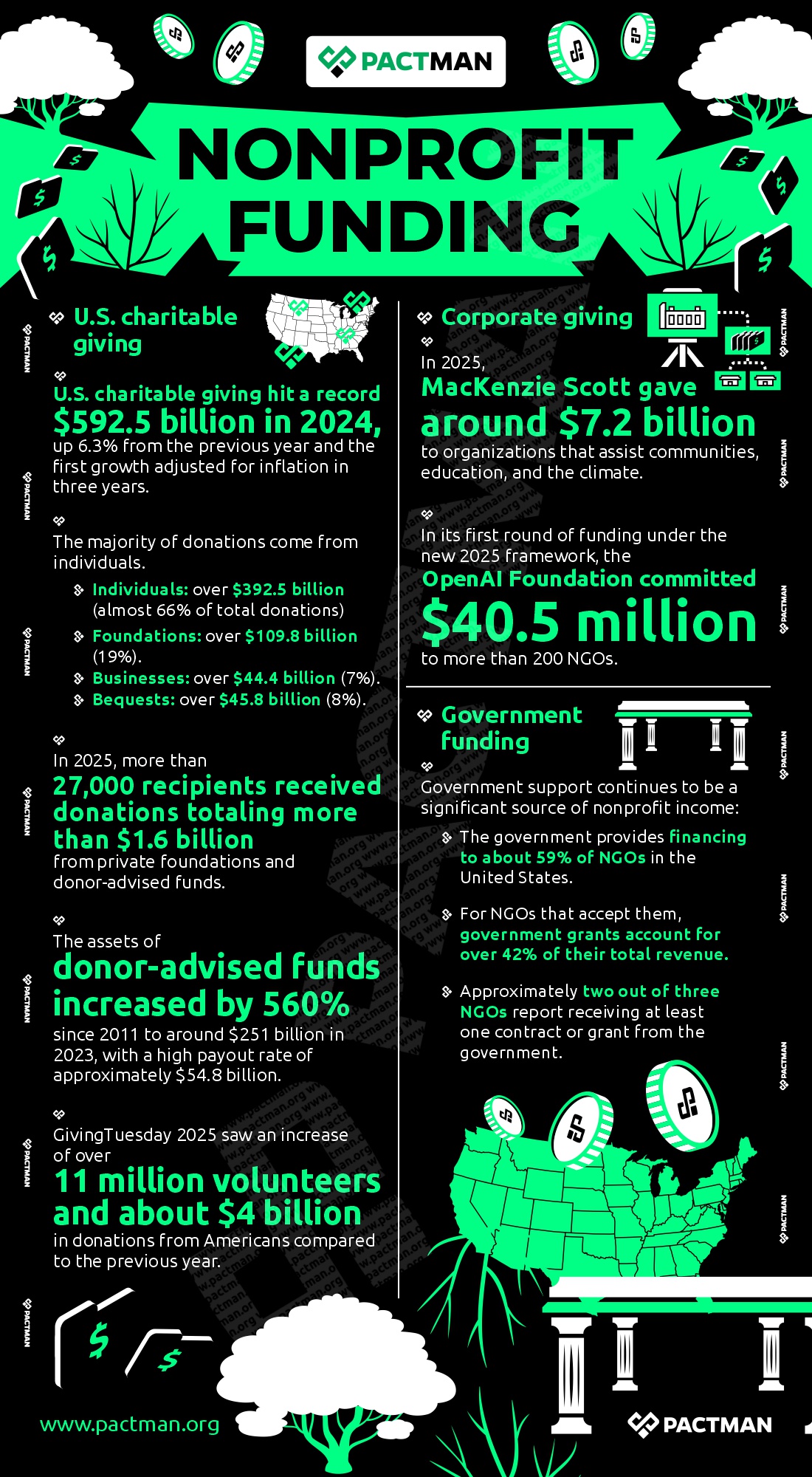
U.S. charitable giving hit a record $592.5 billion in 2024, up 6.3% from the previous year and the first growth adjusted for inflation in three years. Also, the majority of donations come from individuals.
For NGOs that accept them, government grants account for over 42% of their total revenue.
Approximately two out of three NGOs report receiving at least one contract or grant from the government.
IV
The Lifecycle of Resolve-to-Reform in Nonprofit Funding
Conventional top-down management structures frequently crumble under the weight of uncertainty during times of nonprofit funding crisis. In such situations, grantors can create a minimum viable nerve center to guide an organization through such stress. With enterprise-wide authority, this nerve center is a cross-functional team that can swiftly test strategies, maintain successful solutions, and discard unsuccessful ones.
Nonprofit Funding
The Crisis Navigation Five Stages
For the most part, five overlapping stages show the path from early disruption to long-term sustainability:
Resolve: In order to stabilize the organization, leaders need to decide how big, how fast, and how deep to go. This frequently entails addressing urgent cash demands and ensuring that workers are safe.
Resilience: This emphasis switches to handling the strain on the financial system, such as issues with solvency and profitability. To preserve the organization’s muscle, its top-performing employees and core mission programs, this stage necessitates the strategic pruning of low-value projects.
Return: Organizations must manage the process of restoring operational health while striking a balance between the necessity of reactivating systems and the continuous danger of health or market resurgences.
Reimagination: This phase entails a thorough reevaluation of the organization’s value delivery methods. For instance, using social entrepreneurship models to replace lost grant funds or moving toward virtual platforms.
Reform: By promoting improved government reimbursement procedures and fair funding networks, leaders help to shape the social and regulatory structure of the next normal.
All in all, a nerve center’s effectiveness is dependent on deliberate calm and bounded optimism. This is the ability of leaders to remove themselves from a risky circumstance and adopt reason while giving their teams a realistic sense of hope. Also, this leadership approach avoids the inaction and paralysis that frequently impedes the crucial decisions required at the first stage of Resolve.
Case Study 1:
Ford Foundation and the Power of Social Bonds
A once-in-a-century problem in 2020 made the Ford Foundation realize that conventional endowment spending would not be enough. Generally, a yearly distribution of approximately 5% of investment assets is mandated by law for the majority of foundations.
In contrast, Ford made a historic move by issuing $1 billion in taxable Social Bonds in response to the sector’s existential danger. As a result, Ford was able to expand its grantmaking from $600 million to over $1.1 billion annually without liquidating its endowment during a market downturn. The foundation achieved this by employing the strategy of leverage, not liquidation, through the issuance of bonds. Their AAA credit rating and historically low interest rates allowed them to quickly and significantly increase nonprofit funding for organizations that address inequality.
The Explainer: To put it another way, it’s like taking out a mortgage to pay for a major home improvement. When the market is down, you don’t sell your investments. Instead, you take out a low-interest loan using your good credit, which lets your investments recover while you deal with the current crisis.
Case Study 2:
Trust as a Strategic Asset: The MacKenzie Scott Effect
Perhaps the biggest change in contemporary nonprofit funding is the shift to trust-based philanthropy, which was most prominently led by MacKenzie Scott. Scott has awarded substantial, unrestricted gifts totaling more than $19 billion to thousands of organizations since 2020.
The leveraged strategy is Unrestricted Growth Capital. Conventional grants frequently have strings attached, such as specific projects, intricate reporting, and severe deadlines. In contrast, General Operating Support (GOS) is a feature of Scott’s model that allows nonprofit executives to adjust their strategy as needed.
Principal Results:
Reserves: In order to withstand workforce shortages and inflation, recipients of these mega-gifts had a median of twice as many months of operating reserves as their counterparts.
Credibility: 61% of leaders utilized the Scott award as a seal of approval to draw in new donors, thereby attracting additional funding.
Case Study 3:
The Architecture of Capital Aggregation with Blue Meridian Partners
As we all know, more funding is needed to address systemic poverty than can be supplied by any one foundation. In response, Blue Meridian Partners launched a pioneering strategy that scales tested solutions by combining resources from several high-net-worth donors.
The Plan: Taking Scale into Account in its operations, Blue Meridian adopts an investor mindset. They provide unprecedented and unrestricted expansion capital, often $100 million or more over five to ten years, after conducting thorough due diligence.
The Explainer: This is venture capital in a nonprofit form. Rather than each of twenty foundations contributing $50,000 to separate, unrelated projects, they combine their funds to provide one group with the $1 million required to expand a successful program across the country.
V
The Grantor’s Economic Uncertainty Checklist
Grantors should give top priority to the following to maximize impact in economic uncertainty.
Priority Area
Strategic Action
Benefit
Operational Flexibility
Move from project-specific grants to unrestricted funding.
Empowers nonprofits to respond to local inflation and wage hikes.
Administrative Ease
Adopt “Common App” style reporting to reduce the grantee burden.
Trimming 15% off fundraising costs could save the sector $4 billion annually.
Capacity Building
Fund “backbone” support and staff wellness initiatives.
High-performing staff are a nonprofit’s “muscle”; losing them is more expensive than keeping them.
Scenario Planning
Use AI and predictive modeling to identify “at-risk” grantees early.
VI
Strategic Frameworks for Building Relationships and Trust-Based Philanthropy
Over the past ten years, trust-based philanthropy (TBP) has emerged as the most notable change in nonprofit funding. With a focus on mutual trust rather than tacit mistrust, this paradigm aims to lessen the power disparities that naturally exist between grantors and grantees.
Nonprofit Funding
Supporters of TBP contend that an organization becomes more creative and resilient when a funder has faith in a nonprofit leader to know how to utilize funds. All in all, putting TBP into effect entails six fundamental procedures that are crucial in unpredictable economic times:
Unrestricted funding for multiple years: This minimizes the grant application treadmill that takes up leadership time and offers the stability required for long-term planning.
Doing the Homework: Rather than requiring groups to create comprehensive new proposals, funders assume the responsibility of conducting due diligence on their own by investigating them using publicly available data and reports.
Simplifying and Streamlining Paperwork: Nonprofit employees may concentrate on providing services by spending less time on applications and reporting.
Being Responsive and Transparent: In times of crisis, open communication makes it possible to analyze what is working and what needs to change more realistically. Actively seeking grantees’ opinions and acting upon them enables funders to comprehend the practical effects of their programs.
Providing Assistance Beyond the Check: When it comes to constructing organizational infrastructure, non-cash assistance like networking and leadership coaching can be just as beneficial as cash.
VII
The Full Cost Framework in Nonprofit Funding: Putting Money Into the Engine
Strategic nonprofit funding necessitates a break from the overhead myth, the notion that efficiency is proxied by a low administrative cost ratio. According to the Full Cost Framework, a nonprofit organization needs funding for its true costs, which include basic institutional infrastructure as well as program delivery, to be strong and sustainable.
Nonprofit Funding
Grantors who apply this approach understand that unrestricted surpluses are not just spare funds. Rather, they are the means by which nonprofit organizations develop the resilience and financial stability needed to withstand a downturn. Funding is included in a full cost approach for:
Working capital: This is the money required to bridge the gap between bill payment and income receipt.
Operating Reserves: A “rainy day fund” that can sustain operations for several months during periods of low revenue.
Fixed Asset Replacement: Money set aside to fix facilities or upgrade technology so the organization doesn’t lag in terms of operations or technology.
Debt service: This is the capacity to repay loans or bridge finance taken out in times of need.
The New Strategic Funding Paradigm
A period of unending instability has replaced the age of steady funding conditions and predictable economic growth. The charity paradigm, in which one-time gifts are given for specific results, must give way to the investment model, where resources are used to create robust, resilient institutions for grantors.
The strongest organizations are those backed by grantors who place a high value on adaptability, institutional health, and connections based on trust. The following fundamentals describe strategic nonprofit funding in the twenty-first century:
Unlimited Flexibility: Understanding that during a crisis, nonprofit leaders are in the best position to distribute resources in real time as needs change.
Long-Term Commitment: Shifting from an annual funding cycle to commitments that last three to five years to retain staff and provide strategic depth.
Localization: Putting money into grassroots groups and local middlemen who have the social connections and cultural capital to successfully provide services in hard-to-reach places.
Structural infrastructure is the funding of an organization’s full costs; its workforce, working capital, and technology, so that the industry not only weathers the current recession but also comes out stronger. Likewise, the grantor’s job is to provide the financial scaffolding that enables local communities to leverage their social capital in places where urbanization and inflation create a challenging environment.
From digital health upgrades to cascading funding methods, the objective is always the same: to ensure the nonprofit sector continues to be a crucial, resilient, and adaptable partner in the fight for social justice and shared prosperity. The tap of international help may occasionally run dry, but organizations with deep institutional roots will thrive as long as their grantors understand that resilience is a requirement, not a luxury.
Conclusion
A period of steady economic expansion and stable financial conditions has been replaced by a period of continual volatility. This shift requires grantors to reject the charity model, which provides one-time gifts for specific outcomes, and instead adopt an investment strategy, which invests resources to build strong, resilient institutions. The most successful are grantors who value flexibility, institutional health, and trust-based relationships.
Now more than ever, the nonprofit industry must fundamentally transition from a scarcity perspective toward strategic agility. This is essential to survive and perform efficiently in an uncertain economic environment. Organizations that will be significantly more resilient to economic procyclical shocks must embrace data-driven risk management, prioritize employee well-being, and resist the need to minimize acquisition costs. All in all, the path forward demands perseverance, endurance, and return.
In the current nonprofit environment, organizations are increasingly relying on technology to enhance donor interaction, ensure compliance, and streamline operations. The Pactman Nonprofit CheckPlus API […]
TABLE OF CONTENTS Introduction Overview of Nonprofit Grant Options Critical Statistics on Nonprofit Grants in the U.S. Nonprofit Grants in Washington Nonprofit Grants in Alabama […]
TABLE OF CONTENTS Introduction Nonprofit Funding Gaps in Africa Critical Statistics on Nonprofit Grants Local vs International Nonprofit Grants in Africa: A Comparative Analysis Overview […]
As a climate change leader, Virginia establishes its position by implementing forward-thinking policy measures through renewable power investments and nature protection initiatives. The government of […]
The state of Illinois stands out as a climate change leader through its dedicated green legislation, its allocation of renewable energy financing and its distinctive […]