Social Impact Assessment with SDGs: Lessons from Multi-Country Programs
Cersai Stark
I
Introduction to Social Impact Assessment
Social impact assessment is the process of analysing, monitoring, and controlling the intended and unforeseen social repercussions of planned interventions such as policies, programs, and initiatives. The discipline was previously based on biophysical and environmental compliance. However, the current paradigm shift emphasizes net gains and good outcomes that benefit society. As the 2030 deadline for the Sustainable Development Goals approaches, the importance of aligning localised social assessments with global ambitions has become a top priority for US municipalities, corporations, and non-profits.
In this article, we will consider how organizations can align social impact assessment with the SDGs.
II
The Integration of Social Impact Assessment with Global Goals
The convergence of the SDGs and Social Impact Assessment signifies a shift away from exclusively impact-oriented responses toward objective-led planning. Essentially, the 17 goals, 169 targets, and 230 indicators that make up the SDG framework are intended to balance social, environmental, and economic areas. These objectives give social impact assessment specialists a uniform set of results that can be utilised to describe a project’s social impact. Also, this alignment is not just a reporting activity. Rather, it is an integrated approach that assists organizations in identifying positive contributions, managing risks, and communicating value to a wide range of stakeholders.
Social Impact Assessment
Through voluntary local reviews and corporate sustainability initiatives, the application of the SDGs to Social Impact Assessment is gaining traction in the US. Primarily, the first step in this process is mapping, in which an organization determines which objectives and aims are most crucial to its operations. The SDGs, in contrast to previous development frameworks, are relevant to all nations, including wealthy ones like the United States. Even more, they shift the focus from international aid to local and national responsibility.
Linking Goal Objectives to Social Aspects
Also, the ability of social impact assessment to provide the broad objectives of the SDGs in a concrete form is what makes the tool useful. By including these objectives in current impact assessment laws and guidelines, practitioners can incorporate sustainability into the early phases of decision-making. For example, a health impact assessment for a new urban development project in a U.S. city would logically align with Goal 3 (Good Health and Well-Being). Likewise, it can have a specific emphasis on lowering pollution-related illnesses and enhancing access to medical care. Goals 4 (Quality Education) and 8 (Decent Work and Economic Growth) would be mapped to an evaluation of a workforce development program.
Social Impact Domain
Sustainable Development Goal (SDG)
Key Alignment Target
Education and Skills
SDG 4: Quality Education
4.4: Increase the number of youth and adults with relevant skills for employment
Gender and Equity
SDG 5: Gender Equality
5.5: Ensure women’s full and effective participation and equal opportunities for leadership
Health and Safety
SDG 3: Good Health and Well-being
3.9: Substantially reduce the number of deaths and illnesses from hazardous chemicals and pollution
Economic Inclusion
SDG 10: Reduced Inequalities
10.2: Empower and promote the social, economic and political inclusion of all
Urban Resilience
SDG 11: Sustainable Cities and Communities
11.3: Enhance inclusive and sustainable urbanization and capacity for participatory planning
Climate Adaptation
SDG 13: Climate Action
13.1: Strengthen resilience and adaptive capacity to climate-related hazards
As can be seen, the Social Impact Assessment process provides the “how” for these worldwide “whats”. Also, it provides an organized approach to assess how a project can impact a community’s economic mobility (Goal 10), exposure to environmental risks (Goal 3), or access to justice (Goal 16).
III
Critical Statistics on Social Impact Assessment (SIA)
In this section, we will consider critical statistics on social impact assessment alongside their effect and adoption over the years.
a. Poor SIA adoption
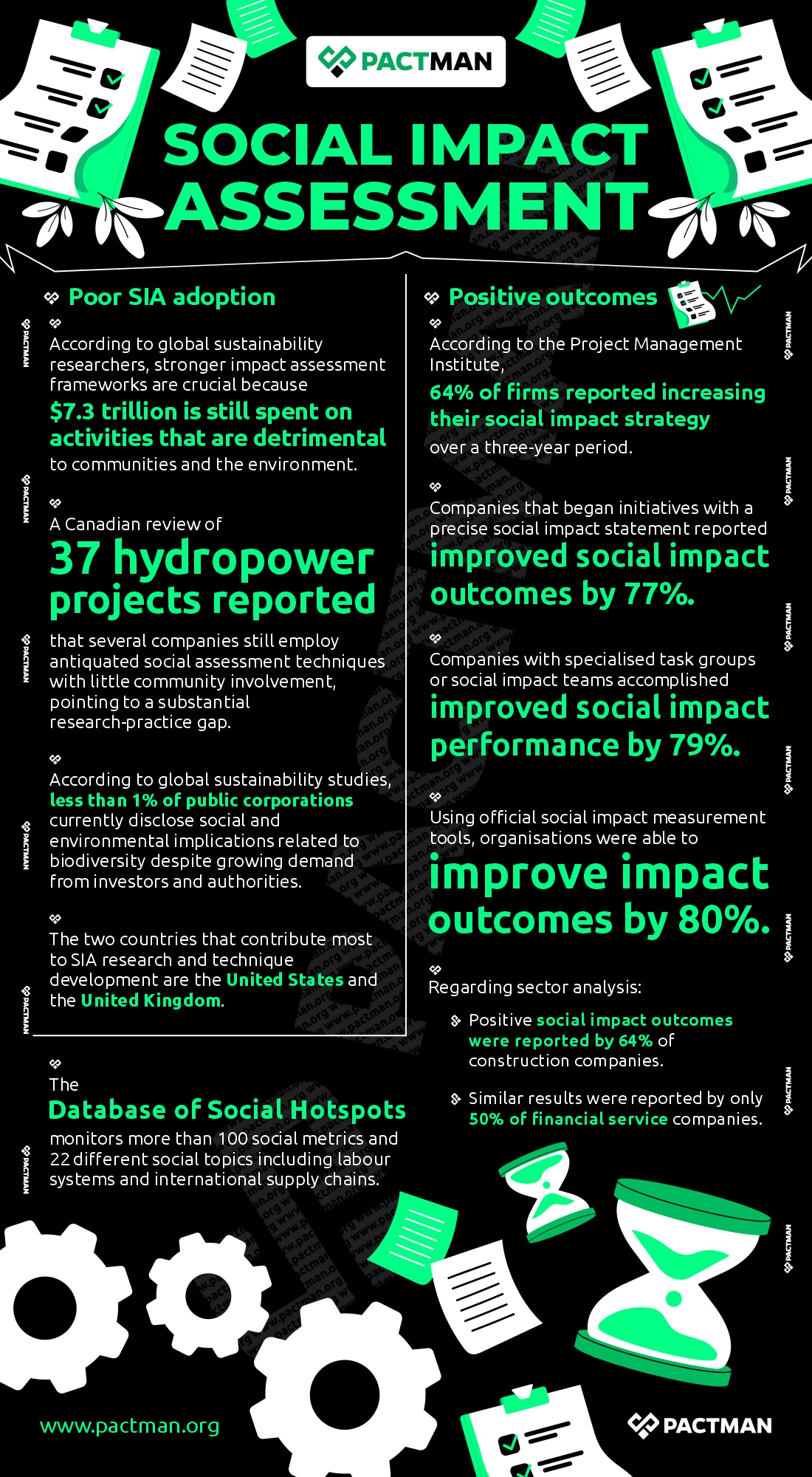
According to global sustainability researchers, stronger impact assessment frameworks are crucial because $7.3 trillion is still spent on activities that are detrimental to communities and the environment. A Canadian review of 37 hydropower projects reported that several companies still employ antiquated social assessment techniques with little community involvement, pointing to a substantial research-practice gap.
Social Impact Assessment
According to global sustainability studies, less than 1% of public corporations currently disclose social and environmental implications related to biodiversity despite growing demand from investors and authorities.
The two countries that contribute most to SIA research and technique development are the United States and the United Kingdom.
b. Positive outcomes
According to the Project Management Institute, 64% of firms reported increasing their social impact strategy over three years. Companies that began initiatives with a precise social impact statement reported improved social impact outcomes by 77%.
Companies with specialised task groups or social impact teams accomplished improved social impact performance by 79%. Using official social impact measurement tools, organisations were able to improve impact outcomes by 80%.
Regarding sector analysis:
Positive social impact outcomes were reported by 64% of construction companies.
Similar results were reported by only 50% of financial service companies.
The Database of Social Hotspots monitors more than 100 social metrics and 22 different social topics, including labour systems and international supply chains.
IV
Methodological Takeaways from Global Social Impact Assessment Initiatives
Over the years, the application of the SDGs across different nations has produced crucial insights into social assessment techniques. The ongoing disparity between political aspirations and technological viability is one of the main conclusions drawn by the international monitoring community. At the project or sub-national level, many goals were set without a clear idea of how they would be assessed. Thus, one of the most crucial lessons is that policymakers and the statistical community must engage in structured dialogue from the start of any endeavour. This guarantees that the indicators used for a Social Impact Assessment are methodologically solid, quantitative, and aspirational.
Social Impact Assessment
The Problem of Selective Reporting and “Cherry-Picking” in Social Impact Assessment
In simple terms, cherry-picking is when organizations only report on the SDGs where they have a positive impact while ignoring potential negative implications. This has been flagged as a key danger in multi-country projects. Oftentimes, solutions to complex issues that are frequently marked by trade-offs are necessary for sustainable transformation. For instance, if a project intended to boost economic growth (Goal 8) is not well managed, it may unintentionally increase inequality (Goal 10) or environmental deterioration (Goal 15). Hence, a comprehensive social impact assessment is crucial to combat this issue.
Even if the primary focus is on an area of the 17 goals, practitioners are encouraged to employ tools that require them to evaluate their influence on all 17 goals. As a result, a thorough map of direct positive, indirect positive, direct negative, and indirect negative effects is produced. Not to mention, understanding impact effects is very important. For example, a direct influence on clean water (Goal 6) will probably have an indirect good impact on health (Goal 3) and education (Goal 4) by cutting down on the amount of time kids spend getting water or recuperating from sickness.
Converting Ex-Post to Ex-Ante Evaluations in Social Impact Assessment
Social impact assessments are most successful when carried out ex ante, or before commitments are made. This enables decision-makers to refine or even suggest ideas that could have disastrous social repercussions. Ex-post evaluations, on the other hand, prioritize results after they have occurred, frequently when it is too late to foresee unforeseen repercussions. In the case of the United States, this entails incorporating the SDGs not only as a framework for year-end reporting but also into the planning stage of infrastructure, social policy, and corporate strategy.
V
Social Impact Assessment Theory of Change: A Simplified Framework for Interpreting Impact
Without a doubt, the technical terms indicators and targets can be intimidating to non-experts and community stakeholders. Oftentimes, professionals employ the Theory of Change paradigm to close this knowledge gap. A theory of change is a road map that describes how a specific action is anticipated to have the intended long-term impact. Essentially, it reveals the underlying presumptions that underpin a project’s reasoning. Also, it goes beyond a straightforward list of tasks to explain the why and how behind the anticipated outcomes.
Social Impact Assessment
The Fruit Farm Example
The Fruit Farm analogy is a popular and very powerful technique to describe Social Impact Assessment and its elements. For the most part, it makes the intricate hierarchy of the SDGs more approachable.
Long-Term Goal: The ultimate achievement, similar to the Sustainable Development Goal itself, such as selling fruit to support the community and secure the farm’s future.
Impact: The systemic shift, including the ecosystem’s general health and the farm’s provision of financial stability.
Long-Term Result: A robust, mature tree that regularly produces fruit of excellent quality.
A developing sampling that has made it through its first few seasons is the mid-term outcome. Secondly, a sprouting seed that has penetrated the ground is the short-term result.
Lastly, the quantity of fertilizer applied, the number of seeds sown, or the number of hours spent watering are examples of outputs, the direct results of your labour.
Activities: Taking care of the farm, weeding, and planting.
Inputs: The necessary resources, such as money, seeds, equipment, and labour.
“The soil is nutrient-rich,” “there will be enough rain,” and “there is a market for the fruit” are examples of assumptions that are necessary for the project to succeed. By and large, it is essential to identify these assumptions in a social impact assessment. No matter how many people complete the training, the entire Theory of Change may fail if a workforce program expects that local businesses are willing to hire, but the local economy is in a downturn.
The Behavioural “Hinge Point”
Also, examining behavioural change is another method of making social impact assessment easier for beginners. Social impact frequently relies on altering human behaviour. For instance, if the project’s objective is to increase community hygiene (Goal 6), participants must switch from not washing hands to washing hands. The COM-B model is used by experts to evaluate this:
Capability: Is the individual capable of performing the task both physically and mentally? (For example, do they know the correct way to wash their hands?)
Possibility: Is the setting conducive to it? (For example, are soap and clean water available?)
Motivation: Are they inclined to do it? (For instance, do they think it will keep them healthy, or is it supported by social norms?)
One way to determine which of these elements is the hinge point is through a social impact assessment. Infrastructure must be the project’s main focus if a community is capable and motivated but lacks the opportunity (water).
VI
An Analysis of the Global FoodBanking Network (GFN)
The Global FoodBanking Network is a great example of how SIA may be extended over multiple countries to solve hunger (SDG 2) and climate change (SDG 13). With operations in over 50 countries, GFN uses a triple-win approach to reduce food waste, provide food aid, and protect the environment.
Environmental Impact: Six community-run food banks prevented 816 metric tonnes of methane emissions in a single year during the trial program.
Social Impact: By linking environmental data with social metrics, the technique showed that every $1 invested in these food banks generated $4 to $7 in long-term social benefits, such as avoided malnutrition and improved community resilience.
As can be seen, this multi-country trial demonstrated the effectiveness of social impact assessment by using well-being as a standard metric. This allowed organizations to simultaneously evaluate the social and environmental aspects of their operations.
A Case Study of Oxfam’s Global CAMSA Framework
Oxfam uses a state-of-the-art technique called CAMSA (Common Approach to Monitoring, Evaluation, Learning, and Social Accountability) across its affiliates in 25 countries. This worldview addresses the root causes of poverty and inequality rather than just short-term fixes.
One notable implementation was a Pay-for-Success initiative implemented in collaboration with university partners. By using a train-the-trainer approach to provide instructors with skills, the effort laid the groundwork for long-term educational gains (SDG 4) that continued long after the initial funding ended. Also, according to Oxfam’s methodology, the longitudinal record of how people’s lives changed over time is more helpful than the project’s diagram.
Case Study: American Cities’ Voluntary Local Evaluations
Due to the growth of voluntary local reviews, the US offers a distinctive setting for localised social impact assessments. U.S. mayors are increasingly utilising the framework to customise their sustainability and equality strategies as cities are at the forefront of accomplishing the SDGs.
a. The World’s Pioneer: New York City
In 2018, New York City made history by being the first city to directly report its progress to the United Nations. The Voluntary Local Review Declaration, developed by the NYC Mayor’s Office, has since motivated hundreds of other local governments to pledge to support the SDGs. In order to keep its OneNYC plan accountable to international standards, New York City uses the goals as a common vocabulary to analyse issues like housing affordability and climate resilience.
b. Los Angeles: Climate Action’s Intersectionality
Also, the Sustainable Development Goals have been adopted by Los Angeles to improve its Green New Deal, with a specific emphasis on the ways in which various communities are impacted by climate risks. The city’s social impact assessment approach highlighted the main threats such as heat, drought, fire, and sea level rise, against vulnerable populations, such as children, low-income families, and the elderly.
A wildfire event’s evaluation (Goal 13) must also take into account its effects on public health (Goal 3) and the unique requirements of people without internet access (Goal 9).
c. Orlando: Developing Medium-Sized Communities
As the fourth American city to complete a Voluntary Local Review, Orlando demonstrated that the SDG framework is not limited to large cities. By aligning its Green Works Orlando plan with the objectives, the city was able to identify data gaps and implement new monitoring systems across its divisions. Also, the hiring of Orlando’s first Equity Official is a noteworthy social result of the city’s alignment and directly supports Goal 10. Essentially, the job role is to integrate inclusion into all municipal initiatives,
VII
Obstacles to Global Alignment in Social Impact Assessment
Oftentimes, practitioners still encounter major obstacles despite these tools:
Vague Targets: Due to their unclear definitions, some of the 169 targets are susceptible to various interpretations and shoddy execution.
The “Lizard Brain” Barrier: Social transformation is often necessary for changing automatic motivations such as instincts and habits, referred to as the lizard brain. Even with the infrastructure, a program may not be able to alter behaviour if it disregards previous traumas or cultural taboos in the area.
Data Gaps: Several nations don’t have the clean data infrastructure required to monitor these measures. Frequently, statistical systems are not considered fundamental investments but rather technical afterthoughts.
Conclusion
As can be seen, aligning social impact assessments with the SDGs is no longer an optional extra. Rather, it is an essential component of showcasing sustainable and responsible development. This process is iterative, demanding a dedication to transparency, a shift toward ex-ante planning, and the application of standardized metrics like GRI and IRIS+. By and large, these are demonstrated by the lessons learned from multi-country programs.
Also, the incorporation of global objectives into local social assessments offers a clear road map for a better future. This could be for a city like Los Angeles using data to shield vulnerable residents from heat or a business like Salesforce using its products for social good. The discipline of social impact assessment will remain a pillar to guarantee that wealth is shared and that no one is left behind as the globe enters the decade of action.
In the current nonprofit environment, organizations are increasingly relying on technology to enhance donor interaction, ensure compliance, and streamline operations. The Pactman Nonprofit CheckPlus API […]
TABLE OF CONTENTS Introduction Overview of Nonprofit Grant Options Critical Statistics on Nonprofit Grants in the U.S. Nonprofit Grants in Washington Nonprofit Grants in Alabama […]
TABLE OF CONTENTS Introduction Nonprofit Funding Gaps in Africa Critical Statistics on Nonprofit Grants Local vs International Nonprofit Grants in Africa: A Comparative Analysis Overview […]
Most organisations prefer Asana as their management tool. It is especially useful for planning a client’s work, such as developing and updating a content calendar […]