


I
Introduction
Digital transformation in the nonprofit sector has drastically changed how supporters and charity organizations interact. At the heart of this change is the online fundraising platform that has developed from a straightforward transactional portal into an advanced instrument for storytelling, community building, and financial sustainability.

Now more than ever, the modern donation website constitutes the primary driver of donor acquisition and retention. Hence, it demands a careful fusion of technical accuracy, psychological insight, and strategic design. It is no longer just a digital convenience. Developing a platform that successfully transforms inactive users into devoted supporters requires an awareness of the donor experience as a whole story rather than a sequence of discrete clicks.
II
The Development of the Digital Giving Environment
The historical trend of online giving shows that pull engagement has replaced push marketing. Early versions of the donation page primarily emphasized the final transaction, which is the time the credit card information was entered. However, recent studies indicate that the process of making a donation starts much before a user even gets to the checkout page.

Donors discover a platform through a variety of avenues, such as social media, email marketing, organic search, and attending live events. Every one of these entry points has a certain degree of emotional preparedness and intent. Visitors to an urgent social media appeal may be driven by empathy, whereas those searching for “best climate charities” may have a more analytical and comparative perspective. A successful online fundraising platform must handle both, offering high-priority channels for the former and in-depth impact data for the latter.
This strategic customizing ensures that the organization meets the donor where they are, rather than imposing a one-size-fits-all experience that may alienate potential donors. Multi-channel engagement highlights the complexity of today’s ecology. Donors do not interact with donation websites in a vacuum; they may view a video on social media, receive an email newsletter, and then conduct a Google search before deciding to give. Due to this interconnection, the online fundraising platform must act as a consistent, branded anchor for all external communications. If a user’s visual identity or tone of voice unexpectedly changes as they move from a social media post to a donation site, the resultant brand friction can undermine confidence and lead to abandoned transactions.
III
Critical Statistics on Online Fundraising Platforms
In this section, we will consider critical statistics on online fundraising platforms and their impact on the nonprofit sector.
a. Fundraising growth
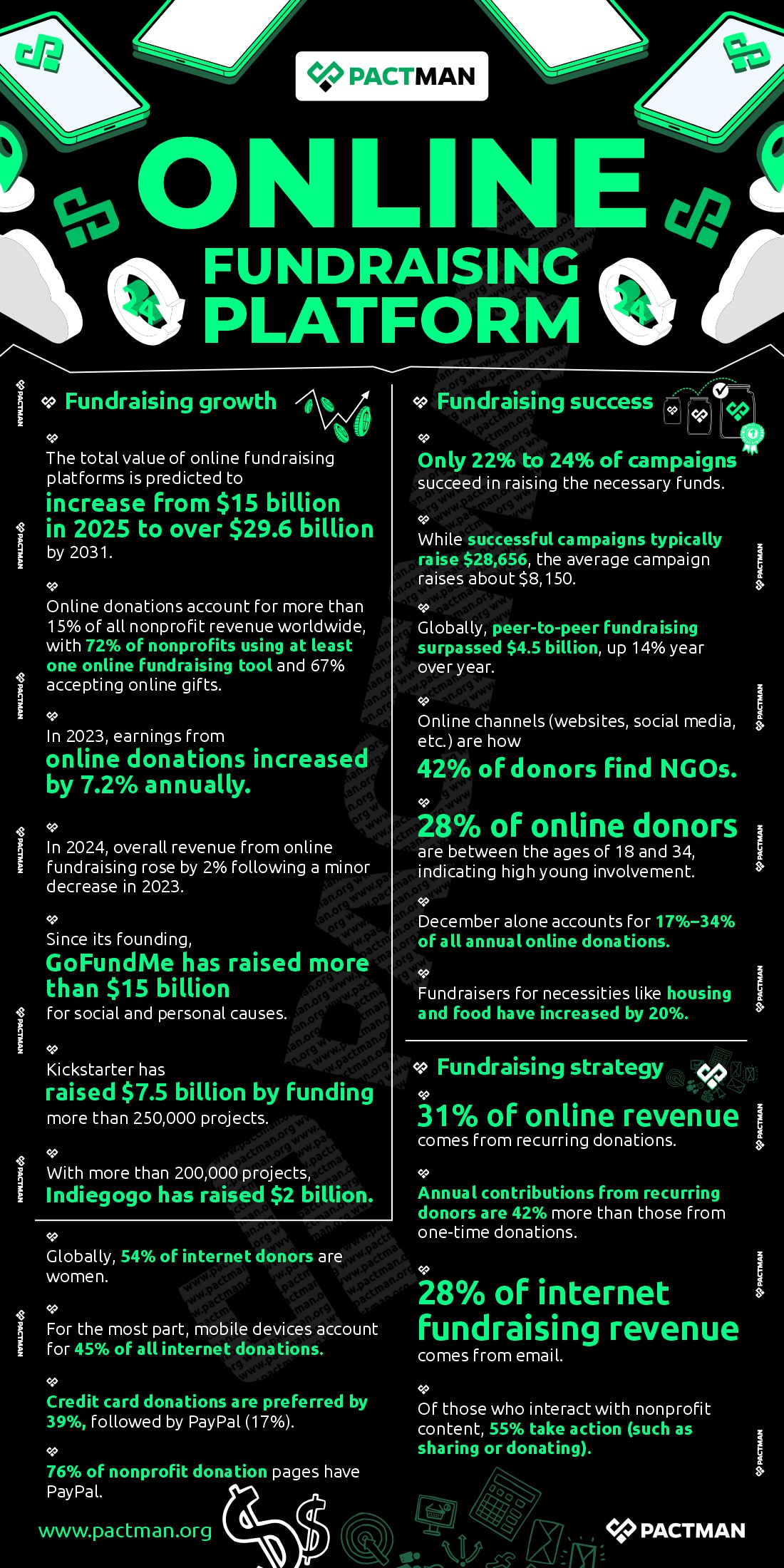
The total value of online fundraising platforms is predicted to increase from $15 billion in 2025 to over $29.6 billion by 2031. Online donations account for more than 15% of all nonprofit revenue worldwide, with 72% of nonprofits using at least one online fundraising tool and 67% accepting online gifts. In 2023, earnings from online donations increased by 7.2% annually. In 2024, overall revenue from online fundraising rose by 2% following a minor decrease in 2023.
Since its founding, GoFundMe has raised more than $15 billion for social and personal causes. Kickstarter has raised $7.5 billion by funding more than 250,000 projects. With more than 200,000 projects, Indiegogo has raised $2 billion.
b. Fundraising success
Only 22% to 24% of campaigns succeed in raising the necessary funds. While successful campaigns typically raise $28,656, the average campaign raises about $8,150. Globally, peer-to-peer fundraising surpassed $4.5 billion, up 14% year over year. Online channels (websites, social media, etc.) are how 42% of donors find NGOs. Also, 28% of online donors are between the ages of 18 and 34, indicating high young involvement.
December alone accounts for 17%–34% of all annual online donations. Likewise, fundraisers for necessities like housing and food have increased by 20%.
c. Fundraising strategy
31% of online revenue comes from recurring donations. Annual contributions from recurring donors are 42% more than those from one-time donations. Also, 28% of internet fundraising revenue comes from email. Of those who interact with nonprofit content, 55% take action (such as sharing or donating). Globally, 54% of internet donors are women.
For the most part, mobile devices account for 45% of all internet donations. Credit card donations are preferred by 39%, followed by PayPal (17%). All in all, 76% of nonprofit donation pages have PayPal.
IV
Comparative Analysis of Online Fundraising Platforms
Small to mid-sized NGOs may find it difficult to create an online fundraising platform from scratch. Instead, they use customized platforms that may be integrated into their existing websites. The platform selection has a huge impact on both the donor experience and the organization’s bottom line.
| Platform | Best For | Standout Features | Cost Structure |
| Donorbox | Most Nonprofits | Ultra-fast checkout, strong recurring tools, employer matching | 2.95% platform fee + processing |
| GiveWP | WordPress Power Users | Total branding control, peer-to-peer tools, donor database | Annual subscription ($149 – $499) |
| Givebutter | Events & Small Orgs | 100% free (tip model), Venmo, text-to-donate | $0 fee (relying on donor tips) |
| Fundraise Up | Mid-to-Large Orgs | AI-powered upselling, optimized mobile experience | 4% (includes processing) |
| Zeffy | Zero-Budget Orgs | Truly 0% fees, covers credit card costs via tips | $0 fee (relying on donor tips) |
| Stripe | Custom Development | Developer-friendly API, high security, international reach | ~2.2% + $0.30 per gift |
All in all, organizations must take into account the Cost of Growth when choosing a platform. For a very small organization, a platform like Donorbox, which takes a percentage of each gift, might be less expensive at first. However, as the organization’s fundraising volume increases, it may become more costly than a flat-fee plugin like GiveWP. On the other hand, a platform like Givebutter or Zeffy that provides free processing by requesting a tip from donations can be quite successful, but it might not match every nonprofit’s branding choices.
V
Creating an Effective Online Fundraising Platform
An online fundraising platform is more than just a page with a Pay button in the modern era; it is the digital lifeblood of an organization. Whether you are a small local shelter or a multinational nonprofit, your website is frequently the first and only opportunity you have to convert a curious visitor into a loyal supporter.

This case study focuses on “GreenCrust,” a fictional forestry effort, and how it improved its internet presence to increase impact.
1. The Strategy:
Starting with “Why”, before writing any code, the team needed to identify its basic objective. A great donation website tells a story rather than simply soliciting funds.
Key objectives:
- Establish trust and credibility immediately.
- Simplify the process to make it easier for users to donate.
- Transparency: Show where the money goes.
2. Designing User Experience (UX)
GreenCrust discovered that its previous website was very busy. As a result, they adopted a donor-first approach to design.
- The “Three-Click” Protocol: The goal was to make it possible for a visitor to reach the homepage and complete a donation with three clicks or fewer.
| Feature | Purpose |
| Hero Banner | A high-quality image of a planted forest with a clear “Donate Now” button. |
| Suggested Amounts | Preset buttons (e.g., $25, $50, $100) to reduce “decision fatigue.” |
| Progress Bars | A visual tracker showing how close the project is to its goal. |
- Pro Tip: The best approach to guarantee a non-profit’s long-term viability is to include a Monthly Giving checkbox.
3. The Foundation for Technology
An online fundraising platform needs to be mobile-friendly, secure, and quick. According to a report, 40% of users will abandon a page if it takes longer than three seconds to load. Here are a few factors to consider;
- Security and Trust: Security is an emotion rather than just a backend feature.
- SSL Certificates: The lock symbol in the browser address bar.
- Acknowledged Payment Gateways: Including Apple Pay, PayPal, and Stripe to offer dependable, secure choices.
- Privacy Policy: A clear privacy policy that guarantees donors’ information won’t be sold.
4. Content Strategy: The Power of Proof
Individuals donate to results rather than organizations. In order to achieve success with the website, the team employed the “Impact Formula.”
The Impact Formula
- The issue: 10,000 acres of local forests are being destroyed by deforestation.
Five native saplings can be planted for ten dollars.
- The Proof: A “Before and After” photo exhibition or a testimonial.
5. Evaluation and Testing
The work continued after the website went live. A/B testing was employed by GreenCrust to improve the experience.
When they tested button colors, they discovered that a bright green button performed 15% better than a blue one.
Eliminating Form Fields: The form felt shorter and simpler once the “How did you hear about us?” field was eliminated, which led to an increase in completion rates.
Within the first six months, GreenCrusts’ online donations increased by 45% thanks to its emphasis on a clean design, mobile optimization, and transparent narrative. As can be seen, a successful online fundraising platform combines seamless technology with poignant storytelling.
Conclusion
Without a doubt, building a successful online fundraising platform requires constant improvement. The first step is understanding the donor experience and the psychological factors that spur generosity. It ensures that giving is as simple as possible because it is based on a technological foundation of speed and security. Also, the process is maintained through strategic SEO that positions the organization as a reliable authority, and it is refined through the development of recurrent connections that supply the funding required to fulfill specific objectives. Organizations that see their website as a strategic asset that embodies the core of their goal rather than as a technical expense will be the ones that prosper.