A donor management software is fundamentally a subset of constituent relationship management (CRM) that is intended to simplify the intricate network of communications between an organization and its supporters. The use of manual techniques, such as spreadsheets, has become a major challenge as philanthropic organizations increase their revenue streams in an increasingly digital market. This can result in data silos, lost opportunities, and administrative fatigue.
Donor management software
A deliberate commitment to institutionalizing donor intelligence is demonstrated by the shift to a dedicated donor management system (DMS). These tools guarantee that each contribution, discussion, and volunteer hour is documented as a foundation for long-term sustainability.
II
A Strategic Architecture of Donor Management Software
The first step towards understanding how to use donor management software demands a conceptual change in an organization’s perspective of its supporters. Expert practitioners see donors through the prism of the donor lifecycle. This is a continuous structure that follows a supporter’s transition from an inquisitive prospect to a lifelong advocate, rather than as a single point of revenue.
Donor management software
The five crucial stages of this lifespan are usually acquisition, retention, upgrade, lapse, and reactivation. By centralizing profiles and automating the interactions that maintain connections, donor management software offers the technical framework needed to get through these phases. Essentially, the “Five A’s” framework, which includes Awareness, Assessment, Action, Affiliation, and Advocacy, constitutes the industry standard for managing this lifecycle.
The software serves as a listener during the awareness and assessment phases, monitoring potential contributors’ interactions with the organization’s website, newsletters, and social media. As soon as a donor takes action in making their initial gift, the software switches into operational mode, initiating automated thank-you sequences and documenting the transaction information.
By and large, the holy grail of fundraising is found in the last phases, affiliation and advocacy. This stage is when data analytics are utilized to discover highly involved people who can be promoted to significant gift categories or leadership positions.
III
Critical Statistics on Donor Management
In this section, we will outline critical statistics on donor management and its impact on the nonprofit sector.
a. Donor retention
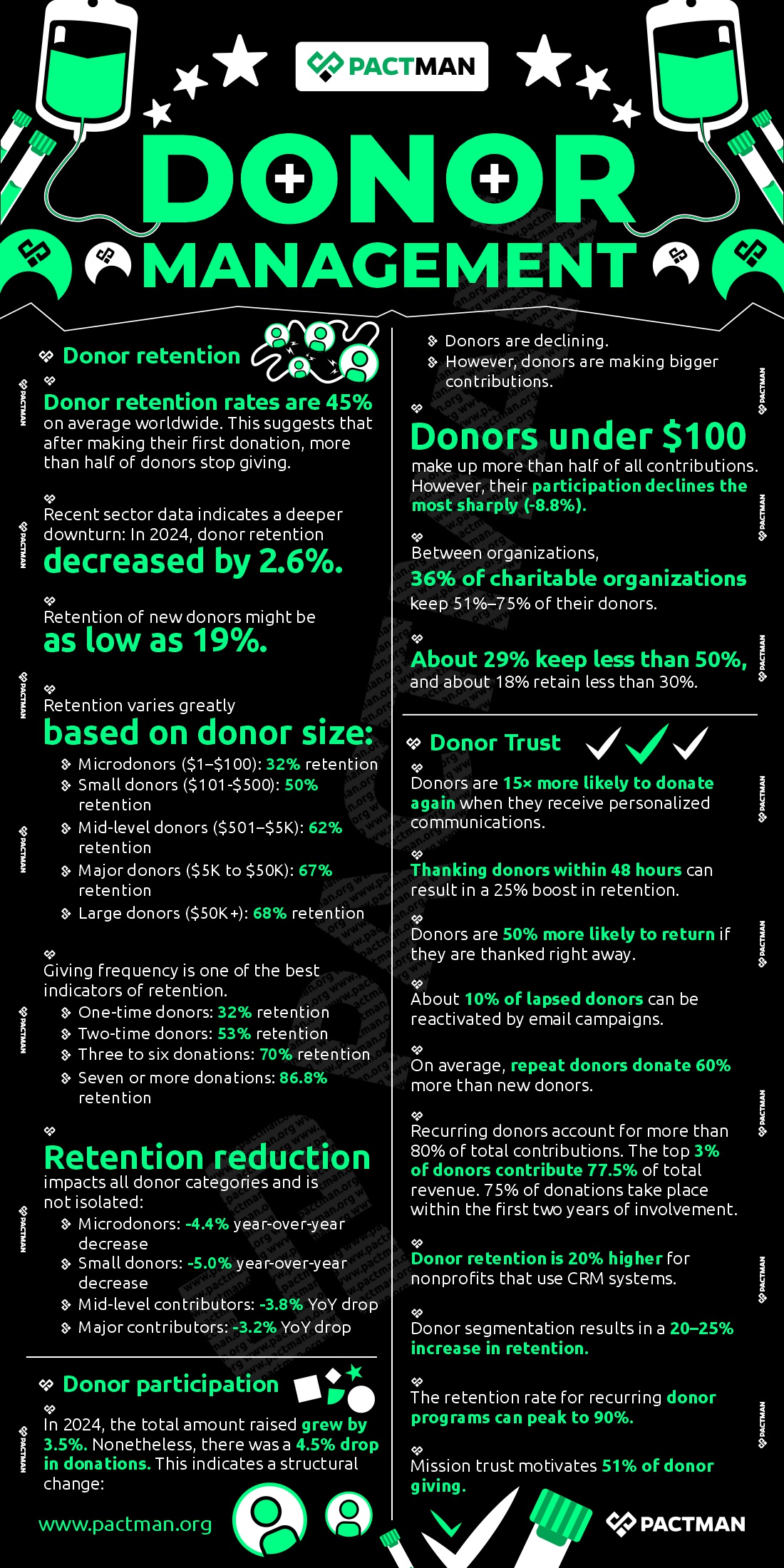
Donor retention rates are 45% on average worldwide. This suggests that after making their first donation, more than half of donors stop giving. Recent sector data indicate a deeper downturn: In 2024, donor retention decreased by 2.6%. Also, retention of new donors might be as low as 19%.
Although overall donations may rise, donor participation is falling. In 2024, the total amount raised grew by 3.5%. Nonetheless, there was a 4.5% drop in donations. This indicates a structural change:
Donors are declining.
However, donors are making bigger contributions.
Small donors are the least consistent, although they make up the majority of donor bases. Likewise, donors under $100 make up more than half of all contributions. However, their participation declines the most sharply (-8.8%).
Even more, about 10% of lapsed donors can be reactivated by email campaigns. On average, repeat donors donate 60% more than new donors. Recurring donors account for more than 80% of total contributions. The top 3% of donors contribute 77.5% of total revenue. 75% of donations take place within the first two years of involvement.
Donor retention is 20% higher for nonprofits that use CRM systems. Also, donor segmentation results in a 20–25% increase in retention. The retention rate for recurring donor programs can peak to 90%, and mission trust motivates 51% of donor giving.
IV
Automation and Daily Tasks for Database Operationalization
Daily operational excellence becomes the main objective after the software goes online. Primarily, the goal is to transition from manual administrative work to a state of automated stewardship. In this case, staff members may concentrate on high-touch donor relationships while the software takes care of the repetitive activities.
Donor management software
a. Gift Acceptance and Automated Recognition
In a well-integrated system, donations should automatically update the donor’s giving history by going straight from online forms into their profile. Staff employ batch-processing technologies to input various donations at once for offline gifts. This includes checks or cash, which the program subsequently links to the relevant campaign.
One essential KPI for nonprofit health is the “time-to-thank” statistic. As soon as a gift is recorded, the donor management software initiates automated, customized receipts and thank-you emails to address the issue of delayed thankfulness. These are stewardship opportunities, not just transactional messages.
Behavior-based communications, such as sending a different thank-you email for a first-time donation compared to a ten-year supporter, are made possible by advanced technologies.
b. The Function of Storytelling Impact
Also, software makes impact storytelling possible on a large scale, going beyond simply recognizing gifts. This entails accessing the database to determine which donors contributed to a specific project (such as a local food drive or a clean water well) and providing them with frequent updates on the project’s status.
Automating these narratives can increase recurring donations by 15%, according to statistics. Also, this helps maintain supporters’ emotional connection to the tangible results of their efforts.
c. Maintaining Data Hygiene
Lastly, organizations should set up a data hygiene practice in order to maintain the system’s optimal performance. This involves conducting routine audits to identify and eliminate duplicates that might have been produced by several input points (such as a donor using two different email addresses). To guarantee that the data stays clean at source, it is crucial to have consistent data entry procedures. Each employee should receive training on how to input names, notes, and appeals.
V
Advanced Segmentation: Going Beyond the RFM Model
Segmentation is the technique of breaking up a large donor base into more manageable, significant groups based on common interests or behaviors. By and large, the goal is to unlock the full strategic potential of donor management software. This enables fundraisers to switch from blunderbuss pitches to communications that are relevant and focused.
Donor management software
1. Recency, Frequency, and Monetary Value (RFM)
The RFM model is the gold standard for donor segmentation. It assigns a score to donors based on three metrics:
the total amount they have donated (Monetary),
how frequently they have given (Frequency), and
how recently they have given (Recency).
An organization can identify its most valuable Heroes (5-5-5) and At-Risk donors (e.g., 1-5-5), who often give frequently but haven’t recently, by assigning scores ranging from 1 to 5 for each of these categories.
2. Psychographic and Demographic Partitioning
Secondly, donor management software enables segmentation by demographics (age, geography, gender) and interests (certain programs or causes), in addition to providing trends. For example, studies reveal that various generations have distinct preferences for communication channels:
Baby Boomers frequently choose direct mail and phone calls
Millennials and Gen Z are more receptive to social media and text messaging.
A nonprofit can maximize its marketing expenditure by segmenting the database according to age and communication preferences, ensuring it isn’t sending pricey direct mail content to donors who would prefer to receive a text.
3. Connecting the Tech Stack through Integration
Thirdly, in the current digital environment, donor management software is hardly ever used independently. Its capacity to communicate with other programs in the organization’s stack increases its power and facilitates the smooth transfer of data between departments.
4. Payment Processors and Reconciliation of Finances
A secure payment processor such as Stripe, PayPal, or Crowded must be connected to a strong DMS. These integrations guarantee that transaction data, including details on whether the gift was confined to a specific fund, is instantly input into the donor’s record. When fundraising and accounting software are integrated, leadership can trust the statistics they see without having to wait for manual reconciliation at the end of the month. This is crucial for financial transparency and compliance.
5. Marketing and Communications via Email
Furthermore, the foundation of donor stewardship is its integration with email services such as Constant Contact or Mailchimp. In order to guarantee that a Lapsed Donor section automatically receives a re-engagement campaign, it enables organizations to synchronize donor segments directly to marketing lists. Advanced integrations can also track soft credits. This entails attributions to individuals who may have impacted a donation, such as a board member who made a personal introduction.
6. Human Factors: Training and Change Management.
Lastly, change is frequently met with reluctance, driven by concerns about greater effort, job insecurity, or the difficulty of learning a complex new system. Without staff adoption, even the most advanced donor management software is ineffective. Technology implementation involves as many people and culture as it does code and data.
VI
Key Performance Indicators for Board Reporting
Key Performance Indicators (KPIs) for nonprofits are indicators that show how well they are accomplishing their goals. The development team and the board of directors should have access to a real-time dashboard that tracks these numbers through the donor management system.
KPI
Description
Strategic Goal
Donor Retention Rate
% of donors who give again year-over-year.
Sustainability and loyalty.
Average Gift Size
The mean dollar amount of all gifts.
Cultivating larger donations.
Donor Lifetime Value (LTV)
Total revenue expected from a donor over time.
Informed acquisition spending.
Cost Per Dollar Raised
Total fundraising cost vs. total funds raised.
Operational efficiency.
Lapsed Donor Reactivation
% of formerly inactive donors who give again.
Minimizing donor churn.
Conclusion
In summary, donor management software is the strategic core of a contemporary nonprofit and is much more than a digital filing cabinet. For the most part, it enables organizations to create solid, significant connections that support long-term mission impact. This is achieved by centralizing information, automating repetitive operations, and offering profound analytical insights.
An organization’s capacity to grow and endure in a world that is changing quickly will ultimately depend on how it employs this software. Essentially, this can be achieved through careful mapping of donor lifetime, strict application of the RFM model, or careful integration of their technology stack. However, the transformative potential of a data-driven culture outweighs the implementation and staff adoption hurdles.
For organizations seeking to transition from survival to thriving, the question is no longer whether they should adopt donor management software. More importantly, it is how quickly they can understand its full potential to steward community support and transform the world.
In the current nonprofit environment, organizations are increasingly relying on technology to enhance donor interaction, ensure compliance, and streamline operations. The Pactman Nonprofit CheckPlus API […]
TABLE OF CONTENTS Introduction Overview of Nonprofit Grant Options Critical Statistics on Nonprofit Grants in the U.S. Nonprofit Grants in Washington Nonprofit Grants in Alabama […]
TABLE OF CONTENTS Introduction Nonprofit Funding Gaps in Africa Critical Statistics on Nonprofit Grants Local vs International Nonprofit Grants in Africa: A Comparative Analysis Overview […]
Most organisations prefer Asana as their management tool. It is especially useful for planning a client’s work, such as developing and updating a content calendar […]