How Grantors Can Prioritize Nonprofit Funding for Long-Term Impact
Cersai Stark
I
Introduction
The charitable sector is experiencing a transformative moment, with an estimated $12 trillion in wealth shifting to a younger, results-driven generation by 2030. Now more than ever, grantors must carefully prioritize nonprofit funding to generate long-term societal transformation, rather than merely a short-term cure. The new charitable operating system emphasizes Value Creation. By and large, this involves taking a more dynamic and networked approach to local growth. Consequently, it is opposed to relying solely on the strategy room’s perspective.
Nonprofit funding
In the social sector, making a lasting impression is infamously challenging. Only 12% of organizations maintain those improvements for longer than three years. Oftentimes, due to a lack of implementation rigor and a failure to adjust to changing realities, significant value of potential benefit is lost in the latter phases of a grant cycle.
Hence, it takes more than just bigger endowments for foundations and grantmakers to make the shift from band-aid solutions to long-term social change. This process calls for a complete overhaul of the philanthropic operating system.
In this article, we will consider how grantmakers can optimize their nonprofit funding strategies for long-term impact.
II
The Strategic Importance of Close Leadership in Nonprofit Funding
Top-down directives rarely have a lasting impact. As a result, grantors must move toward Proximate Leadership, which involves funding people and institutions with strong linkages to and firsthand knowledge of the communities they support. For the most part, proximate leaders are better able to pinpoint the underlying reasons for structural inequalities. As a result, they can create the social capital required for long-lasting transformation.
Nonprofit funding
Research indicates that organizations are more creative and provide fairer services when their leadership reflects the community. Likewise, grantors should eliminate the use of command and control and act more like hosts who foster communal intelligence rather than heroes who dictate answers from a distance to assist these leaders.
a. Removing the Administrative Burden
Furthermore, conventional grantmaking frequently puts organizations in a starvation cycle where the expenses of applying for and reporting on grants are greater than the funding’s actual benefit. According to McKinsey, a sector-wide initiative to streamline these procedures, like a Common App for grant applicants, could result in $4 billion in yearly savings for US organizations.
b. Defining Success as Human Sustainability
Lastly, grantors must adjust the metrics they use. Long-term impacts are measured by human sustainability, or the extent to which an intervention improves a community’s health, well-being, and social capital. This goes beyond just vanity metrics like the number of individuals serviced.
To accomplish their charitable goal and lay the groundwork for a more inclusive future, foundations must consider social impact with the same rigor as financial capital. More often than not, establishing long-lasting change is a journey, not a race. Hence, the board must serve as a steward for Value Creation, and the leadership team must be at ease with uncertainty and ongoing education.
III
Critical Statistics on Nonprofit Funding
In this section, we will consider critical statistics on nonprofit funding and its impact within the sector.
a. U.S. charitable giving
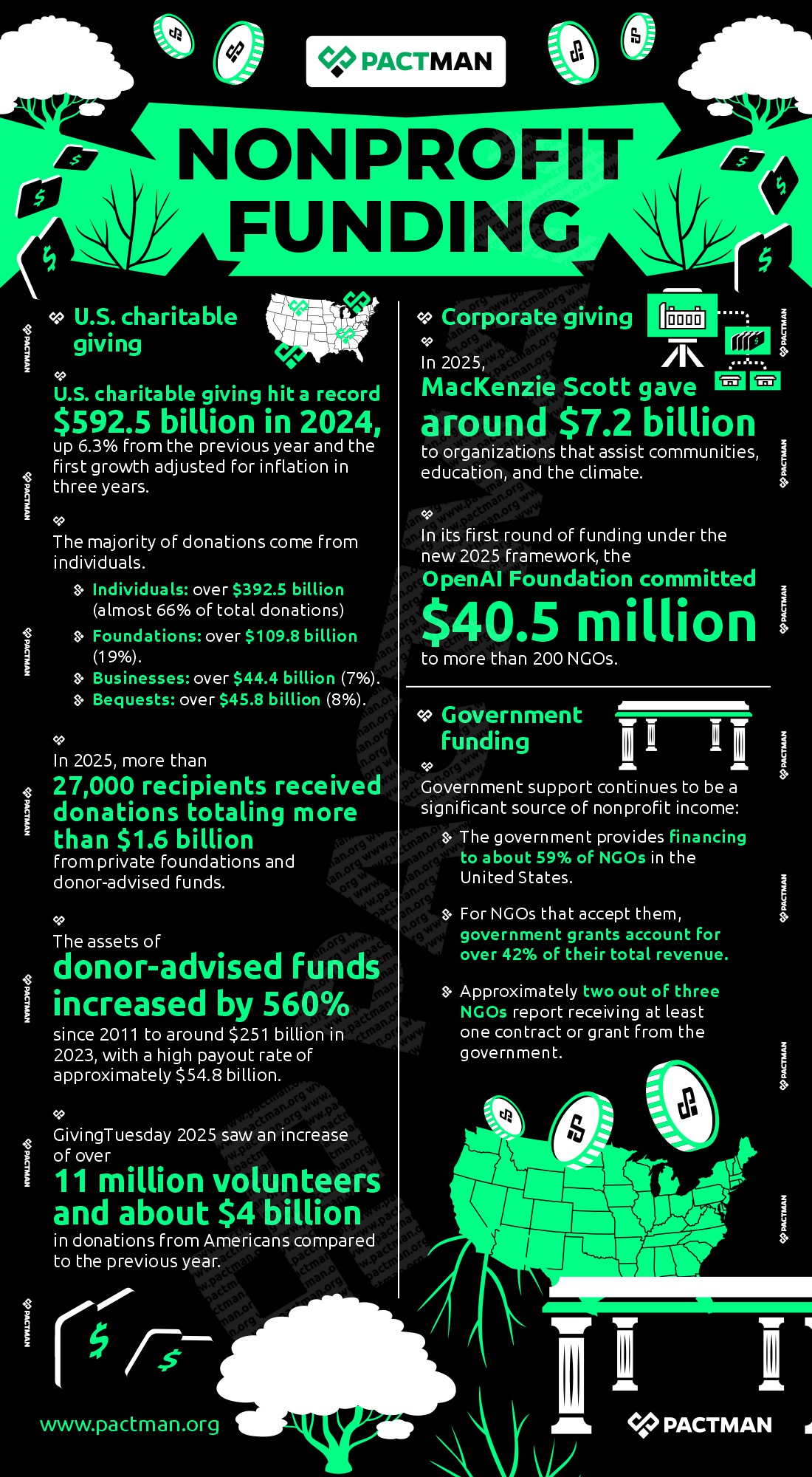
U.S. charitable giving hit a record $592.5 billion in 2024, up 6.3% from the previous year and the first growth adjusted for inflation in three years. Also, the majority of donations come from individuals.
For NGOs that accept them, government grants account for over 42% of their total revenue.
Approximately two out of three NGOs report receiving at least one contract or grant from the government.
IV
Avoiding the Inside View and the Hockey Stick Trap in Nonprofit Funding
The inside view bias is the psychological propensity for boards to base strategy exclusively on internal data and over-optimism. This is a major obstacle to long-term influence. On the other hand, the hockey stick effect is a strategy plan that forecasts a slight initial decline in performance as a result of investment. Afterwards, it is followed by a spectacular increase in success, which rarely occurs in reality.
Nonprofit funding
In response, grantmakers need to make three crucial mental changes to generate ground-breaking outcomes:
Transitioning from Annual Planning to Strategy as a Path: An annual assessment of a strategy should not be a static document. To shift resources toward what is truly working, there needs to be a continuous conversation with 12-month rolling plans and regular milestone reviews, usually as often as every six months.
From Getting to Yes to Discussing Possible Courses: Leaders should discuss several strategy options with varying risk profiles rather than rushing to approve a single vetted approach.
Going from Peanut-Buttering to Major Motions: Impact is reduced when resources are dispersed among dozens of subpar initiatives. The secret to great performance is to spot a select few big moves and high-probability opportunities.
V
Increasing Capacity by Building Grantees’ Capacity
Capacity building is a calculated investment in the internal muscle of grantees. This strengthens the processes, abilities, and structures that enable organizations to function reliably, expand responsibly, and make a lasting impact.
Nonprofit funding
How Grantors Prioritize Nonprofit Funding for Long-Term Impacts
1. Take General Operating Support over Restrictive program-only grants:
Invest in the “Roots“: Giving organizations unlimited funding, also known as general operating support, enables them to pay for necessities like rent, utilities, and competitive salaries, which lowers employee turnover and burnout.
Promote Trust: Grantors promote a trust-based philanthropy paradigm by refraining from micromanaging every dollar’s expenditure. This gives organization directors the flexibility to change course and address pressing community needs without waiting for grant modifications.
2. Invest in building capacity
Secondly, a powerful internal engine is crucial for long-term impact. Donors have the option to give preference to grants that improve a nonprofit’s infrastructure as opposed to only its output. Investments in data analytics, cybersecurity, and contemporary CRM systems are examples of technological upgrades.
Leadership development: This is the process of spending funds on executive coaching and board training to guarantee that the organization is run efficiently.
Strategic Planning: Award fund expressly for the development of three-to-five-year plans, which are crucial for negotiating future expansion and financial shortages.
Predictability: Nonprofit organizations can focus on long-term societal issues that cannot be resolved in a year, recruit specialist people for long-term initiatives, and prepare for the future with multi-year commitments.
Risk mitigation: Knowing that they have a financial safety net for multiple fiscal years creates the breathing room for organizations to try out creative ideas.
4. Prioritize cooperation over rivalry
In the ecosystem, grantors might serve as connectors to increase impact.
Promote Partnerships: Apps that involve two or more organizations collaborating to achieve a common objective should be given preference. By doing this, resources are pooled and service duplication is minimized.
Resource Sharing: Assist backbone organizations or community foundations that offer smaller charities shared services (such as accountancy or legal assistance).
5. Standardize and Make Measurement Easier
Lastly, grantors need to assist NGOs in shifting from monitoring outputs (such as attendance) to outcomes (such as how lives were genuinely impacted) in order to observe long-term repercussions.
Flexible Metrics: Rather than enforcing strict, top-down KPIs, collaborate with the nonprofit to establish what success looks like.
New approach: Recognize that producing high-quality reporting takes time and experience, and provide funding for the actual costs of data collection and impact assessment.
Conclusion
As can be seen, setting priorities for impact is a continual strategy journey. Consequently, it demands rolling plans and regular milestone reviews, rather than a one-time event. Also, grantmaking organizations can transform from straightforward check-writers to ecosystem architects of a more resilient and inclusive society. However, this can only occur by instituting automated compliance, trust-based funding, and strict SROI evaluation.
In the current nonprofit environment, organizations are increasingly relying on technology to enhance donor interaction, ensure compliance, and streamline operations. The Pactman Nonprofit CheckPlus API […]
TABLE OF CONTENTS Introduction Overview of Nonprofit Grant Options Critical Statistics on Nonprofit Grants in the U.S. Nonprofit Grants in Washington Nonprofit Grants in Alabama […]
TABLE OF CONTENTS Introduction Nonprofit Funding Gaps in Africa Critical Statistics on Nonprofit Grants Local vs International Nonprofit Grants in Africa: A Comparative Analysis Overview […]
I Introduction Form 990 is eventually required of all nonprofit leaders. It appears once a year, seems bureaucratic, but quietly accomplishes a crucial task: it […]
The Muslim charity organisations generally assist needy Rwandans and create unity among Muslim fellows. Rwanda has a small but growing Muslim population in a country […]
Muslim charity organisations in Mauritius are active and help in various areas, such as helping poor people, providing education, providing health care, and supporting disaster-affected […]