From Philanthropy to Partnership: How Community Service Is Redefining Local Development
Cersai Stark
I
Introduction
Community service is now seen as a vital component of value creation and human sustainability rather than as an incidental good deed. The host approach, which aims to co-create solutions with public and private partners, is being adopted by leading foundations.
Community service
At the center of this redefinition is the idea of human sustainability, the extent to which an organization adds value to individuals as human beings, leaving them with improved health, well-being, and social capital. This entails transforming the “S” in ESG (Environmental, Social, and Governance) from a compliance need to a strategic priority for foundations.
Now more than ever, high-performing grantmakers are asking, “To what extent did we strengthen the underlying human systems of this community?” rather than “How much did we give?” This change is motivated by the realization that inclusive economic growth is optimal and most sustainable. Through the prism of cooperation, this article examines the strategic changes in community service that are accelerating local development.
II
What Qualifies as a Genuine Community Service Collaboration?
A true community partnership represents a crucial divergence from the conventional, transactional form of charity. According to the new philanthropy operating system, a partnership is an intentional ecosystem arrangement between two or more organizations to generate and distribute collective value for the community.
Community service
Hence, foundations and grantmakers need to go beyond the inside view of the boardroom and embrace four fundamental pillars of structural integration to create a partnership that is long-lasting and significant.
1. The High-Benefit Matrix for Strategic Alignment
To begin with, true partnerships align with a strategic matrix of social responsibility. Research identifies four sorts of social initiatives: Pet Projects, Propaganda, Philanthropy, and Partnering. Pet projects and philanthropy generally have a low benefit to organizations and a medium benefit to society, as they are often prioritized by C-suites over community needs.
True Partnering is the only paradigm that provides significant economic and social benefits. This approach aligns with the primary objective of all partners, allowing organizations to focus on their strengths rather than seeking financial support from several sources.
2. Radical Interdependency and Co-evolution
Secondly, a true community partnership is an ecosystem in which all participants have similar interests, as opposed to a collection of loose agreements. This implies that each partner will only be successful if the ecosystem as a whole is successful.
Co-Evolution: As their investments are directed toward a common goal, partners co-evolve their roles and capabilities over time.
The “Host” Leadership Model: The foundation serves as a host, encouraging collective intelligence and inviting everyone impacted by a choice to participate in the process without discrimination. Fundamentally, this replaces a single heroic leader making top-down decisions.
3. Inclusion, Equity, and Diversity as the Operating Framework
Thirdly, a genuine collaboration actively seeks out and eliminates obstacles that prevent underrepresented groups from participating. It views diversity, equity, and inclusion as the foundation of the partnership rather than as an add-on.
Power-Sharing (Participatory Governance): This entails a change from consulting stakeholders (seeking input on predetermined objectives) to co-designing solutions and participatory budgeting, in which the community makes direct decisions about the distribution of funds.
Inclusive Representation: To be true, a partnership needs its decision-makers to be representative of the communities they serve. Diverse leadership teams foster better problem-solving and innovative solutions for challenging societal issues.
4. Asset-Based Versus Deficit-Based Development
Lastly, modern community partnerships prioritize investing in strengths rather than fixing problems (a deficit-based strategy). Asset-Based Community Development (ABCD) leverages local assets, including resident abilities, neighborhood groups, and informal networks, to increase collective effectiveness. Corporate partners providing expertise (specific skills in IT, marketing, or strategy) strengthen partnerships and help local groups establish long-term muscle.
III
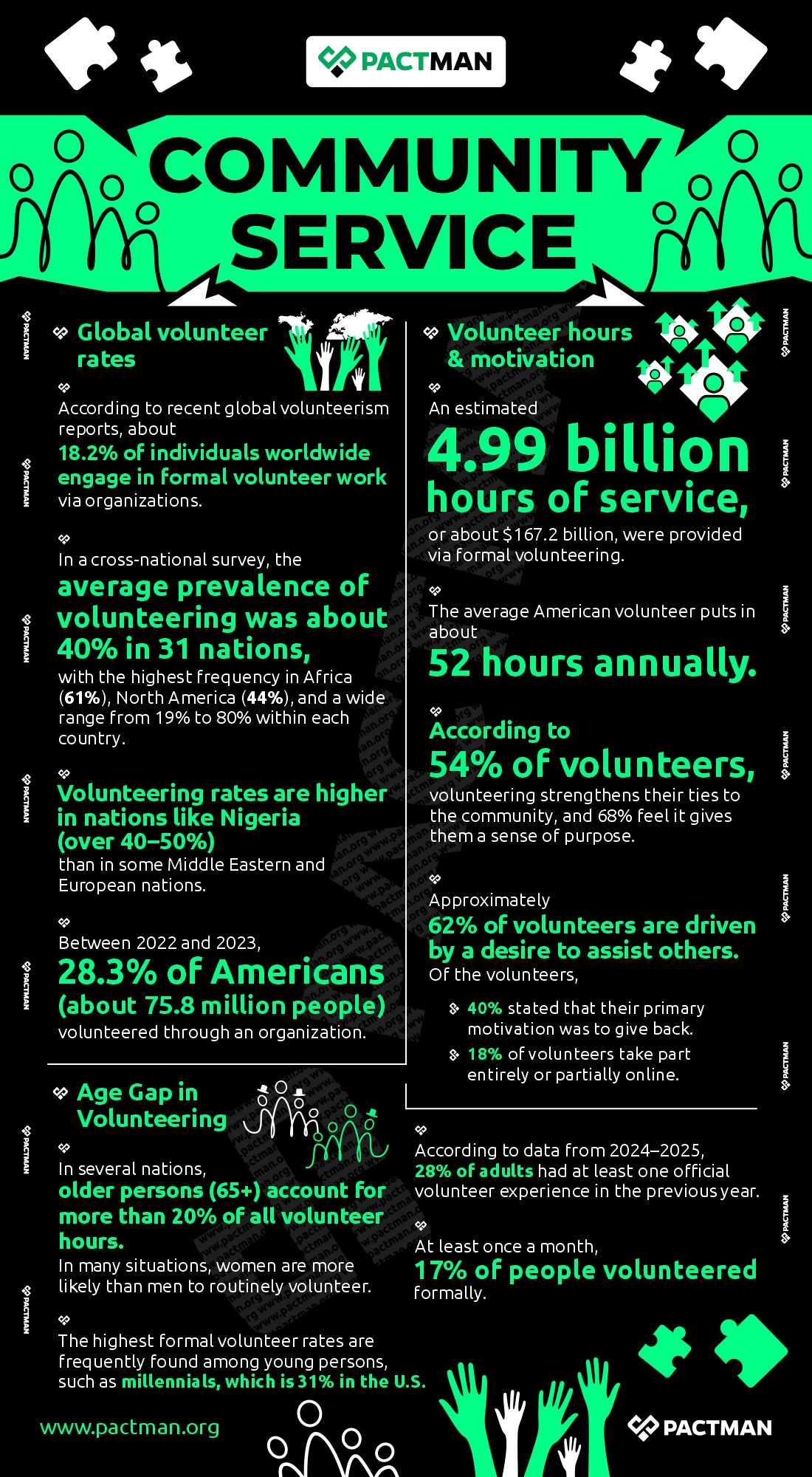
Critical Statistics on Community Service
In this section, we will consider critical statistics that highlight the impact of community service across society.
The economic value of volunteer labor is estimated in a variety of ways; estimates like $28.54 per hour are frequently used for more comprehensive community service impact analyses.
Community service
b. Volunteer hours & motivation
An estimated 4.99 billion hours of service, or about $167.2 billion, were provided via formal volunteering. Also, the average American volunteer puts in about 52 hours annually.
According to 54% of volunteers, volunteering strengthens their ties to the community, and 68% feel it gives them a sense of purpose. Likewise, approximately 62% of volunteers are driven by a desire to assist others. Of the volunteers,
40% stated that their primary motivation was to give back.
Approximately 18% of volunteers take part entirely or partially online.
About 21% of volunteer work is in the healthcare industry, 15% is in environmental protection, and 12% is in homelessness outreach.
According to data from 2024–2025, 28% of adults had at least one official volunteer experience in the previous year. Also, at least once a month, 17% of people volunteered formally. Even more prevalent is informal community support, such as lending a hand to neighbors; approximately 54% of Americans participated in this activity.
IV
The Significance of Community Service in Local Development
Leading foundations and grantmaking agencies are realizing more and more that people systems, not physical capital, are the most resilient growth engines. Likewise, community service has evolved from a supporting good deed to a key component of diversity, equity, and inclusion under this new paradigm, which is what experts refer to as human sustainability.
Community service
The section that follows explains why grantmakers may spearhead this shift and why community service is now seen as a strategic necessity for local development.
For many years, economic development and community service were treated as distinct fields by governments and the social sector. But as 2030 draws near, a new consensus is taking shape: inclusive economic growth is the most robust and successful. To accomplish this, organizations are reorienting their strategy around the concept of human sustainability, which is the extent to which an organization adds value to people as individuals, leaving them with improved social capital, health, and well-being.
1. The Foundational Asset: Social Capital
Community service’s function in creating social capital is the main reason it has become essential to development. Essentially, social capital is the glue that keeps communities together. It is defined as the links, shared values, and understandings in society that enable individuals and groups to trust each other and work together.
Research shows that improving social capital is associated with improved health outcomes, more economic mobility, and higher-quality jobs. Hence, investing in community service allows grantmakers to network. The soft infrastructure necessary for any economic intervention to be successful is essentially being built when foundations finance programs that encourage community ownership and group action.
2. Asset-Based Development Replaces Deficit-Based Development
Secondly, conventional development frequently uses a deficit-based strategy, which involves determining what is wrong with a community (such as poverty, crime, or unemployment) and then bringing in professionals to fix it.
However, Asset-Based Community Development (ABCD), which is preferred in contemporary models of community service, prioritizes resident-led development of current connections, abilities, and strengths over a primary focus on needs.
Collective Efficiency: ABCD promotes a sense of agency by recognizing local resources, such as resident abilities and unofficial networks.
Equity through Ownership: By allowing impacted groups to take the lead in their own solutions, this strategy guarantees that Diversity, Equity, and Inclusion are ingrained in the project’s DNA.
3. The Reinforcement Loop in Inclusive Growth
Economic exclusion and inequality pose a threat to long-term stability if they are not addressed. As a result, initiatives for community service that emphasize diversity, equity, and inclusion contribute to the establishment of High Road training pathways.
High Road Training Partnerships (HRTPs), for instance, help alleviate economic disparities by promoting cooperation between employees, labor unions, and employers in order to provide access to opportunities for promotion and family-sustaining incomes. Rather than being a one-time program, this systematic approach to workforce development creates an industry-led skills infrastructure.
4. The PPPP Model’s Ascent
Lastly, the intricacy of contemporary issues, such as housing affordability and climate resilience, surpasses the capabilities of any one sector. As a result, Philanthropic-Public-Private Partnerships (PPPPs) have become more prevalent. In these ecosystems, philanthropy serves as a nimble accelerator, offering the scale that public and private partners give, while risk-taking capital is used to test novel social solutions.
By acting as the engagement layer of these collaborations, community service ensures that significant investments are both socially and contextually acceptable.
Conclusion
As can be seen, the shift from philanthropy to collaboration signifies a significant reinterpretation of community work. It reflects a more profound realization that long-term local development must be constructed collaboratively rather than individually.
Partnership-driven community service offers a more sustainable and respectable way forward by putting communities at the center as co-creators, bolstering local institutions, and coordinating incentives among stakeholders.
Likewise, “How much can we give?” is no longer the most crucial question in this new paradigm. The real question is “How well can we build together?” All in all, the future of local development will be determined by such a question and the collaborations it spurs.
1 response to “From Philanthropy to Partnership: How Community Service Is Redefining Local Development”
[…] Lead magnets are lead generation techniques that exchange a useful resource for a potential supporter’s contact details. It is sometimes referred to in marketing circles as a content offer or an incentive. This information usually consists of a person’s or donor’s name, phone number, or email address, which subsequently acts as the starting point for a long-term partnership. […]
In the current nonprofit environment, organizations are increasingly relying on technology to enhance donor interaction, ensure compliance, and streamline operations. The Pactman Nonprofit CheckPlus API […]
TABLE OF CONTENTS Introduction Overview of Nonprofit Grant Options Critical Statistics on Nonprofit Grants in the U.S. Nonprofit Grants in Washington Nonprofit Grants in Alabama […]
TABLE OF CONTENTS Introduction Nonprofit Funding Gaps in Africa Critical Statistics on Nonprofit Grants Local vs International Nonprofit Grants in Africa: A Comparative Analysis Overview […]
Most organisations prefer Asana as their management tool. It is especially useful for planning a client’s work, such as developing and updating a content calendar […]
As a climate change leader, Virginia establishes its position by implementing forward-thinking policy measures through renewable power investments and nature protection initiatives. The government of […]










1 response to “From Philanthropy to Partnership: How Community Service Is Redefining Local Development”
[…] Lead magnets are lead generation techniques that exchange a useful resource for a potential supporter’s contact details. It is sometimes referred to in marketing circles as a content offer or an incentive. This information usually consists of a person’s or donor’s name, phone number, or email address, which subsequently acts as the starting point for a long-term partnership. […]