How to Optimize Grant Administration Costs Without Sacrificing Quality
Cersai Stark
I
Introduction
The philanthropic sector relies on grantmaking for its survival. Proposal reviews, due diligence, compliance checks, reporting, and monitoring are just a few of the complex procedures that come with grant administration costs behind every dollar given. The Center for Effective Philanthropy (CEP) states that, depending on the size and maturity of the organization’s systems, these expenses may account for 10–20% of grant expenditures overall.
Grant Administration
Today’s dilemma for the majority of foundations is straightforward: how to cut administrative costs without sacrificing the integrity and quality of grantmaking. As we all know, accountability or impact should never be sacrificed for efficiency. Although minimizing the administrative expense ratio is a reasonable goal, doing so at the expense of quality—the thorough due diligence, strategic thinking, and solid grantee relationships—often results in a hollowed-out organization.
Presently, the modern issue is not cutting costs. Rather, it is redesigning the administrative core to devote all available financial and human resources to the tasks that generate the greatest value. In this article, we outline key pillars for achieving high-quality, low-cost grant administration by referencing best practices in organizational excellence.
II
Critical Statistics on Grant Administration Costs
In this section, we will consider critical statistics on grant administration and its relevance to the entire operation.
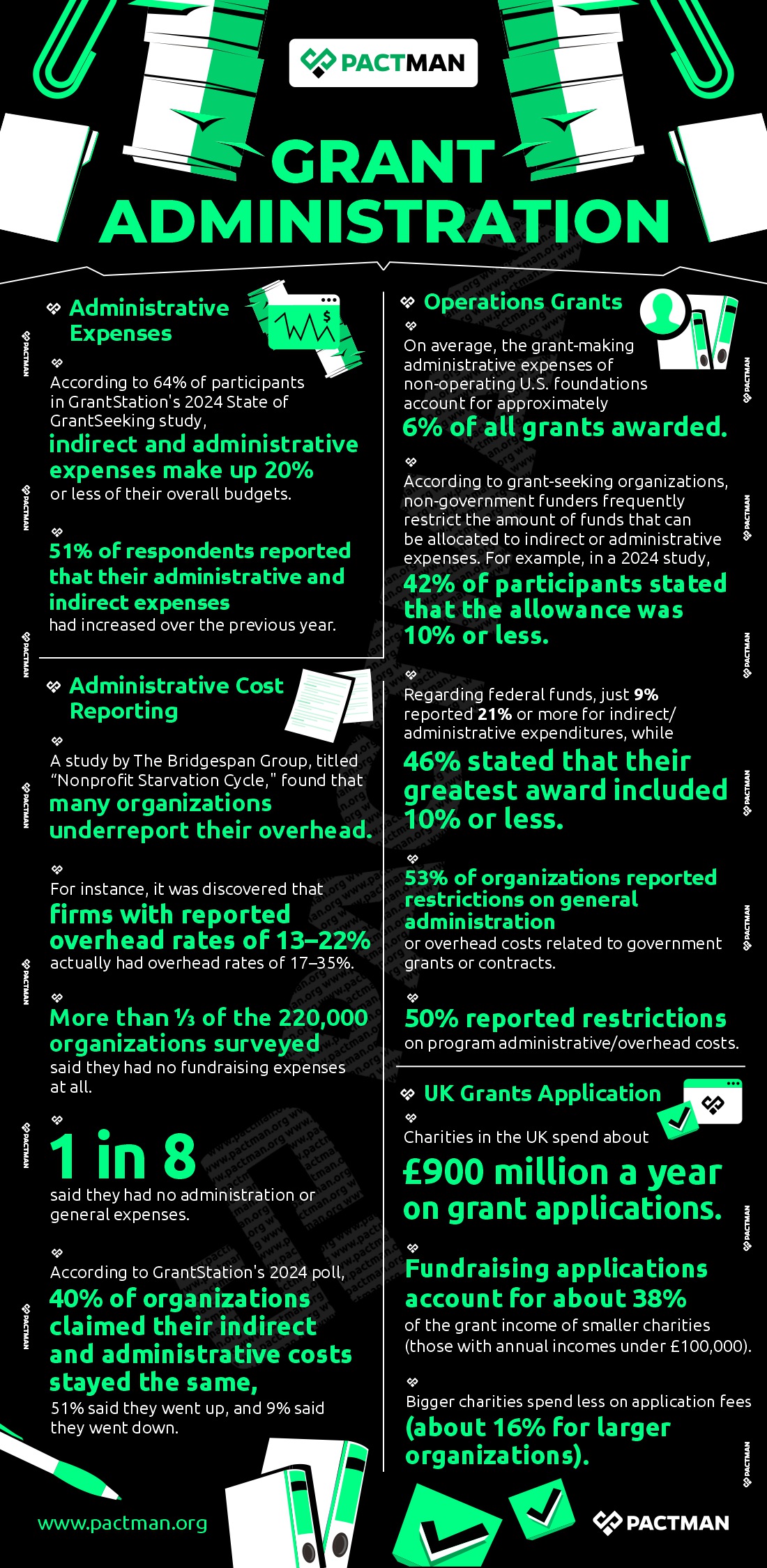
On average, the grant-making administrative expenses of non-operating U.S. foundations account for approximately 6% of all grants awarded. According to grant-seeking organizations, non-government funders frequently restrict the amount of funds that can be allocated to indirect or administrative expenses. For example, in a 2024 study, 42% of participants stated that the allowance was 10% or less.
A study by The Bridgespan Group, titled “Nonprofit Starvation Cycle,” found that many organizations underreport their overhead. For instance, it was discovered that firms with reported overhead rates of 13–22% actually had overhead rates of 17–35%. Also, more than ⅓ of the 220,000 organizations surveyed said they had no fundraising expenses at all, and 1 in 8 said they had no administration or general expenses.
Charities in the UK spend about £900 million a year on grant applications. Fundraising applications account for about 38% of the grant income of smaller charities (those with annual incomes under £100,000). On the other hand, bigger charities spend less on application fees (about 16% for larger organizations).
III
How to Curtail Grant Administration Costs Without Compromise on Quality
Intelligent reallocation, not personnel reduction, is the key to strategic efficiency in grantmaking. In this section, we will consider effective practices to curtail grant administration costs while still embracing quality standards.
grant administration
1. Using Lean Principles to Re-Architect Processes
Numerous administrative responsibilities stem from inherited procedures that were never scaled or optimized for complexity. By adopting lean concepts, foundations can get rid of “waste” (any action that doesn’t improve the mission, the recipient, or the decision-making process).
a. Make the Application Process Unique:
The cycle of applications and reports is the biggest administrative burden for grantees and foundations alike. Hence, a one-size-fits-all strategy makes large, established institutions and small, early-stage grantees face the same degree of scrutiny, which is extremely resource-intensive. By and large, the answer is Different Levels of Due Diligence.
To begin with, segment grantees using a risk-based evaluation, then modify administrative requirements as necessary.
Low-Risk/High-Trust Tier (General Operating Support): Make the switch to Trust-Based Philanthropy for organizations with a long history or those that receive grants frequently. Furthermore, limit applications to a brief discussion or a single letter of inquiry (LOI). Instead of using traditional financial reporting, use the grantee’s current, standard annual report.
Medium risk tier(specific to a project): Secondly, keep the budget and storyline requirements the same, but use technology to automate data tracking and extraction.
High-Risk Tier (High-Complexity/New Grantees): Only concentrate intense due diligence efforts on this tier, which calls for thorough capability evaluations and financial analysis. Due to the limited size of this group, the investment is high-value and targeted.
b. Transition from Adherence to Knowledge
Conventional grant management places a strong emphasis on rigid budget line item conformance, which frequently inhibits creativity and adaptability. Hence, by shifting the administrative team’s emphasis from compliance checks to strategic learning, costs are justified by generating organizational insights.
Actionable Reporting: Request that grantees report on more than simply spending categories; ask them to report on outcomes and important lessons learned. From reviewing receipts, the administrative team’s responsibilities also include combining performance data. This, in turn, directly influences board choices and future grant strategies.
2. Utilizing Technology to Strengthen the Digital Core
Technology shouldn’t just digitize outdated forms; it should also automate repetitive, low-value operations. As a result, highly qualified employees (program officers) can concentrate on high-value work (developing relationships, planning).
a. Establish a unified grant management system (GMS)
The cornerstone of strategic effectiveness is a contemporary GMS. When administrative data is dispersed among disparate spreadsheets, email accounts, and physical files, the hidden costs of data search, reconciliation, and verification soon surpass the cost of a reliable solution.
Autonomy Hotspots: Pay attention to automation on:
Automated Data Validation: This process compares TINs, legal names, and 501(c)(3) status with external databases automatically using optical character recognition (OCR) or structured data input.
Automated Payment Scheduling: By doing away with human check requests, it ensures fast and consistent financial flow for grantees.
Automated Correspondence: Grant agreements that are already filled out, reminders for reporting, and uniform rejection letters.
b. Data Synthesis and Benchmarking using AI
Now more than ever, new technologies provide advanced methods for processing unstructured data and transforming unprocessed data into strategic intelligence.
Financial Health Benchmarking: Use technologies to automatically compare grantee financial documents (such as Form 990s) to the financial statements of peers in the industry, rather than manually analyzing spreadsheets. This drastically cuts down on administrative work by expediting financial review and immediately identifying irregularities.
Narrative Synthesis: Utilize machine learning models to examine hundreds of grantee reports to identify recurring themes, difficulties, or achievements. By doing this, the program team may quickly identify systemic problems and avoid spending hundreds of hours examining reports by hand.
3. Redefining Employee Roles to Create Value
Lastly, human capital is the most costly resource in any foundation. When highly paid employees are only assigned to activities requiring human judgment, empathy, and strategic insight, optimization is accomplished.
a. Professionalise and centralise support services
Program officers are frequently overburdened with low-value administrative duties (e.g., scheduling, file maintenance, basic budget review). This expertise application is not optimal.
Create a Central Administration Team for Grants: The GMS, compliance checklists, payment processing, and data integrity management should all be the exclusive focus of a dedicated staff, no matter how small. This centralized service approach frees up program staff to concentrate on strategy and field involvement while guaranteeing consistency.
Utilize Common Services: For smaller foundations, consider sharing back-office services with other nonprofits. This is especially for tasks like IT assistance, legal review, and payroll. Essentially, this will allow them to take advantage of economies of scale that are typically only available to larger organizations.
b. Invest in Grantee Capacity
Although grantee training may appear like an additional expense at first, improving grantee organizational and financial literacy is the best long-term cost-cutting measure.
Standardized Equipment: Make basic, cost-free templates available to grantees for tracking their budgets and reporting results. By and large, it saves time and money for both grantee and your administrative staff. Also, it allows grantees to clarify and resubmit a well-structured report that satisfies requirements on the first submission.
The “No-Wrong-Door” policy: Encourage grantees to make inquiries early. A quick phone call to clarify a budget item before submission is far less expensive than the work required to make corrections after submission.
Conclusion
Cost optimization for grant administration is a strategic development rather than just an operational undertaking. Grantmaking foundations can declare lower overhead ratios with confidence when they implement tiered due diligence, automate the digital core, and professionalize the administrative function. Also, it ensures that the quality and impact of their work have been purposefully improved rather than compromised. The objective is to transition from being a proficient check processor to an adaptable change investor.
4 responses to “How to Optimize Grant Administration Costs Without Sacrificing Quality”
[…] and governance are strategic assets, not administrative expenses. In an era of complexity, social urgency, and growing expectations, organizations that improve […]
[…] a distinct group of private donors known as “The Well” covering all operational and administrative expenditures, their “100% Model” guarantees that every penny of public donations goes directly […]
[…] the US, where domestic labour is quite expensive, organizations can control administrative costs. This is by using affordable, specialized virtual support for scheduling, routine data input, and […]
[…] Justification: Be open and honest about what this purchase will not fund. Clearly state why administrative expenditures, such as staff training on the new equipment, are essential capacity-building steps that allow for […]
In the current nonprofit environment, organizations are increasingly relying on technology to enhance donor interaction, ensure compliance, and streamline operations. The Pactman Nonprofit CheckPlus API […]
TABLE OF CONTENTS Introduction Overview of Nonprofit Grant Options Critical Statistics on Nonprofit Grants in the U.S. Nonprofit Grants in Washington Nonprofit Grants in Alabama […]
TABLE OF CONTENTS Introduction Nonprofit Funding Gaps in Africa Critical Statistics on Nonprofit Grants Local vs International Nonprofit Grants in Africa: A Comparative Analysis Overview […]
California is at the forefront when it comes to climate change action in the United States. Through their passionate and active policies, clean energy funding, […]
Education nonprofits are effective change agents. Individual lives as well as communities can be influenced through education. Additionally, it helps close the gaps, open up […]
Homeless charities provide a haven for individuals who cannot afford to procure homes or fend for themselves. Ireland is a country faced with homelessness, just […]









4 responses to “How to Optimize Grant Administration Costs Without Sacrificing Quality”
[…] and governance are strategic assets, not administrative expenses. In an era of complexity, social urgency, and growing expectations, organizations that improve […]
[…] a distinct group of private donors known as “The Well” covering all operational and administrative expenditures, their “100% Model” guarantees that every penny of public donations goes directly […]
[…] the US, where domestic labour is quite expensive, organizations can control administrative costs. This is by using affordable, specialized virtual support for scheduling, routine data input, and […]
[…] Justification: Be open and honest about what this purchase will not fund. Clearly state why administrative expenditures, such as staff training on the new equipment, are essential capacity-building steps that allow for […]