How to Build a Strong Code of Ethics for Nonprofit Leadership and Governance
Cersai Stark
I
Introduction
Nonprofits are a huge economic power in the US. In 2021, 19 of the nation’s top 30 charitable organizations brought in more than $1 billion annually. Likewise, hundreds of thousands of dollars in cash flow are regularly managed by local, neighborhood-based nonprofits. However, in contrast to conventional corporate businesses that work to maximize shareholder wealth, tax-exempt organizations exist to further the public interest.
Code of Ethics
Due to this special social compact, a nonprofit’s most important asset is its public credibility rather than its balance sheet, as trust is a fluctuating commodity. A single widely reported incident, a poorly handled conflict of interest, or accusations of financial waste can rapidly halt donations, repel volunteers, and result in harsh legal repercussions.
Adherence to federal and state legislation serves as the foundation for appropriate behaviour. However, true organizational integrity demands a commitment that goes far beyond the text of the law. Hence, nonprofit boards must create, execute, and actively uphold a robust, all-encompassing Code of Ethics in order to safeguard this public trust.
II
Three Fiduciary Obligations of the Nonprofit Boards
Board members are fiduciaries under established US corporate and philanthropic regulations. This implies that they are legally trusted to oversee assets that the general public technically owns. Hence, state and federal regulations mandate that board members adhere to three basic standards of conduct in exchange for tax exemption.
Code of Ethics
1. The Duty of Care
Board members are required by the Duty of Care to use the same degree of care, diligence, and caution that any reasonable person would exercise in a comparable situation. Being a board member is not an honour. Directors must actively evaluate financial packages, plan and attend meetings, and keep a close eye on resource allocation to ensure the organization is viable to fulfil the Duty of Care.
2. The Duty of Loyalty
Secondly, board members are required by the Duty of Loyalty to make decisions with complete loyalty to the nonprofit. A director is prohibited from using information they have access to for financial, professional, or personal benefit. Strict conflict of interest regulations are based on this obligation. Also, it mandates that board members put the organization’s best interests ahead of their personal, familial, or professional ties.
3. The Duty of Obedience
Lastly, board members are required by the Duty of Obedience to uphold the organization’s core values, internal policies, and relevant legal requirements. It is legally forbidden for directors to take actions that conflict with the primary goals for which the nonprofit was given tax exemption. By guaranteeing that gifts are used precisely as promised to further the stated objective, this obligation safeguards the public’s trust.
III
Critical Statistics on Code of Ethics
In this section, we will consider critical statistics on code of ethics and the role it plays across organizations.
a. Code acceptance
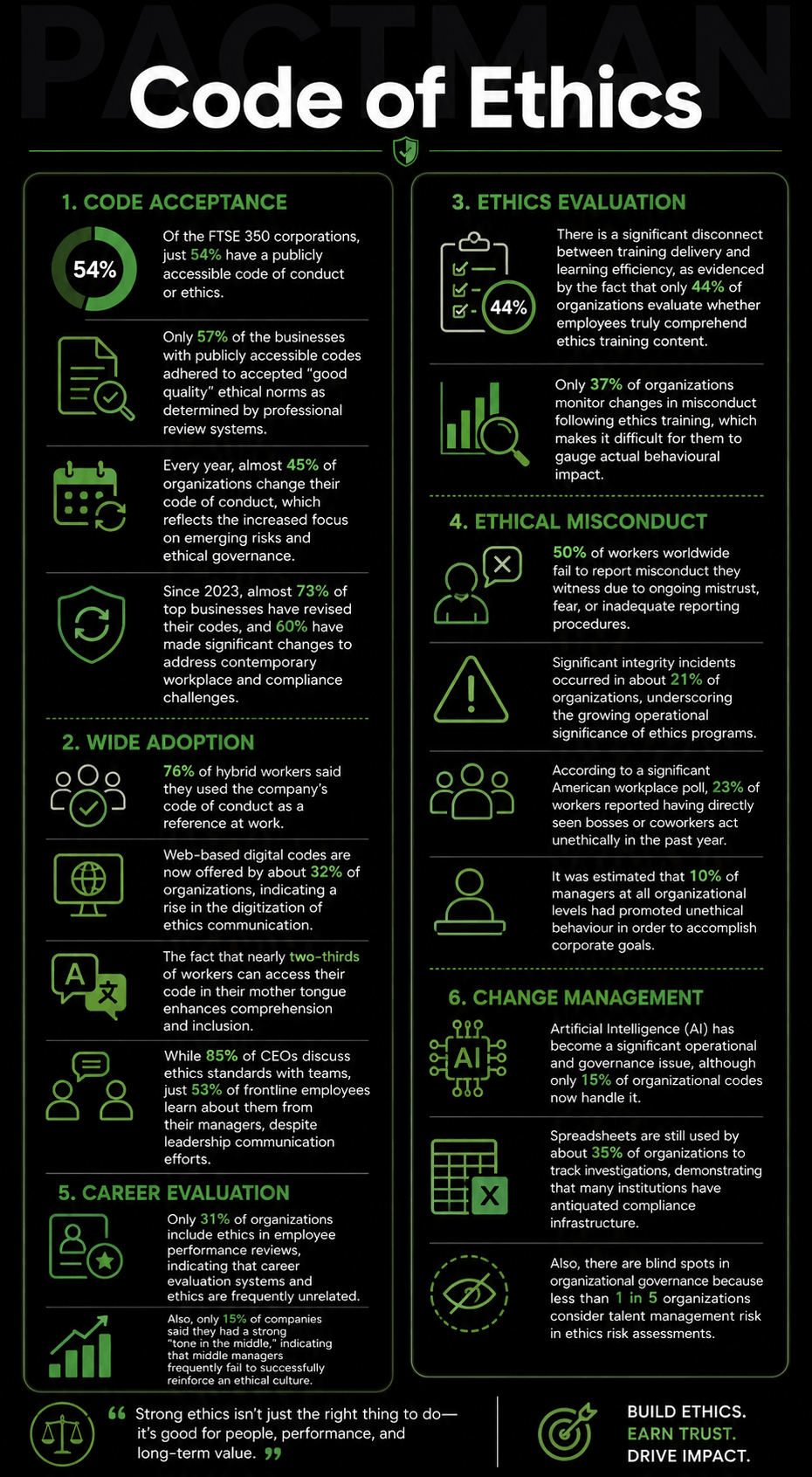
Of the FTSE 350 corporations, just 54% have a publicly accessible code of conduct or ethics. Only 57% of the businesses with publicly accessible codes adhered to accepted “good quality” ethical norms as determined by professional review systems.
Every year, almost 45% of organizations change their code of conduct, which reflects the increased focus on emerging risks and ethical governance. Since 2023, almost 73% of top businesses have revised their codes, and 60% have made significant changes to address contemporary workplace and compliance challenges.
Code of Ethics
b. Wide adoption
76% of hybrid workers said they used the company’s code of conduct as a reference at work. Web-based digital codes are now offered by about 32% of organizations, indicating a rise in the digitization of ethics communication. The fact that nearly two-thirds of workers can access their code in their mother tongue enhances comprehension and inclusion.
There is a significant disconnect between training delivery and learning efficiency, as evidenced by the fact that only 44% of organizations evaluate whether employees truly comprehend ethics training content.
Only 37% of organizations monitor changes in misconduct following ethics training, which makes it difficult for them to gauge actual behavioural impact.
d. Ethical misconduct
50% of workers worldwide fail to report misconduct they witness due to ongoing mistrust, fear, or inadequate reporting procedures. Significant integrity incidents occurred in about 21% of organizations, underscoring the growing operational significance of ethics programs.
According to a significant American workplace poll, 23% of workers reported having directly seen bosses or coworkers act unethically in the past year. It was estimated that 10% of managers at all organizational levels had promoted unethical behaviour to accomplish corporate goals.
e. Career evaluation
Only 31% of organizations include ethics in employee performance reviews, indicating that career evaluation systems and ethics are frequently unrelated. Also, only 15% of companies said they had a strong “tone in the middle,” indicating that middle managers frequently fail to successfully reinforce an ethical culture.
Higher-quality codes of ethics are positively correlated with views of diversity, workplace culture, leadership trust, and employee satisfaction. Over five years, companies with excellent ethical standards outperformed the market by 7.8%, indicating that an ethical culture can enhance long-term corporate value.
f. Change management
Artificial Intelligence (AI) has become a significant operational and governance issue, although only 15% of organizational codes now handle it.
Spreadsheets are still used by about 35% of organizations to track investigations, demonstrating that many institutions have antiquated compliance infrastructure.
Also, there are blind spots in organizational governance because less than 1 in 5 organizations consider talent management risk in ethics risk assessments.
IV
Fundamental Operational Elements of a Successful Code of Ethics
A robust code of ethics needs to be all-encompassing, covering financial supervision, equity, professional behaviour, and asset protection.
Code of Ethics
1. Ethical Behaviour and Fair Culture
To begin with, a nonprofit’s principles must be reflected in its workplace. The code must specify standards for client contacts, vendor interactions, and workplace conduct. It should create explicit guidelines for safety, harassment, inclusiveness, and discrimination that apply to both in-person work environments and virtual ones like social media, emails, and texts.
Organizations must make a commitment to preserving settings that are both physically and emotionally safe, as well as to civility and equal employment opportunities. Additionally, a robust code encourages professional growth. It guarantees that everyone has the opportunity to acquire new skills in a welcoming setting.
2. Asset Protection and Financial Management
Secondly, the code must require responsible and judicious management of all resources. This entails establishing sufficient internal accounting controls, allocating a fair portion of the yearly budget directly to programs, and controlling administrative and fundraising expenses. The code should mandate that all financial documents and public disclosures, such as Form 990, be comprehensive, factually correct, and significant in order to preserve transparency.
3. Running Unrelated Enterprises
Federal tax restrictions restrict charities’ capacity to run an unrelated business, despite the fact that many of them engage in commercial operations to supplement their income. According to the 501(c)(3) Operational Test, an organization’s primary focus must be on actions that directly fulfil its exempt purpose.
There are ethical concerns while running an unconnected business. The board must assess:
How important stakeholders will view the activity,
If the business aligns with the charity’s values, and
Whether allocating resources to it will hinder its capacity to carry out its primary objective.
4. Conflict of Interest and Personal GainLimits
Also, strict guidelines for personal gain should be included in the code of ethics, in addition to fundamental legal compliance. Directors and employees should not be allowed to take large gifts, favours, or gratuities from vendors, sponsors, or related organizations. Additionally, the policy should forbid leaders from choosing consultants, service providers, or workers based only on personal or familial ties.
5. The Rights of Donors and Ethical Fundraising
One of the primary areas where NGOs face ethical risk is fundraising. These organizations must uphold strict standards of ethics and transparency because they rely on voluntary contributions. To demonstrate their dedication to moral behaviour, nonprofits ought to legally adopt the Donor Bill of Rights.
Nonprofits must also abide by the eDonor Bill of Rights to accommodate the increase in online giving. This framework enhances the original donor rights by
Guaranteeing that online transactions take place through secure networks,
Offering donors easy methods to opt out of data sharing, and
The Association of Fundraising Professionals (AFP) Code of Ethical Standards must also be followed by fundraisers. This law expressly forbids fundraisers from taking commissions, finder’s fees, or percentage-based payments.
Paying fundraisers a portion of the money generated can encourage aggressive, high-pressure solicitation strategies that harm donor relationships and put self-interest ahead of the charity’s goal.
V
Implementation: How to Create and Update the Code
Developing a robust code of ethics is a continuous, active effort. To create, develop, and manage their code, boards should use an organized roadmap:
1. Board Governance versus Daily Administration
The board must recognize the distinction between management and governance to preserve an ethical culture.
The nonprofit’s direction is determined by board governance, which also establishes strategic goals, sets high-level policies, and guarantees accountability to the mission.
Management prioritizes execution, transforming those policies into day-to-day tasks and quantifiable outcomes.
A dynamic board collaborates with management and offers independent monitoring without getting involved in day-to-day operations.
2. Specific Guidelines for the CEO and Board Directors
Secondly, part of a robust code of ethics should be clear performance guidelines for directors and the CEO. The code should require board directors to actively participate in meetings, prepare thoroughly, and contribute financially to the organization. It should also have a “solidarity clause,” which stipulates that directors, regardless of their personal opinions, must respect the outcome of a board vote and refrain from openly undermining board solidarity.
Also, the policy should provide clear guidelines for the CEO, forbidding them from changing their pay or benefits and mandating that they notify the board of any significant changes to senior staffing.
3. A Practical Model for Ethical Decision-Making
A structured decision-making approach should be used by leaders to assess a challenging ethical dilemma:
Who would get hurt? Determine any potential drawbacks for the community, employees, or beneficiaries.
Do you have worries about transparency? Imagine what the choice would seem like if it were made completely public or covered in the press.
Does the behaviour make sense and make sense? Make sure supporters and the general public can understand the decision.
Would the same worries exist if I were the decision’s subject? In this case, apply the principles of empathy and justice.
Does the action align with the organization’s mission and values? Check to see if the choice is consistent with the nonprofit’s main goals.
Are our legal counsel or ethics officers in agreement with this decision? Seek expert, unbiased advice to ensure the decision is compliant.
Nonprofit boards may safeguard their organization’s reputation, methodically handle ethical dilemmas, and ensure their governance stays closely aligned with public trust by employing this structured approach.
In the current nonprofit environment, organizations are increasingly relying on technology to enhance donor interaction, ensure compliance, and streamline operations. The Pactman Nonprofit CheckPlus API […]
TABLE OF CONTENTS Introduction Overview of Nonprofit Grant Options Critical Statistics on Nonprofit Grants in the U.S. Nonprofit Grants in Washington Nonprofit Grants in Alabama […]
TABLE OF CONTENTS Introduction Nonprofit Funding Gaps in Africa Critical Statistics on Nonprofit Grants Local vs International Nonprofit Grants in Africa: A Comparative Analysis Overview […]
Most organisations prefer Asana as their management tool. It is especially useful for planning a client’s work, such as developing and updating a content calendar […]
As a climate change leader, Virginia establishes its position by implementing forward-thinking policy measures through renewable power investments and nature protection initiatives. The government of […]