


I
Introduction
The social transformation process in society is significantly influenced by fundraising websites. The way the information is presented often leads to social change and influences how people choose to respond to community needs.

Even more, the Internet is used to donate and fundraise as much as it is used to look up information and make purchases. Hence, it has resulted in a myriad of online fundraising platforms. Fundraising websites allow users to donate conveniently without worrying about distance, and it allows the public to track how their funds are being used.
An efficient system must be quick, simple, and transparent to users. It must also be adaptable, allowing users to make changes more easily. One of the numerous benefits of online donations is that they are not restricted by time or location, allowing for social campaigning and donations at any time and from any location.
According to hyperpersonal communication, not being able to communicate nonverbally actually facilitates interaction because it allows people to feel more at ease expressing themselves via digital media. This study aims to ascertain the impact of fundraising websites and how they assist nonprofits in accomplishing their mission.
II
Fundraising Websites: What Purpose Do They Accomplish?
In simple terms, fundraising is known as persuading individuals to contribute money to a worthy cause. It is an online technique of raising funds from Internet users worldwide to support or invest in a project. Hence, it is seen as a tool that contributes to the “democratisation of philanthropy” and is transforming the global aid system.

Traditionally, governments of sovereign nations or sizable non-governmental organisations like Oxfam or the International Red Cross have overseen international aid projects. However, with the introduction of the Internet, this paradigm has quickly evolved. By removing middlemen and putting contributors and help programs in direct contact, online fundraising is pushing the global aid system in the direction of an individual-centric approach. This paradigm gives people total power over their financial decisions as they may decide which nation, cause, and population to support.
Also, individuals and donors worldwide can now take a more active role in international aid initiatives. This gives charities and their community beneficiaries the ability to become more financially and strategically autonomous.
III
Critical Fundraising Statistics to Consider
This section will consider various statistics that highlight the importance and impact of fundraising and donations.
a. Online fundraising
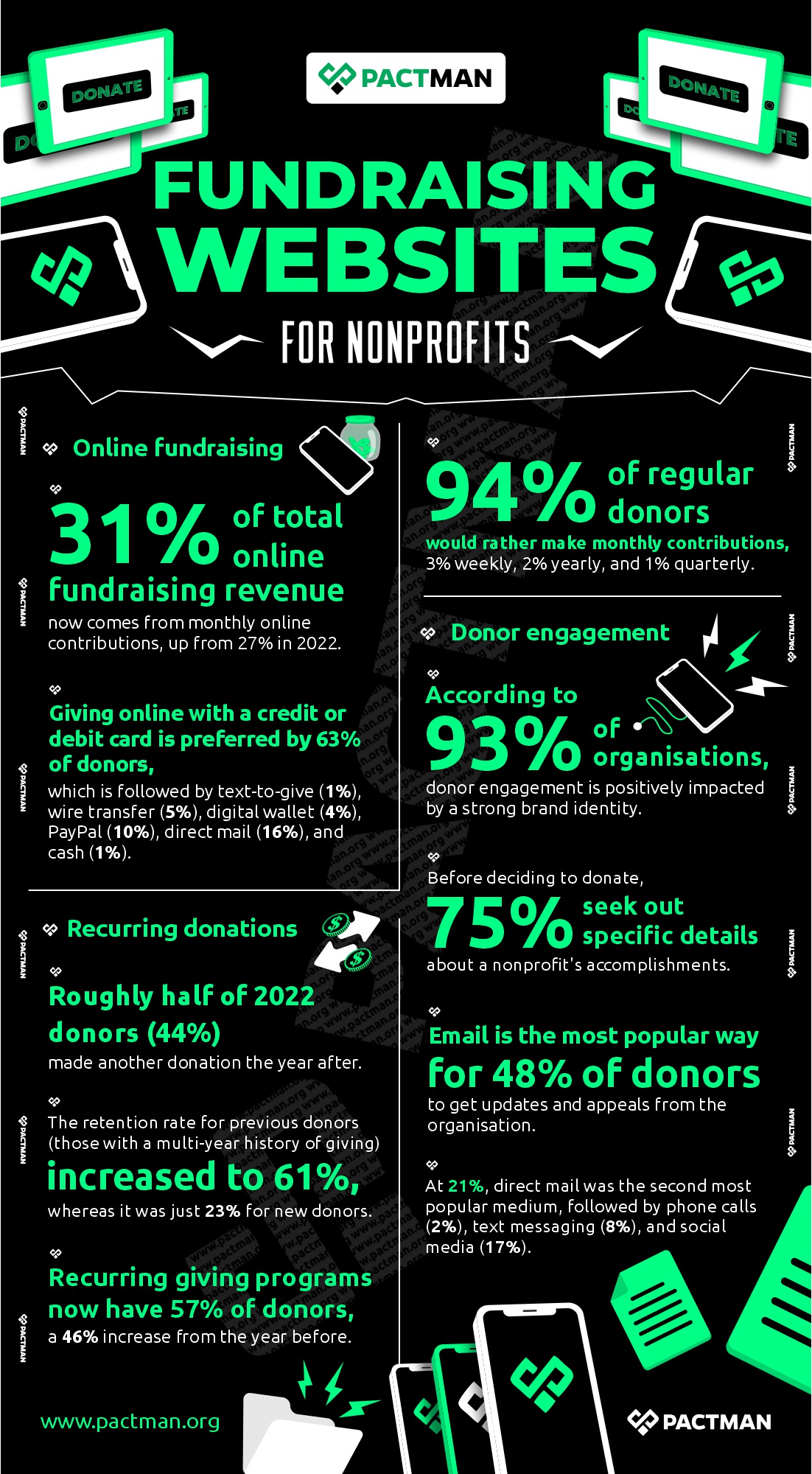
31% of total online fundraising revenue now comes from monthly online contributions, up from 27% in 2022. Also, giving online with a credit or debit card is preferred by 63% of donors, which is followed by text-to-give (1%), wire transfer (5%), digital wallet (4%), PayPal (10%), direct mail (16%), and cash (1%).
b. Recurring donations
Roughly half of 2022 donors (44%) made another donation the year after. Even more, the retention rate for previous donors (those with a multi-year history of giving) increased to 61%, whereas it was just 23% for new donors. Recurring giving programs now have 57% of donors, a 46% increase from the year before. Also, 94% of regular donors would rather make monthly contributions, 3% weekly, 2% yearly, and 1% quarterly.
c. Donor engagement
According to 93% of organisations, donor engagement is positively impacted by a strong brand identity. Consequently, before deciding to donate, 75% seek out specific details about a nonprofit’s accomplishments.
Email is the most popular way for 48% of donors to get updates and appeals from the organisation. At 21%, direct mail was the second most popular medium, followed by phone calls (2%), text messaging (8%), and social media (17%).

d. Email fundraising
Email is the instrument that motivates 26% of donors to donate, followed by social media (25%), websites (17%), and print (13%). Also, email is the communication channel that is most likely to encourage repeat gifts, according to 45% of online contributors.
In 2023, 16% of all internet revenue came from email messaging. Also, in 2023, NGOs raised $76 for every 1,000 fundraising communications. Having the email addresses of offline contributors boosts donor retention by 29%.
e. Digital fundraising
Despite the widespread use of online fundraising, over half of charities (41%) reported being “poor” at digital fundraising, and another 25% claimed they don’t use digital fundraising at all. However, more than half (52%) of charities stated that they prioritised boosting digital fundraising going into 2025, making it the sector’s second-highest digital priority this year.
In 2022, 26% of donors made charitable contributions via websites or apps, according to CAF.
f. Fundraising platforms vs Nonprofit websites
Enthuse discovered in their “Donor Pulse Report: Spring 2023” that more donations were being made via charities’ websites rather than fundraising platforms. According to the survey, the average direct donation increased from £32.25 to £41.37. Hence, donations made through direct websites were worth 22% more than those made through consumer-giving platforms.
Also, according to Enthuse, donors are 78% more likely to remember the name of a charity if they donate directly. This establishes a connection between the number of individuals who donate directly through charity websites and the number of people who can recall the name of the organisation they most recently donated to.
According to 49% of donors, the reason they are unable to recall the name of the previous charity they donated to is that consumer-giving platforms do not display the charity’s logo. Also, according to 72% of respondents, seeing a charity rating label makes them more likely to donate.
IV
Benefits of Fundraising Websites
Through fundraising technology, charities can reach contributors directly rather than having to go for larger, better-funded non-profits or government organisations to assist them. As a result, it minimises time-consuming and complex procedures that could jeopardise the objectives of the project and the charity.

Additionally, fundraising websites make it possible for nonprofit organisations to swiftly and simply get funds for development initiatives in underserved, rural communities. This is especially true for nonprofits unable to obtain cash from conventional commercial lending institutions without putting in place cumbersome government procedures.
Opportunities for contributing have increased significantly as a result of the growth of platforms that link private donors with international charity and development initiatives. Hence, people can now select from millions of specialised online projects. By creating opportunities for more focused, deliberate donations, fundraising significantly boosts individual agencies in the international aid paradigm.
Online requests from people and organisations worldwide seeking funds and resources to address regional issues are available for everyone to peruse. Requests are made for a wide range of projects, including the construction of wells and schools, the creation of retail establishments, and cooperative farming.
However, charities must continually compete with one another for funds because of the vast number of donor request profiles and fundraising websites.
Using convincing rhetorical appeals, nonprofits can show that they are a legitimate group advancing a respectable cause to raise the maximum funds. Their capacity to create compelling, expert arguments using text, images, and videos is essential to their ability to raise funds.
V
What to Consider When Fundraising
NPOs’ private donations are impacted by and proportionate to the money they spend on fundraising campaigns. In other words, the more money they spend on fundraising, the more private donations they receive. By comparing the revenue from monetary donations with the organisation’s promotion expenses, the return on fundraising investment index (ROFI) helps non-profits assess the effectiveness of their fundraising investments. In general, the higher the expense relative to income generated, the lower the value of ROFI and the lower the efficiency of the fundraising investment.

However, contextual factors like the organisation’s age, fundraising longevity, cause type, location, top management commitment, and even the political and economic climate can affect the amount of donations and the fundraising cost for non-profit organisations. Specifically, donations can rise when dedicated managers from well-established organisations concentrate their fundraising efforts on a particular need and cause.
Here are some tips to consider when choosing to fundraise for your nonprofit.
- What do you need to know to successfully start your initiative? Fundraising is about telling a story of a better future and inviting people to help make that future a reality.
- Share your story before you start fundraising! Spread the word about it right away. Establish your Facebook and Twitter networks, start an email list, and start a blog. Encouragement of donations will be easier if you have previously engaged a larger number of people.
- Video is the most effective way to tell a story, and some crowdsourcing websites, such as StartSomeGood, require it. Don’t get discouraged if you lack video production experience! Nevertheless, people primarily want to connect with the individuals behind a project and feel their passion for it. Hence, authenticity is far more crucial than production values. Often, a straightforward recording to a mobile device or camera will work.
- Also, supporters of fundraising campaigns should receive prizes; the more and better the benefits, the higher the donation level. Incentives can include anything from handcrafted items or acknowledgement on a donor’s wall to thank-you notes and event invitations. The more original and imaginative, the better!
- You have a limited amount of time to accomplish your goals. Therefore, you want to get off to a solid start so you have the best opportunity of gaining momentum. Before you launch, gather a few supporters.
- It takes effort to raise money! Getting out there and asking others to support your vision is ultimately what fundraising is all about.
VI
Relational Determinants of Fundraising Effectiveness
Due to the rising demand for social and humanitarian services, the expansion of NPOs, the heightened competition among them, and the shrinking supply of corporate and governmental funding, fundraising is becoming more and more important within NPOs. Here are some of the determinants to look out for when fundraising.

- Accessibility: How simple it is to assist with the website.
- Support case: How well the website explains why the group deserves funding.
- Respect: The degree to which the organisation interacts politely and appropriately with the donor.
- Accountability: The degree to which the website makes clear that supporters gain transparency for how it uses resources like funds and personal information.
- Interaction: The degree to which the website provides users with multiple avenues for interacting with the organisation.
- Education: The degree to which the website offers a suitable means of educating the donor about the cause.
- Customisation: The degree to which the donor can modify the website or the correspondence they receive to suit their requirements or interests.
- Empowerment: The degree to which the website enables contributors to act or influence the cause.
VII
How to Know the Classes of Donors
Donors or prospective donors help support the goals or initiatives of an NPO. However, for NPOs to engage with the various donor types and establish a good rapport, they must understand them. Both private donors and internet donors are common forms of donors for small and medium-sized nonprofit organisations.

a. Private Donors
Without a doubt, donors are well-informed about the cause they wish to support. They take the time to read about the nonprofit projects and also want to know how much their donation can help those in need. Following a thorough review of the data, the donors are prepared to make their donation to the nonprofit.
Likewise, donors vary in the amount, frequency, and conditions of their donations to nonprofit organisations. They seek project reports to assess the efficiency of the organisation’s work. To maintain donor loyalty, the NPO must consistently complete its projects successfully. Some donors prefer to have a little control over the NGO projects and activities after a while of sponsorship.
b. Online Donors
Donors who prefer to shop online are known as shoppers. Most consumers don’t want to take the time to research a nonprofit organisation when making a charitable donation. They do, however, pay attention to social and humanitarian issues and are eager to assist those in need.
An NPO can use social media to interact with this kind of donor, and audio-visual content is a smart method to get them to visit their online store. Customers prefer to purchase products from nonprofit online retailers, particularly when those products are exclusive to the NPO or have lower prices than those offered by for-profit online retailers. Customers also help by purchasing branded goods from a typical internet retailer.
VIII
Top Fundraising Websites for Nonprofits
This section will consider the top 3 fundraising websites that stand out for their transparency, trust and accountability.

1. GoFundMe
The GoFundMe system is straightforward but effective. Individuals run campaigns about their needs and goals and then share those campaigns with friends, family, and strangers on social media. Also, with just a few clicks and the addition of funds, supporters can easily connect with these causes, making the process simple for both the helper and the helpee.
GoFundMe is the top platform of choice and has been a trusted leader in online fundraising since 2010. Although the platform charges a fee for handling donations, its open pricing structure lets donors know how their money is being used. One of GoFundMe’s distinctive features is that it rejects incentive-based models, which sets it apart from other fundraising websites.
2. Double the Donation
Double the Donation is a website that locates corporate sponsors by leveraging your current donor base. Afterwards, automated marketing materials asking for matching gifts can then be sent to these corporate sponsors. Through workplace giving and matching gift initiatives, Double the Donation assists schools and nonprofits in increasing their fundraising.
By providing supporters with concrete next steps for utilising workplace giving programs, fundraisers can increase mission support. With Double the Donation’s industry-leading solution, you can automate your workplace giving and matching gift fundraising.
Nonprofits and educational institutions can use the Double the Donation platform to find contributors who qualify for corporate volunteer incentive programs, matching donations, and other benefits.
3. Charity Navigator
By matching them with the top charities that share their beliefs and passions, Charity Navigator empowers millions of people to take action and support the causes they care about. Essentially, the goal is to enable everyone to give in an effective way.
Since 2001, Charity Navigator has given millions of donors free access to information, resources, and tools to help them make charitable decisions. With over 225,000 organisations evaluated, the platform’s thorough assessments provide insight into the overall health and cost-effectiveness of a charity’s initiatives. This also takes into account metrics like sustainability, efficiency, and stability. Donors can learn from the analytics not only where their money is going but also what it is doing.
Additionally, the organisation’s ratings are impartial since they don’t charge the charities they assess. In turn, Charity Navigator relies on the kindness of people, charities, and businesses to finance our initiatives.
Conclusion
NPOs require more helpful individuals than financial contributions to support their operations, such as managing fundraising efforts. Over time, a solid donor-organisation relationship can improve the effectiveness of fundraising.
Although Donor retention rates are low, NPOs must devote sufficient funds to public outreach to establish and preserve their reputation. Also, fundraising efforts can be strengthened by including details on the goals and activities of nonprofits, the needs of beneficiaries, or the results of projects. Furthermore, provides information about the advantages of online donations over conventional offline donations. You could highlight the cost differences between online and offline fundraising to entice donors to adopt online methods. Online solutions may have an advantage when it comes to fundraising because they offer information about the organisation that could affect the donation amount.