Enterprise Resource Planning and Financial Transparency in Social Enterprises
Cersai Stark
I
Introduction
The link between trade and community impact is undergoing a remarkable transition throughout the United States. In the past, the economy was split into two separate sectors: commercial businesses that prioritized increasing shareholder income and nonprofits that relied on donations to provide public services. These days, social enterprises such as hybrid organizations that simultaneously pursue commercial prosperity and social or environmental missions bridge this gap.
Enterprise Resource Planning
By and large, these organizations balance financial performance with quantifiable social rewards as part of their double bottom line (DBL) mandate. However, a complex structural issue is introduced by this hybrid operating approach. In order to attain economies of scale and sustain long-term financial stability, social enterprises must generate enough trade revenue while shielding their principal objective from the corrupting impact of market forces, a problem known as “mission drift.”
Legal structures to assist these hybrid businesses have hitherto been mostly ineffectual. In order to close this gap, B Lab invented the “benefit corporation” form and the Certified B Corp classification. This offers businesses looking to combine profit and public good a strict legal and operational framework.
II
Critical Statistics on Enterprise Resource Planning
In this section, we will consider critical statistics in enterprise resource planning and its impact across sectors.
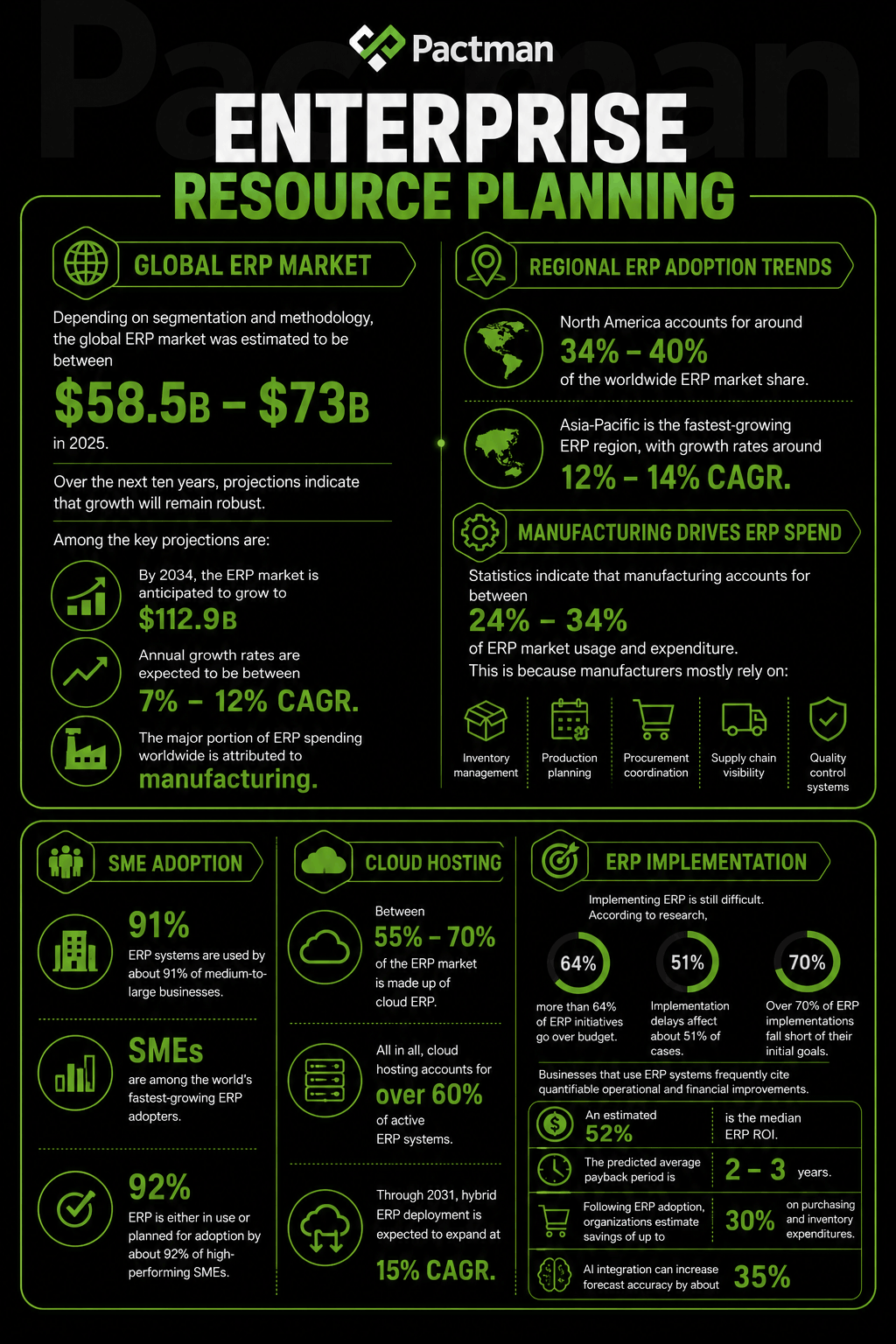
a. Global ERP market
Depending on segmentation and methodology, the global ERP market was estimated to be between $58.5 billion and $73 billion in 2025. Over the next ten years, projections indicate that growth will remain robust.
Among the key projections are:
By 2034, the ERP market is anticipated to grow to $112.9 billion.
Annual growth rates are expected to be between 7% and 12% CAGR.
The major portion of ERP spending worldwide is attributed to manufacturing.
Enterprise Resource Planning
Also, regional ERP adoption trends reveal that North America accounts for around 34%-40% of the worldwide ERP market share. Asia-Pacific is the fastest-growing ERP region, with growth rates around 12%-14% CAGR.
Statistics indicate that manufacturing accounts for between 24% and 34% of ERP market usage and expenditure. This is because manufacturers mostly rely on:
Between 55% and 70% of the ERP market is made up of cloud ERP. All in all, cloud hosting accounts for over 60% of active ERP systems. Through 2031, hybrid ERP deployment is expected to expand at a 15% CAGR.
d. ERP implementation
Implementing ERP is still difficult. According to research, more than 64% of ERP initiatives go over budget. Implementation delays affect about 51% of cases. Over 70% of ERP implementations fall short of their initial goals. Businesses that use ERP systems frequently cite quantifiable operational and financial improvements.
Important figures include: An estimated 52% is the median ERP ROI. The predicted average payback period is two to three years.
The Information Gap: Why Social Impact Is Smothered by QuickBooks and Spreadsheets
A social enterprise eventually reaches a barrier of operational complexity as it grows. During their early stages, most hybrid businesses use a patchwork of disparate spreadsheets and point-of-sale (POS) systems. This is in conjunction with simple, localized accounting programs like QuickBooks. Oftentimes, manual techniques are adequate for small businesses. However, as transaction volumes increase, they soon become irreversible obstacles.
Enterprise Resource Planning
When important information is stored in separate, departmental databases, an organization suffers from data redundancy, human error in data entry, and sluggish decision-making. Consequently, fragmentation causes instantaneous logistical breakdowns in inventory-heavy industries. This results in both costly surpluses of unpopular products and shortages of in-demand items.
According to a Nonprofit Trends Report, 85% of purpose-driven organizations concur that technology is the key to future operational success. Also, 75% of them have seen an increase in demand for their programs. However, 40% of these organizations find it difficult to demonstrate to their leadership teams the tangible return on investment (ROI) of their technology expenditures, and 51% of them are hindered by severe budgetary constraints.
The “Postmates effect,” a change in donor and investor expectations, exacerbates this tension. Modern donors and impact investors, who are accustomed to tracking lunch orders in real time on their mobile devices, demand the same amount of openness when their donations are used to fix a social problem.
In the United States, this expectation of transparency is supported by regulatory requirements. Tax-exempt organizations must legally make their yearly financial statements, executive remuneration, and Form 990 filings available to the public and potential donors.
Fulfilling these fiduciary duties is nearly impossible when financial data is dispersed over manual records, spreadsheets, and disconnected, outdated programs.
NOTE
Operating without a centralized, integrated source of financial truth poses serious organizational dangers. This is demonstrated by the unexpected revelation of a hidden and expanding deficit. Hence, adopting more recent, eye-catching software is not the answer for a social organization. Digital transformation is never about technology per se. Rather, it is about understanding the organization’s strategic goals and leveraging technology as a tool to communicate and carry out those goals.
IV
How to Align Technology With Mission Using Theoretical Frameworks
To prevent mission drift and ensure commercial success directly fuels social outcomes, social enterprises must align their digital infrastructure with recognized hybrid organizing frameworks. Organizational scholars Battilana and Lee identify five primary dimensions of hybrid organizing that managers must integrate to maintain legitimacy while also delivering commercial and social value:
Organizational activities,
Workforce composition,
Organizational design,
Culture, and
Inter-organizational relationships.
Enterprise Resource Planning
These five dimensions are supported by an ERP system, which serves as their operational framework. The approach guarantees that decisions made in a commercial subsidiary automatically reflect and promote the social goals of the parent non-profit by centralizing operational data.
The Diffusion of Innovation hypothesis, which looks at how organizations embrace and maintain technological change, supports this connection.
Tatianna Gilliam of Walden University conducted a seminal study that examined ERP deployment strategies among small and medium-sized businesses (SMEs) in the United States. The study concluded that effective digital transformation depends on
managing change proactively,
recognizing and overcoming employee resistance to organization-wide buy-in, and
matching the ERP software strategy with the current corporate culture.
According to the study, when leaders effectively manage these human factors, the ensuing improvement in organizational effectiveness has a direct influence on local employment and strengthens the economies of local communities, resulting in good social development.
Table 1 shows how traditional, profit-centric ERP modules are modified to meet the needs of double-bottom-line social companies in the US. This demonstrates how a modern ERP system bridges these academic and operational needs.
Table 1: Strategic Alignment of ERP Systems with Hybrid Organizing Dimensions
Hybrid Organizing Dimension
Core ERP Module
Traditional Commercial Focus
Social Enterprise Adaptation
Organizational Activities
Inventory & Supply Chain Management
Maximize inventory turnover, reduce storage costs, and optimize vendor pricing.
Track organic/fair-trade material sourcing and optimize donated goods intake.
Workforce Composition
Human Capital Management (HCM)
Streamline hiring, automate corporate payroll, and track employee hours.
Manage apprenticeships, track support services, and simplify tasks for transitional staff.
Organizational Design
Multi-Entity Financials
Consolidate corporate subsidiaries and automate currency exchange.
Isolate non-profit parents from tax-liable commercial entities and track grants.
Organizational Culture
Business Intelligence Dashboards
Monitor sales pipelines, profitability margins, and employee output.
Align commercial performance KPIs directly with real-time social outcome metrics.
Inter-Organizational Relationships
Centralized CRM & EDI
Drive sales, manage commercial suppliers, and automate business invoicing.
Provide verified compliance audit trails to foundations and corporate buyers
V
Mission Alignment and Agile Operations in US SMEs
Large manufacturing companies and extensive non-profit networks are not the only organizations that can benefit from the operational discipline offered by contemporary ERP solutions. Likewise, these platforms are being used by an increasing number of small to medium-sized hybrid organizations to create institutional stability and simplify complex reporting.
Enterprise Resource Planning
1. Rumpl: Using Tiered ERP Rollouts to Handle Supply Shocks
Based in the US, Rumpl is a registered B Corp that employs recycled materials to make high-performance blankets. The organization offsets 100% of its carbon footprint and contributes 1% of its profits to environmental organizations. The brand grew quickly after a very successful $250,000 Kickstarter campaign. However, they eventually came to a turning point where a patchwork of interconnected networks jeopardized their expansion.
To integrate its activities, Rumpl opted for Oracle NetSuite as its primary ERP. In order to keep a clean system, the company, along with solution vendor Blu Banyan, decided to import only its trial balances and accounting data, leaving behind pre-ERP historical baggage. Rumpl adopted a phased implementation strategy under Blu Banyan’s direction, gradually turning on features to prevent operational disturbance. This made it easy for the business to implement the inbound shipments and supply allocation capabilities of NetSuite.
The sales team was able to allocate future inventory in real-time by using these integrated tools to track incoming container shipments from international suppliers. During pandemic-related supply chain interruptions, this degree of operational insight proved to be extremely beneficial. All in all, it freed up employee time and enabled a 120% rise in yearly sales.
2. Green Rabbit & N&N Moving Supplies: From Disconnection to Integration
N&N Moving Supplies is a family-owned distributor that grew from a single warehouse in Georgia to three facilities across multiple states. The organization discovered that utilizing QuickBooks and different payroll providers to reconcile hours and payroll with general ledger accounts was not feasible. Hence, the company reduced its payroll processing time by 84%, increased the accuracy of vacation monitoring, and obtained insight into labor-cost patterns across all sites. This was achieved by deploying NetSuite ERP in conjunction with a customized time-clock partner, NOVAtime. Most importantly, they ensured strong buy-in and increased morale by giving staff members customized dashboards on iPads at each location.
In a similar vein, Green Rabbit is a US-based logistics company that specializes in delivering chocolate and heat-sensitive goods. In the past, they had trouble communicating with several databases. Waiting for assistance from the IT team to conduct simple reports often paralyzed the warehouse. In just three months, NetSuite’s professional services team made Green Rabbit fully functional on a single ERP platform. This gave the business the real-time supply chain tracking required to handle seasonal growth.
3. Case Study of RubinBrown: Automating Direct Labour and Grant Monitoring
A well-known US non-profit research and teaching organization in the field of sustainable agriculture teamed up with consulting firm RubinBrown to replace several custom applications and a legacy accounting system with a cutting-edge, cloud-based ERP and HCM platform. The company had switched to a fee-for-service business model. However, to guarantee precise cost tracking, its Chart of Accounts needed to be completely redesigned.
In response, RubinBrown created a unique connection between the HCM and ERP systems. This automatically distributed direct labour cost components to ongoing research initiatives and charitable funding. Consequently, the automated process reduced payroll errors, eliminated human spreadsheet entries, and expedited budget reporting, procurement, and accounts payable. Also, the integration lessened the administrative burden on the research teams while providing the transparency needed to demonstrate compliance to grant makers and federal auditors.
VI
Executives’ Strategic Steps in a Realistic Implementation Framework
Successful US case studies provide evidence that a systematic approach to system selection and change management is necessary to achieve operational efficiency and financial transparency. The path may be broken down into a useful, four-step structure for social enterprise CEOs and board members based on tried-and-true industry best practices.
Enterprise Resource Planning
Step 1: Evaluate the Argument for Change
A social enterprise must thoroughly evaluate its current operational environment and technical literacy before evaluating vendors. Systemic obstacles include manual data reconciliation, unintegrated databases, and sluggish month-end closure times. All such bottlenecks should be identified by leaders. Also, this step requires honest discussion about organizational preparedness, available resources, and possible employee resistance to new workflows.
Step 2: Establish Organizational Priorities and Needs
Secondly, when the case for change has been made, the leadership team must distinguish between essential operational requirements and superfluous software features. These needs, which include multi-entity accounting, grant monitoring, cost center allocations, and real-time inventory management, must be in line with reporting goals for a hybrid company.
By establishing these criteria, the company may avoid getting sidetracked by complex, expensive platforms. Rather, it can concentrate on software that facilitates mission-driven decision-making.
Step 3: Strategically Assess Options
After defining its needs, the company should assess possible ERP systems and implementation partners. Choosing between a two-tier ERP approach and an all-in-one centralized ERP is a significant strategic decision at this point. In a two-tier architecture, smaller retail branches or commercial subsidiaries use a lightweight, cloud-based platform (Tier 2 ERP), while the parent non-profit maintains a strong corporate database (Tier 1 ERP) to manage high-level financials.
Faster deployment times, reduced subsidiary expenses, and the local flexibility required to manage daily sales and logistics are all provided by this cloud-native Tier 2 configuration. Also, the core financial system is shielded from intricate local changes by the automatic upward synchronization of data.
Furthermore, businesses should think about the advantages of a hybrid ERP strategy that combines conventional transactional databases with Enterprise Social Software (ESS). This configuration links informal, peer-to-peer communication technologies with structured data processing. The company may create a more responsive and cooperative operational model by allowing frontline employees to ask questions, share practical information, and propose improvements through integrated forums.
Step 4: Get Ready for Successful Implementation and Change Management
Change management is essential for true ERP success. Likewise, this calls for creating a distinct change narrative, gaining solid leadership backing, and assembling a committed group of change champions from several departments.
Data hygiene must be given top priority during the transition process, and historical records must be cleaned using data-cleansing tools before being moved to the new platform. Also, organizations should adopt a tiered strategy, delivering essential financial structures before adding specialized modules, as opposed to offering all system features at once.
Even more, the company must make training investments to maintain these changes over time. To develop digital literacy, this entails offering interactive learning portals, customized user dashboards, and practical practice settings. Leaders can proactively address concerns, minimize fear, and ensure the system stays in line with the company’s social goal by monitoring post-implementation performance indicators and setting up feedback channels.
Conclusion
Enterprise Resource Planning technology enables social companies to transition from reactive administration to strategic leadership. This is achieved by combining operations, finance, compliance, and reporting into a single ecosystem. It takes more than just enthusiasm to strike a balance between the social and commercial aspects of a double bottom line. Such change calls for uniform systems of record, strong data hygiene, and operational discipline.
In the end, an ERP system’s actual worth is found in its capacity to empower individuals. When a social enterprise successfully integrates its digital core with its social principles, it demonstrates that social impact and operational efficiency are mutually reinforcing engines of sustainable change rather than conflicting priorities. When operational excellence is combined with social purpose, mission-driven organizations have a stronger impact.
In the current nonprofit environment, organizations are increasingly relying on technology to enhance donor interaction, ensure compliance, and streamline operations. The Pactman Nonprofit CheckPlus API […]
TABLE OF CONTENTS Introduction Overview of Nonprofit Grant Options Critical Statistics on Nonprofit Grants in the U.S. Nonprofit Grants in Washington Nonprofit Grants in Alabama […]
TABLE OF CONTENTS Introduction Nonprofit Funding Gaps in Africa Critical Statistics on Nonprofit Grants Local vs International Nonprofit Grants in Africa: A Comparative Analysis Overview […]
The Muslim charity organisations generally assist needy Rwandans and create unity among Muslim fellows. Rwanda has a small but growing Muslim population in a country […]
Muslim charity organisations in Mauritius are active and help in various areas, such as helping poor people, providing education, providing health care, and supporting disaster-affected […]
Muslim Charity Organisations in Cameroon are crucial in poverty alleviation, supporting needy communities, and the health and education sectors. Today, there are various online Muslim […]