How to Tailor Lead Magnets to your Nonprofit Cause
Cersai Stark
I
Introduction
Lead magnets are lead generation techniques that exchange a useful resource for a potential supporter’s contact details. It is sometimes referred to in marketing circles as a content offer or an incentive. This information usually consists of a person’s or donor’s name, phone number, or email address, which subsequently acts as the starting point for a long-term partnership.
Lead magnets
The fundamental idea underlying this mechanism is reciprocity: the human propensity to want to give back when something of value is received. In this case, a nonprofit establishes itself as a subject-matter expert by offering instant, palpable value up front and builds a foundation of trust. Consequently, this increases the likelihood that subsequent donation appeals will be successful.
In the past, several NGOs used a straightforward call to action, such as Join our Newsletter or Sign up for Updates. However, statistics indicate that these passive requests seldom convert successfully since they don’t address the visitor’s internal query, “What is in it for me?” A customized lead magnet, on the other hand, offers an “aha!” moment or a workable solution that feels more important than the personal information being shared by addressing a specific issue or interest of the target audience.
II
Psychological Underpinnings of Donor Engagement
A thorough examination of the psychological factors influencing human behavior is crucial to comprehending the function of lead magnets. Emotions, values, social cues, and identity are often the driving forces behind charitable giving and participation. Likewise, a nonprofit that offers a lead magnet appeals to several crucial psychological factors.
Lead magnets
a. Gift Economy and Reciprocity
The lead magnet’s most straightforward engine is the reciprocity principle. This is comparable to getting a complimentary sample at a grocery shop in the business world. The modest gift generates a psychological duty to consider making a purchase. The “gift” in the nonprofit sector can be inspiration, information, or a practical item.
Afterwards, a supporter is much more likely to respond positively to a subsequent fundraising request after interacting with a useful toolkit or a behind-the-scenes story because the organization has previously demonstrated its worth.
b. Social Pressure and Information
As social creatures, humans frequently rely on other people to tell them what is right to do. This is referred to as social proof or social information. According to research, people often modify their conduct to fit in with the norms of the group after learning about the activities of others. Lead magnets that emphasize a community, like a pledge or a petition, leverage this by giving the impression that the person is joining a movement that is greater than themselves.
c. Brand Archetypes and Identity
Also, supporters often choose to interact with charities that align with their personal beliefs. Lead magnets that work are made to fit specific brand archetypes that appeal to these personalities. For example, charitable givers who wish to shield the weak are drawn to the Caregiver archetype, which represents compassion and nurturing. An example of a lead magnet that fits this paradigm would be a Rescue Animal Care Guide.
On the other hand, the Hero archetype appeals to impact-driven supporters who wish to conquer an issue since it conveys strength and results. This persona could be used by an organization to provide a Policy Change Advocacy Toolkit.
III
Critical Statistics on Lead Magnets
In this section, we will consider critical statistics on lead magnets and relative impact.
1. Email marketing
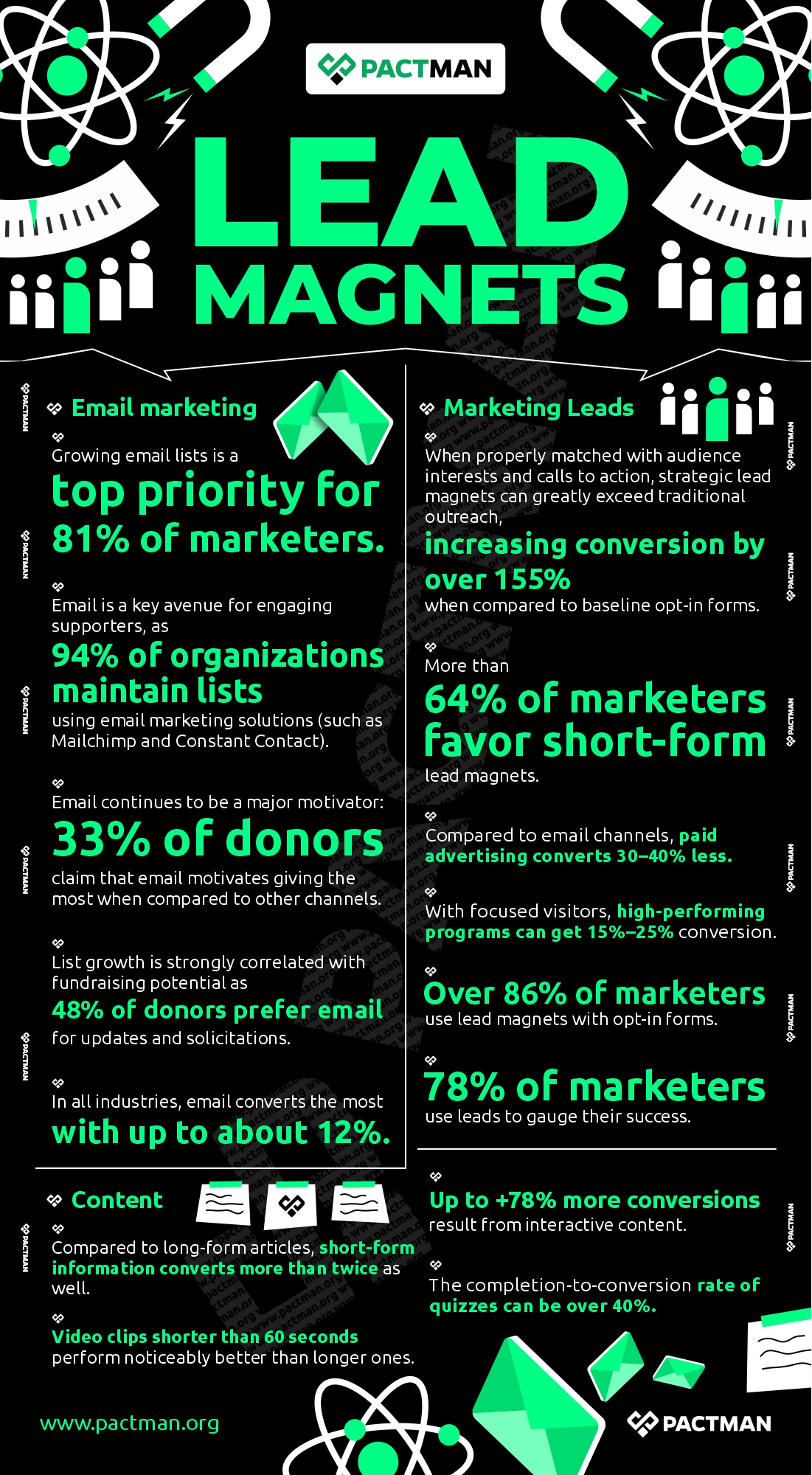
Growing email lists is a top priority for 81% of marketers. Email is a key avenue for engaging supporters, as 94% of organizations maintain lists using email marketing solutions (such as Mailchimp and Constant Contact). Also, email continues to be a major motivator, as 33% of donors claim that email motivates giving the most when compared to other channels.
When properly matched with audience interests and calls to action, strategic lead magnets can greatly exceed traditional outreach, increasing conversion by over 155% when compared to baseline opt-in forms. Over 86% of marketers use lead magnets with opt-in forms.
Compared to email channels, paid advertising converts 30–40% less.
3. Content
Compared to long-form articles, short-form information converts more than twice as well. Video clips shorter than 60 seconds perform noticeably better than longer ones.
The Technical Blueprint: From Database to Landing Page
For the most part, content creation is only half the battle. The technical implementation of content decides whether or not it produces leads.
Lead magnets
1. The Architecture of Conversion Funnels
Three main digital stages make up a typical lead magnet funnel.
The Landing Page: This is a specific, simple page that displays the offer to the visitor. Getting the user to complete the form should be its only objective.
Lead Capture Form: Ask only what is necessary on the Lead Capture Form. Shorter forms have greater conversion rates, according to research. Sign-ups can be greatly increased by reducing fields from seven to three.
The Thank-You site: After submitting the form, the user should be taken to a site that verifies their registration and offers a download link.
2. Encouraging the Lead Magnet
Secondly, the lead magnet needs to be visible to drive traffic. Hence, organizations ought to use a variety of channels:
Website Pop-ups: Exit-intent pop-ups can increase conversion rates by more than 14%, while occasionally being viewed as bothersome.
Social media: Promoting lead magnets on sites like Facebook or Instagram is an affordable strategy for attracting new donations.
Google Ad Grants: Nonprofits can utilize their $10,000 grant each month to target users who are seeking terms associated with their lead magnet.
3. Mobile Enhancement
The entire lead magnet experience should be mobile-first, as over 59% of people use their phones to explore the web. Likewise, an organization will lose leads if a PDF is too big to download on a mobile device or if a form is too challenging to tap with a thumb.
V
Benchmarks & Metrics: Assessing Achievement
Nonprofits must look beyond download numbers to determine whether a lead magnet is effective.
Lead magnets
1. Acquisition
Efficiency Sign-Up Rate: This is the proportion of website visitors who generate leads. While a generic Newsletter sign-up is frequently less than 1%, a customized lead magnet should aim between 10% and 30%.
Cost Per Lead (CPL): CPL is calculated by dividing the total amount spent on advertisements by the quantity of leads. When this figure decreases over time, it means that your offer and targeting are effective.
2. Involvement and Retention
Open and Click Rates: Your magnet may be clickbait or irrelevant if users download it but do not open your emails. Approximately 80% of welcome emails should be opened.
Unsubscribe Rate: In a welcome series, the unsubscribe rate should not exceed 1%. A high rate suggests a discrepancy between the organization’s real work and the promise of the lead magnet.
3. Conversion to Donor
In the end, donations are the only way a lead magnet can generate funds. A lead magnet’s ROI is determined based on the lifetime value of the donors it attracts. For instance, a $1,000 campaign that produces 500 emails could appear to be a loss at first. However, if those leads result in $969 in donations within a year and retention stays strong, the long-term value is enormous.
VI
Construction of a High-Converting Lead Magnet
A successful lead magnet persuades a stranger to become a partner by adhering to a specific architectural flow.
The Micro-Problem Focus: Try not to use a single PDF to solve your entire mission. Find a solution to a single, minor issue. If your cause is ocean conservation, a lead magnet on Sustainable Seafood Choices works better than one on How to Save the Ocean.
Authoritative Tone: Leverage insights derived from data. For example, “Many children are hungry” should be replaced with “A Meta-Analysis of Food Insecurity in Urban Corridors.” This is similar to a professional journal or research institute’s authoritative style.
High Visual Hierarchy: Use infographics, charts, and distinct titles to create a high visual hierarchy. The asset ought to be rich in value but skimmable.
Mission-Complexity-Based Formats
The format of the lead magnet should be determined by the complexity of your cause.
Complexity
Mission Type
Suggested Lead Magnet
High
Research, Policy, Systems Change
The Technical Brief: A deep-dive report with proprietary data and trend analysis.
Medium
Education, Healthcare, Environment
The Diagnostic Tool: A self-assessment or quiz (e.g., “Calculate Your Carbon Legacy”).
Direct Service
Hunger, Housing, Animal Welfare
The Field Report: Behind-the-scenes footage or a “Day in the Life” case study.
Conclusion
For organizations, using customized lead magnets is now essential for long-term growth in a competitive online market. By shifting from formulaic solicitations and toward a high-value interaction model, organizations may create email lists that are not only huge but also highly engaged and mission-aligned.
An organization’s acquisition approach can be completely changed by the right offer, which lowers the cost per lead while raising each donor’s lifetime value. The NGOs that provide the greatest value up front will win over the hearts and minds of the upcoming generation of supporters.
1 response to “How to Tailor Lead Magnets to your Nonprofit Cause”
[…] Non-profits often struggle at the organizational level with fragmented information and antiquated databases. This unintentionally makes the donation experience more difficult. Hence, the organization or the donor can’t keep a 360-degree perspective of the relationship when donor data, such as event participation, volunteer hours, and donation history, is dispersed across several systems. This disarray results in impersonal, repetitious outreach that overlooks the donor’s specific connection to the cause. […]
In the current nonprofit environment, organizations are increasingly relying on technology to enhance donor interaction, ensure compliance, and streamline operations. The Pactman Nonprofit CheckPlus API […]
TABLE OF CONTENTS Introduction Overview of Nonprofit Grant Options Critical Statistics on Nonprofit Grants in the U.S. Nonprofit Grants in Washington Nonprofit Grants in Alabama […]
TABLE OF CONTENTS Introduction Nonprofit Funding Gaps in Africa Critical Statistics on Nonprofit Grants Local vs International Nonprofit Grants in Africa: A Comparative Analysis Overview […]
When you want to donate, consider the best charities to donate to. Various charity groups in Jamaica work to improve education, healthcare, the environment, and […]
Nonprofit status always determines whether a Gauteng-located organisation gets grant funding or walks away with nothing. Let’s delve into the reasons this happens and how […]











1 response to “How to Tailor Lead Magnets to your Nonprofit Cause”
[…] Non-profits often struggle at the organizational level with fragmented information and antiquated databases. This unintentionally makes the donation experience more difficult. Hence, the organization or the donor can’t keep a 360-degree perspective of the relationship when donor data, such as event participation, volunteer hours, and donation history, is dispersed across several systems. This disarray results in impersonal, repetitious outreach that overlooks the donor’s specific connection to the cause. […]