How to Build an Early-Warning Risk Management System for Grantmaking
Cersai Stark
I
Introduction
The majority of grantmaking risks don’t materialize overnight. They develop covertly through anomalous expenditure patterns, beneficiary complaints, delayed program reports, financial irregularities, or gaps in governance. Many foundations don’t act until the damage is apparent.
Risk management
Effective risk management involves strategically anticipating, preparing for, and managing risks rather than completely avoiding risk to ensure that your grants produce the desired results. Hence, it is strategically essential to have an Early-Warning Risk Management System (EWMS). Similar to how top companies handle operational or market risks, it shifts grantmaking organizations from reactive problem-solving, such as dealing with crises after they happen, to proactive, data-informed intervention.
This article will serve as an effective guide to building an early-warning risk management system.
II
The Importance of Proactive Risk Management and Risk Management Systems
Organizations utilize a systematic framework called a Risk Management System (RMS) to detect, evaluate, track, and address risks that could jeopardize their goals. It’s essentially a methodical strategy to maximizing possibilities and minimizing undesirable results. In plain language, a risk management system assists organizations in identifying dangers early on, comprehending their implications, and taking appropriate action to keep them from undermining objectives.
risk management
For grantmaking foundations, a risk management system is basically a proactive radar. It detects risks before they become more serious. Likewise, risks are ranked according to likelihood and impact. As a result, key indicators are regularly monitored. It mandates prompt, organized answers.
Foundations that have a well-executed RMS not only safeguard their assets but also enhance social impact, fortify grantee relationships, and maintain their reputation.
Risk is frequently treated in transactional grantmaking as a straightforward compliance checklist, such as examining financial records and IRS status. Also, risk is seen as a dynamic force that impacts mission success in strategic grantmaking, which follows a paradigm.
Protecting Mission Capital: By stepping in before a grantee’s crisis ruins a high-impact initiative, an EWMS safeguards the foundation’s financial commitment as well as its reputation.
Enabling Strategic Risk-Taking: Rather than sticking to safe, incremental projects, the foundation can feel more at ease sponsoring creative, higher-risk endeavors that have the potential for significant systemic change. This is achieved by better understanding and keeping an eye on common dangers.
Building Trust: The foundation strengthens its relationship with the recipient by acting as a true partner and providing assistance before a situation becomes disastrous.
III
Critical Statistics on Nonprofit Risk Management
In this section, we will consider the impact of risk management on organisational processes using statistics.
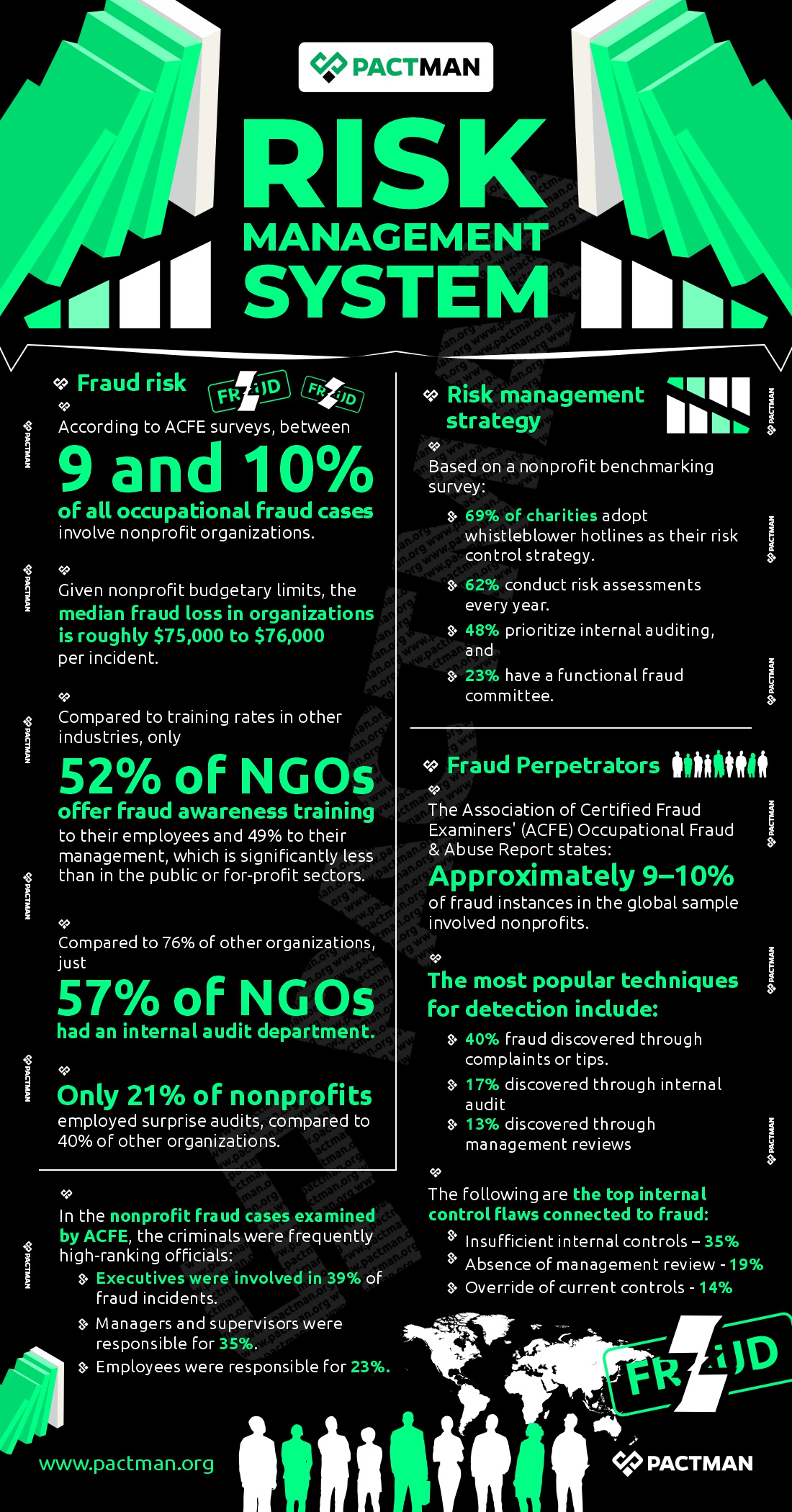
Compared to training rates in other industries, only 52% of NGOs offer fraud awareness training to their employees and 49% to their management, which is significantly less than in the public or for-profit sectors.
Organizations that lack fraud awareness training typically lose twice as much money as those that do. Also, compared to 76% of other organizations, just 57% of NGOs had an internal audit department. Even more, only 21% of nonprofits employed surprise audits, compared to 40% of other organizations.
Risk management
2. Risk management strategy
Based on a nonprofit benchmarking survey:
69% of charities adopt whistleblower hotlines as their risk control strategy.
62% conduct risk assessments every year.
48% prioritize internal auditing, and
23% have a functional fraud committee.
3. Fraud Perpetrators
The Association of Certified Fraud Examiners’ (ACFE) Occupational Fraud & Abuse Report states: Approximately 9–10% of fraud instances in the global sample involved nonprofits. The most popular techniques for detection include:
40% fraud discovered through complaints or tips.
17% discovered through internal audit
13% discovered through management reviews
Also, the following are the top internal control flaws connected to fraud:
Insufficient internal controls – 35%
Absence of management review – 19%
Override of current controls – 14%
In the nonprofit fraud cases examined by ACFE, the criminals were frequently high-ranking officials:
Managers and supervisors were responsible for 35%.
Employees were responsible for 23%.
IV
Components of An Early-Warning Risk Management System (EWMS)
The three main components of an efficient EWMS are Identify, Signal, and Respond.
risk management
A. IDENTIFY: Identifying and Tracking Crucial Indicators
The first approach is finding the precise internal and external elements that frequently predict grantee distress. The Key Risk Indicators (KRIs) are as follows.
Risk Category
Key Risk Indicators (KRIs)
Data Sources
Financial Health
Decreased cash reserves (e.g., less than three months’ operating capital), increased reliance on a single source of funding (lack of diversification), and a considerable gap between budget and actuals.
Quarterly financial reports, audited statements, and cash flow statements.
Organizational Stability
High turnover of key professionals (Executive Director or Finance Officer), board vacancies, abrupt changes in mission, and a lack of succession planning.
Grantee check-in notes, staff interviews, organizational charts, and annual reports.
Programmatic Impact
Persistent failure to reach non-financial milestones (e.g., participant enrollment targets), altering project scope without contacting the funder, and consistent unfavorable feedback from beneficiaries.
Program reports, developmental evaluation feedback, and field visits.
External Environment
Adverse policy changes (for example, reductions in government funding), a significant local economic downturn, and an unexpected increase in resource competition.
Foundation’s internal policy monitoring, Google Alerts, and sector-specific news feeds.
B. SIGNAL: Configuring and Activating Alerts
Without a mechanism to identify significant changes, KRIs are worthless. The “early-warning” feature is turned on at this point.
Establish Thresholds: For every KRI, establish quantitative thresholds. For instance, the Financial Health alert could be configured as follows: “Cash reserves drop below 90 days of operations OR more than 40% of funding comes from a single source.”
The HBR Approach, or Red/Yellow/Green System:
Green: Every KRI is within a reasonable range. Continue with your regular reporting.
Yellow (Warning): A minor threshold has been exceeded by one or more KRIs (e.g., ED turnover is rumored, or cash dipped below six months).
Trigger: Internal conversation between the portfolio manager and grant team.
Red (Critical Alert): KRIs have exceeded significant benchmarks (e.g., cash is less than three months, and the CFO quit).
Trigger: Implementing the Intervention Protocol right away.
Make Use of Technology: Include KRI monitoring in your software for managing funding. Make sure that no red signal is overlooked because of human error by automating warnings when reported numbers exceed predetermined thresholds.
C. RESPOND: Creating a Protocol for Intervention
Having a well-defined, prearranged Intervention Protocol for Yellow and Red warnings is the most important component of an EWMS. This guarantees that the response is quick, strategic, and centered on collaboration.
i. The Advisory Support “Yellow Alert” Reaction
Early indicators of stress should be treated with tact and encouragement.
Candid Conversation: “We noticed [KRI] and want to understand how we can help,” the Program Officer says when setting up an open, nonjudgmental check-in with the grantee leadership.
Provide Non-Financial Support: The foundation’s strategic assets, which are a defining characteristic of a strategic partnership, come into play here. Foundations can make a pro-bono resource connection offer to the grantee:
Governance: Present a specialist in board recruitment.
Finance: Pay a temporary consultant to assist with financial modeling or a diversification plan.
Increased Check-Ins: To better monitor the KRI, temporarily switch from quarterly to monthly check-ins.
ii. The Crisis Management “Red Alert” Response
Quick, coordinated action is needed to stabilize the organization after a Red Alert.
Internal Mobilization: To assess the degree of the risk and identify the required support resources, assemble a small internal Foundation Crisis Team consisting of the Program Officer, Grants Manager, and Legal Counsel.
Emergency Capacity Funding: Give a one-time, flexible gift with the express purpose of resolving the issue (e.g., supporting an interim executive director, paying for a forensic audit, or covering short-term cash flow concerns). This shows dedication and cooperation.
iii. Co-Creation of a Recovery Plan
Next, create a 90-day stabilization plan with mutual accountability and well-defined milestones in collaboration with the grantee leadership. Most importantly, the solution cannot be dictated by the basic factors. The recovery must belong to the grantee.
Communication: To guarantee transparency and maybe rally more support, assist the grantee in crafting communications to their board and other important funders.
iv. Ongoing Enhancement: System Auditing
The EWMS needs to be routinely evaluated to guarantee its efficiency, just like any complicated system.
Post-Intervention Review: Perform a “Lessons Learned” review following the resolution of a crisis.
Did the KRIs foresee the failure correctly?
Did the Intervention Protocol work?
Was the reply prompt enough?
Regular KRI Calibration: Your KRIs must change as your grantmaking approach does. Also, ensure they accurately represent current political, economic, and industry-specific risks by reviewing them every year.
Conclusion
Foundations that effectively manage risk not only prevent losses but also increase their impact. Furthermore, risk management becomes the unseen catalyst for successful grantmaking in a world where philanthropic funds must go farther than ever. By putting in place an Early-Warning Risk Management System, foundations become active risk-sharers and strategic partners rather than passive financiers. This change enhances the grantee ecology, safeguards the mission, and eventually results in a longer-lasting, stronger impact.
In the current nonprofit environment, organizations are increasingly relying on technology to enhance donor interaction, ensure compliance, and streamline operations. The Pactman Nonprofit CheckPlus API […]
TABLE OF CONTENTS Introduction Overview of Nonprofit Grant Options Critical Statistics on Nonprofit Grants in the U.S. Nonprofit Grants in Washington Nonprofit Grants in Alabama […]
TABLE OF CONTENTS Introduction Nonprofit Funding Gaps in Africa Critical Statistics on Nonprofit Grants Local vs International Nonprofit Grants in Africa: A Comparative Analysis Overview […]
As a climate change leader, Virginia establishes its position by implementing forward-thinking policy measures through renewable power investments and nature protection initiatives. The government of […]
The state of Illinois stands out as a climate change leader through its dedicated green legislation, its allocation of renewable energy financing and its distinctive […]